Piano Keyboard Notes Chart: Free Printable for Beginners
This post may contain affiliate links.
Learning the notes on a piano keyboard is one of the first steps in learning to play the piano! Whether you’re teaching a child, starting piano lessons, or just want to understand how the keys work, these free printable piano keyboard note charts make it easy to get started.
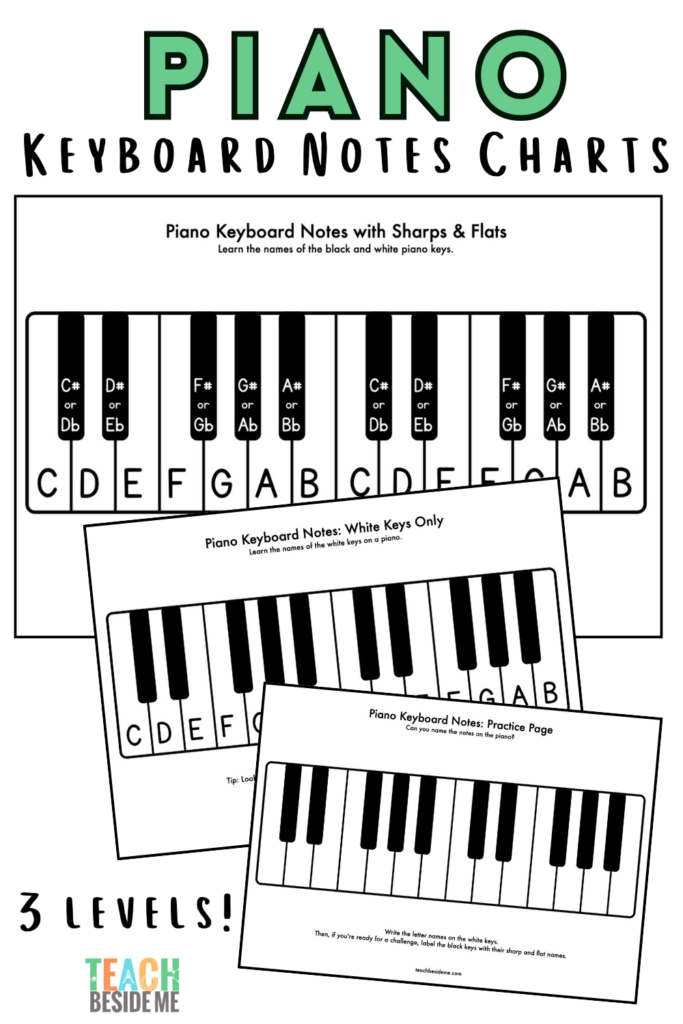
I have three versions of the piano keyboard chart so you can choose the one that works best for your learner. There’s a simple chart with the white keys labeled, a complete chart showing sharps and flats, and a blank keyboard for practicing.
How to Find the Notes on a Piano Keyboard
At first glance, all those black and white keys might seem a little confusing. But once you recognize the pattern, finding the notes is surprisingly simple!
Start by looking at the black keys. You’ll notice they are arranged in repeating groups of two and three. Find a group of two black keys. The white key immediately to the left of that group is C.
From there, the white keys follow the musical alphabet:
C – D – E – F – G – A – B
After B, the pattern starts over again at C.
That’s it! Once you know how to find C, you can figure out the names of notes of all the white keys on the piano and begin to read some sheet music.
What Are the Black Keys on a Piano?
The black keys are called sharps and flats. They are the piano notes between most of the white keys.
A sharp (♯) raises a note by one half step, while a flat (♭) lowers a note by one half step.
For example, the black key between C and D can be called C sharp (C♯) or D flat (D♭). These are two different names for the same piano key. In music, this is called an enharmonic equivalent.
You might also notice that there are no black keys between B and C or between E and F. Those pairs of white keys are already one half step apart.
Beginning piano students often start with the white keys before learning the sharps and flats.
Free Printable Piano Keyboard Note Charts
I’ve included three different piano keyboard printables to help kids and beginning piano students learn the notes.
1. Piano Keyboard Notes: White Keys
This is the best place to start for young children and absolute beginners.
The white keys are labeled with their letter names, while the black keys are left unlabeled. This helps students focus on learning the musical alphabet and recognizing the repeating pattern.
Use this chart to practice finding the note C, identifying the other white keys, and noticing how the notes repeat across the keyboard.
2. Piano Keyboard Notes: Sharps and Flats
Ready to learn the black keys?
This version includes the names of both the white and black keys. The black keys are labeled with their sharp and flat names so students can see how the same key can have two different names.
It’s a helpful reference for students beginning to learn about half steps, sharps, flats, and basic music theory.
3. Blank Piano Keyboard Practice Sheet
Once students have practiced with the labeled charts, give them the blank piano keyboard and see how many notes they can identify on their own!
Start by labeling the white keys. For an extra challenge, add the sharp and flat names to the black keys.
You can also slip the page into a dry-erase pocket and use it again and again.
Download the charts now!
Fun Ways to Practice Piano Keyboard Notes
You don’t need to be sitting at a piano to practice identifying the notes! Here are a few simple ways to use these printable charts.
Find the C Keys: Have your child find and circle every C on the keyboard chart. Then try the same activity with D, E, or another note.
Name That Note: Point to a key on the chart and ask your child to name it. Start with white keys and add black keys as they become more confident.
Keyboard Detective: Give your child clues such as, “Find the white key between two black keys in a group of two,” or “Find the white key immediately to the left of a group of three black keys.”
Label the Keyboard: Use the blank chart to practice writing note names. Keep the labeled version nearby for reference until your child is ready to try it independently.
Match the Real Piano: If you have a piano or keyboard at home, use the chart to find the same notes on the instrument.
Beginner Piano Keyboards for Kids
Want to practice these piano keyboard notes on a real instrument? You don’t need an expensive piano to get started!
An electronic keyboard can be a great way for kids to explore music, learn note names, and begin playing simple songs.
If your child is planning to take piano lessons, I recommend looking for a keyboard with at least 61 full-size, touch-sensitive keys. This gives them plenty of room to learn and helps them practice playing softly and loudly.
Here are a few options worth considering:
- Yamaha: A 61-key beginner keyboard with touch-sensitive keys and built-in learning features.
- Casio CT-S300: Another 61-key option with touch response, built-in sounds, and a portable design.
- Casio SA-81: A smaller 44-key keyboard that’s fun for younger children who are just beginning to explore music.
For children who want to continue with formal piano lessons, a full-size (88 key) keyboard is the better long-term investment. But even a small keyboard can be a fun introduction to the musical alphabet!
Print out the piano keyboard note charts above and keep them nearby while your child practices.
More Music Learning Activities for Kids
Learning the piano keyboard is just one part of exploring music! You can also practice reading musical notes, learn about rhythm, and explore different instruments.
Be sure to check out more of my for hands-on ways to make music learning fun.
- Recorder Fingering Chart (Free Printable for Beginners)
- Free Beginner Ukulele Chord Chart Printable
- Printable Treble Clef Music Note Flashcards
- Printable Bass Clef Notes Chart and Flash Cards
- Printable Guitar Chord Chart and Learning Pack for Beginners
Whether you’re teaching piano at home, preparing for music lessons, or introducing children to the musical alphabet, I hope these printable piano keyboard charts make learning the notes a little easier!