Gumdrop Molecules: A Fun Chemistry STEM Activity for Kids
This post may contain affiliate links.
Learning about atoms and molecules doesn’t have to be complicated! This colorful gumdrop molecule activity is a fun, hands-on way to introduce kids to chemistry using candy and toothpicks.
Kids can build their own molecule models, explore how atoms connect, and discover the differences between elements and compounds. It’s a simple science activity that makes some pretty big ideas easier to understand.
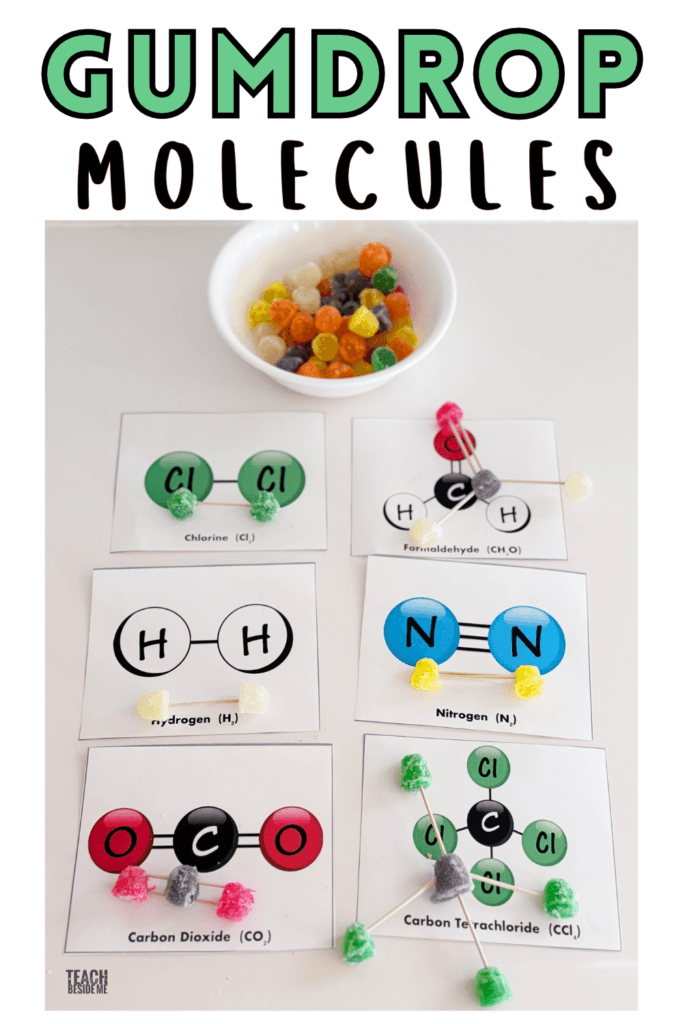
We’re using gumdrops to represent atoms and toothpicks to represent the bonds between them. With our printable molecule model cards, kids can follow a diagram to build different molecules, from simple hydrogen and oxygen molecules to more complex compounds.
This activity is great for elementary and middle school science lessons, homeschool chemistry studies, and STEM learning centers.
What Are Atoms and Molecules?
Before you start building, it helps to understand a few basic chemistry terms.
Atoms are the basic building blocks of matter. Everything around us is made of atoms, including water, air, food, and even our bodies.
An element is a substance made of only one type of atom. Hydrogen, oxygen, carbon, and nitrogen are all examples of elements.
A molecule is a group of two or more atoms held together by chemical bonds. Some molecules contain only one type of atom, while others contain different elements.
For example:
- Oxygen (O₂) contains two oxygen atoms bonded together.
- Water (H₂O) contains two hydrogen atoms and one oxygen atom.
- Carbon dioxide (CO₂) contains one carbon atom and two oxygen atoms.
- Methane (CH₄) contains one carbon atom and four hydrogen atoms.
A chemical compound is a substance made from two or more different elements chemically bonded together. Water and carbon dioxide are compounds, but oxygen gas (O₂) is not because it contains only oxygen atoms.
This distinction is a great discussion point as children explore the molecule cards!
Supplies for Building Gumdrop Molecules
You only need a few inexpensive materials for this chemistry STEM activity.
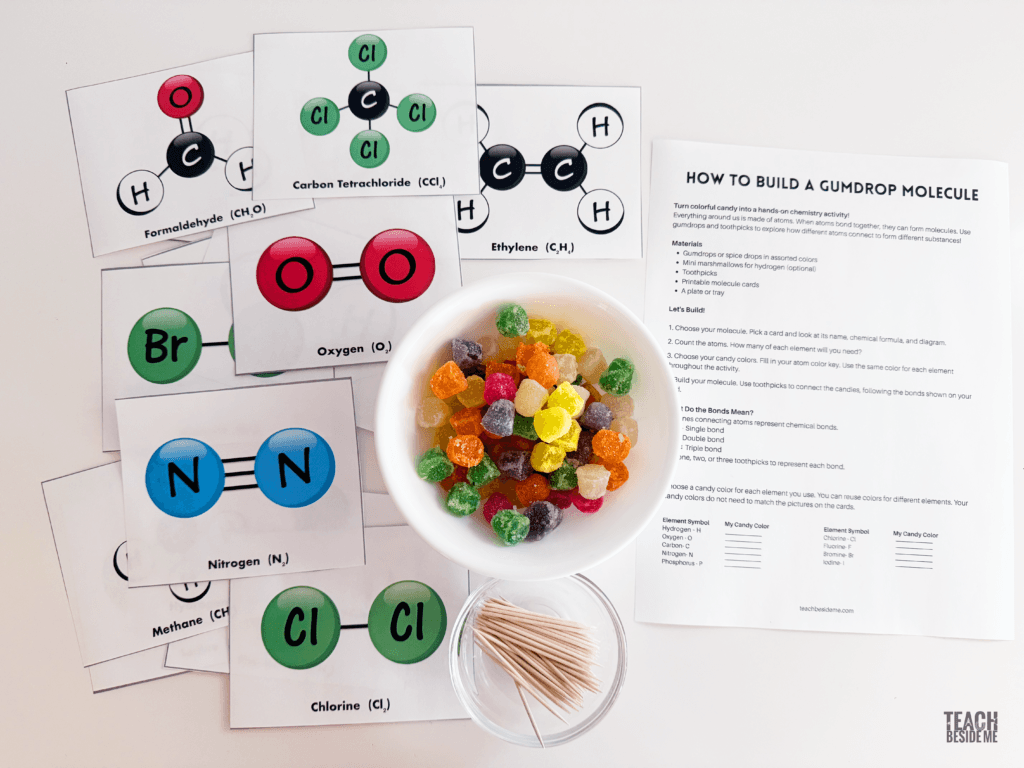
- Gumdrops or spice drops in assorted colors
- Toothpicks
- White mini marshmallows (optional, for hydrogen atoms)
- A plate or tray for building
- Printable molecule model cards (optional, but helpful)
- Paper and pencil for recording observations
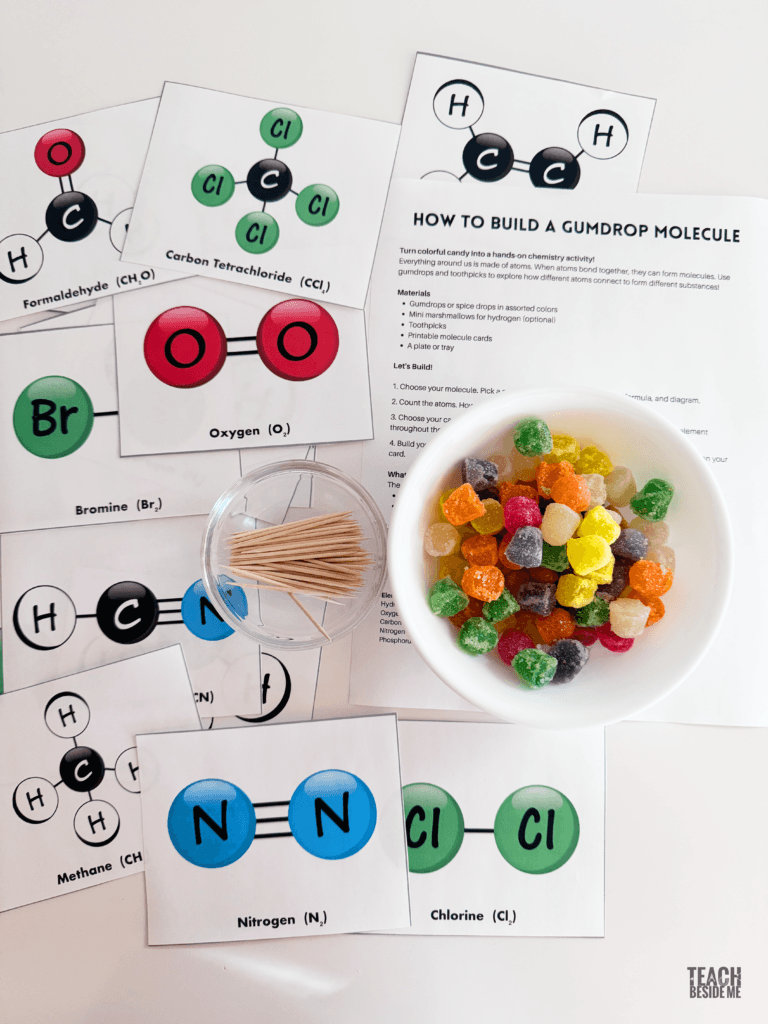
Gumdrops work especially well because they’re colorful, easy to handle, and soft enough to connect with toothpicks.
If you prefer a non-candy version, you can also use modeling clay or play dough.
Gumdrop Molecule Color Key
Scientists often use different colors to help identify elements in molecular models. A common convention uses white for hydrogen, black for carbon, red for oxygen, and blue for nitrogen.
For our gumdrop models, we can use similar colors and make substitutions based on the candy available.
| Element | Symbol | Suggested Color |
|---|---|---|
| Hydrogen | H | White |
| Carbon | C | Dark purple |
| Oxygen | O | Red |
| Nitrogen | N | Blue |
| Chlorine | Cl | Green |
| Fluorine | F | Green |
| Bromine | Br | Green |
| Iodine | I | Green |
| Boron | B | Orange |
| Beryllium | Be | Yellow |
| Phosphorus | P | Blue |
The colors are a visual learning tool, not the actual colors of atoms. Because some elements share a color in this activity, use the chemical symbols on the cards to identify each one.
You can also create your own color key if your gumdrop assortment is different. Just be consistent as you build.
How to Build Gumdrop Molecules
Once you’ve gathered your materials, you’re ready to start building!
Step 1: Choose a Molecule
Start with a simple molecule such as hydrogen (H₂), oxygen (O₂), or water (H₂O).
Look at its chemical formula and model diagram. Identify which elements are included and how many atoms of each element you’ll need.
For example, the formula H₂O tells us that water contains two hydrogen atoms and one oxygen atom.
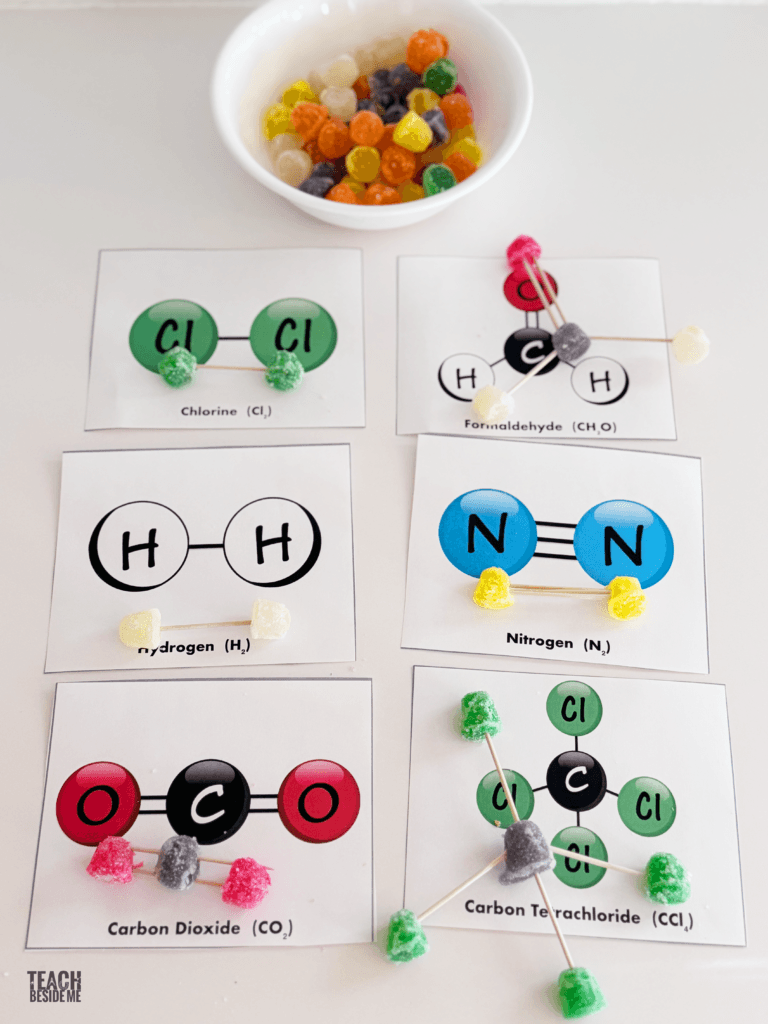
Step 2: Select Your Gumdrops
Choose the gumdrop colors that represent each element.
For a water molecule, you might use one red gumdrop for oxygen and two white mini marshmallows for hydrogen.
This is a great opportunity to practice reading chemical symbols and counting atoms.
Step 3: Connect the Atoms
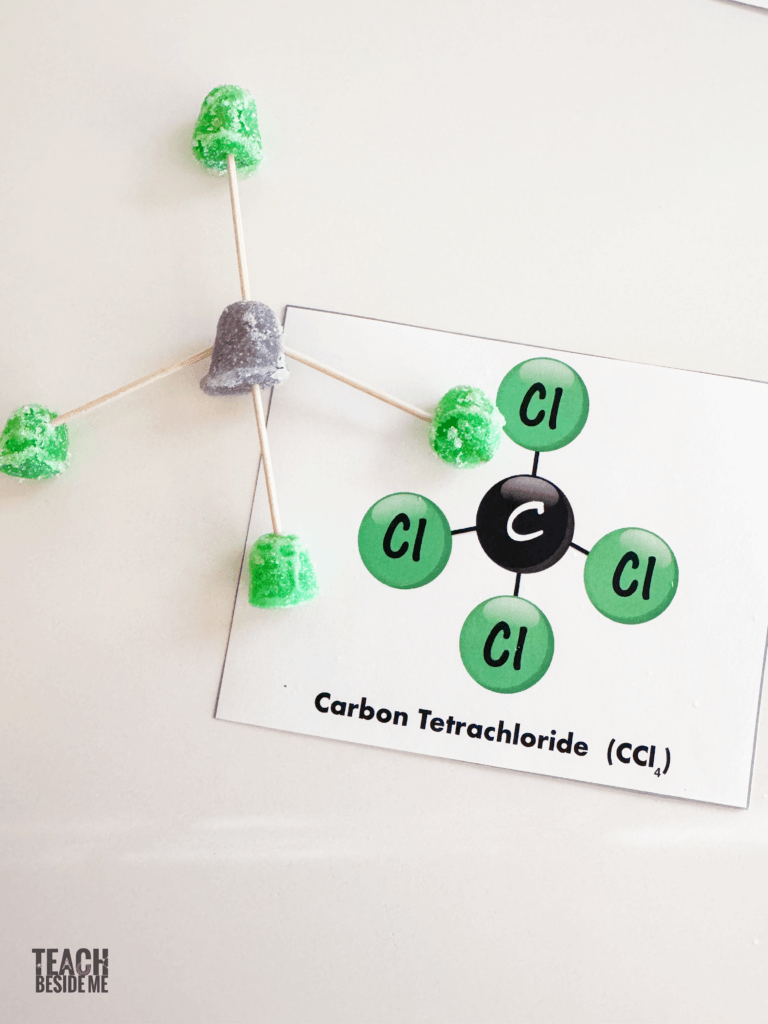
Carefully insert toothpicks between the gumdrops to represent chemical bonds.
Some molecule diagrams show different numbers of lines between atoms:
- Single bond: One line
- Double bond: Two lines
- Triple bond: Three lines
You can represent these with one, two, or three toothpicks where practical. For small gumdrops, multiple toothpicks may be difficult to fit, so children can also identify the bond type by looking at the printed diagram.
Step 4: Compare Your Model
Once you’ve finished building, compare your gumdrop molecule with the diagram.
Ask yourself:
- Did I use the correct number of atoms?
- Did I use the right elements?
- How are the atoms connected?
- Does this molecule contain one element or more than one?
Our gumdrop models are simplified representations. Real molecules have three-dimensional shapes, and the size and spacing of the candy won’t match actual atoms.
Easy Gumdrop Molecules to Build First
If your children are new to chemistry, start with these four examples.
Hydrogen Molecule (H₂)
Connect two hydrogen atoms with a single toothpick. Hydrogen gas consists of molecules containing two hydrogen atoms.
Oxygen Molecule (O₂)
Connect two oxygen atoms. The oxygen atoms share a double bond, which is shown by two lines in a chemical diagram. Oxygen is an example of a molecule that is not a compound because it contains only one element.
Water Molecule (H₂O)
Connect two hydrogen atoms to one oxygen atom. Water is an excellent example of a compound because it contains two different elements. In reality, the water molecule has a bent shape rather than forming a straight line.
Carbon Dioxide (CO₂)
Connect one carbon atom to two oxygen atoms.
Carbon dioxide has a double bond between carbon and each oxygen atom. Its molecular structure is linear, with carbon in the center.
Once children are comfortable with these simple models, they can try building methane, ammonia, ethylene, and other molecules from the printable cards.
Printable Molecule Model Cards
To make this chemistry activity easier, I’ve created a set of 18 printable molecule and chemical compound cards. Each card features a colorful molecular diagram, helping children see which atoms are present and how they’re connected.
The cards include examples such as water, oxygen, hydrogen, carbon dioxide, methane, ammonia, ethylene, and more.
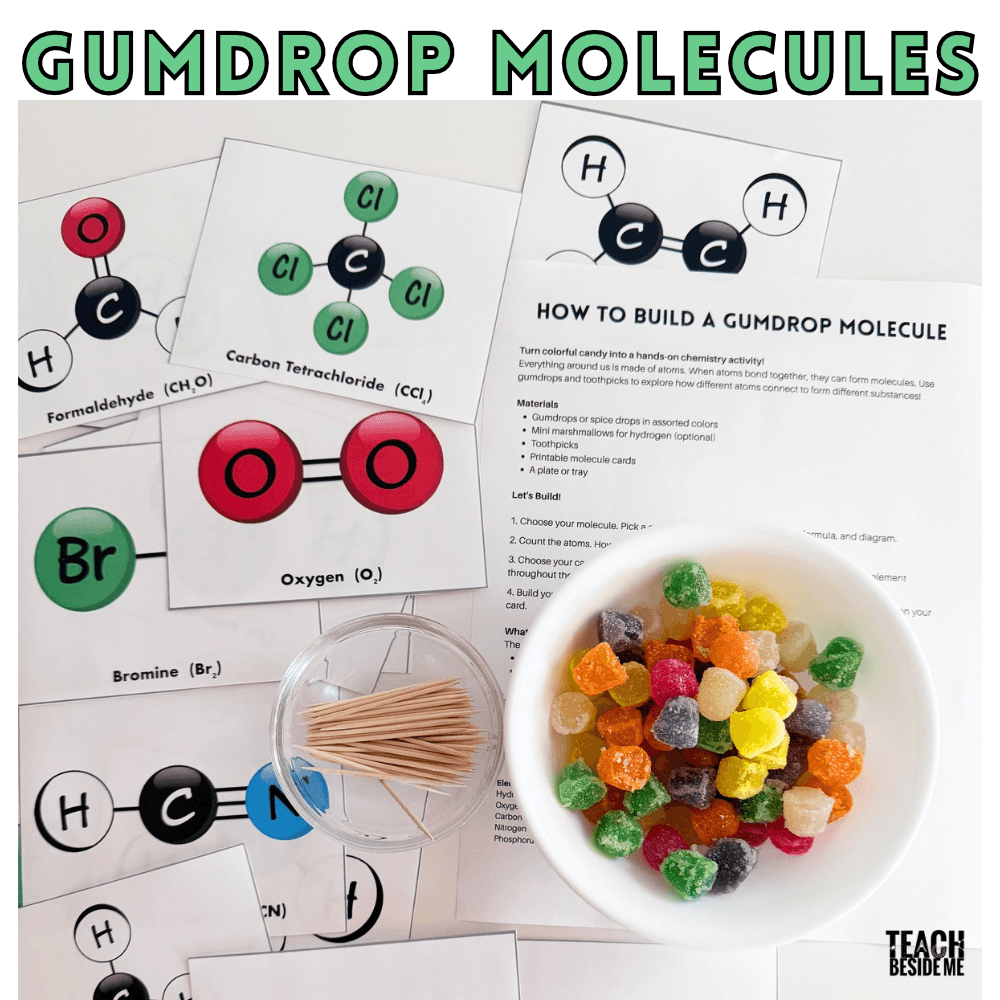
This is available for purchase in my shop!

Try These Molecule Building Challenges
Once kids have practiced following the molecule diagrams, give them a few extra challenges!
1. The Smallest Molecule: Find and build a molecule with only two atoms. Can you find another?
2. Double Bond Challenge: Find a molecule containing a double bond and build its model.
3. Hydrogen Hunt: Find three different molecules containing hydrogen. Which one has the most hydrogen atoms?
4. Element or Compound?: Build one molecule made from a single element and another containing different elements.
5. Carbon Collection: Find and build three molecules that contain carbon. How are they different?
6. Triple Bond Detective: Find a molecule with a triple bond. Can you find a second example?
7. Molecule Comparison: Build two different molecules and compare their elements, atoms, and bonds.
8. Build It From Memory: Study a molecule card, turn it over, and try to recreate the model without looking.
These challenges are a fun way to encourage observation, comparison, problem-solving, and scientific thinking. The printable set includes challenge prompts that children can use independently or in small groups.
More Ways to Explore Molecules and Chemistry
There are several ways to extend this activity, depending on the ages and interests of your children.
- Practice reading chemical formulas. Ask children to count the number of atoms in a formula. Explain that a small number written after an element symbol tells how many atoms of that element are present.
- Sort molecules and compounds. Separate cards showing molecules made from one element, such as O₂ and N₂, from cards showing compounds, such as H₂O and CO₂.
- Compare molecules with similar elements. Water (H₂O) and hydrogen gas (H₂) both contain hydrogen, but they are very different substances. Discuss why changing the elements in a molecule changes its identity.
- Investigate molecular shapes. Some molecules are linear, some are bent, and others have three-dimensional structures. Compare your gumdrop models with pictures of actual molecular shapes.
- Research everyday chemistry. Choose a familiar substance, such as water, oxygen, or carbon dioxide, and learn about its properties and uses.
Why Build Molecules with Candy?
Chemistry introduces children to things they can’t easily see. Atoms are far too small to observe directly with an ordinary classroom microscope, so models help make their structures more understandable.
Building molecules with gumdrops gives kids the chance to work with chemical symbols, practice counting, explore bonds, and compare different substances.
It also combines science with hands-on problem-solving, which makes it a wonderful STEM activity for homeschool lessons, classrooms, or science clubs.
Whether you build just a few simple molecules or explore all 19 printable cards, this is a colorful and memorable way to introduce kids to the building blocks of matter.