
Printable Place Value Cards: Hands-On Math for Kids
This post may contain affiliate links.
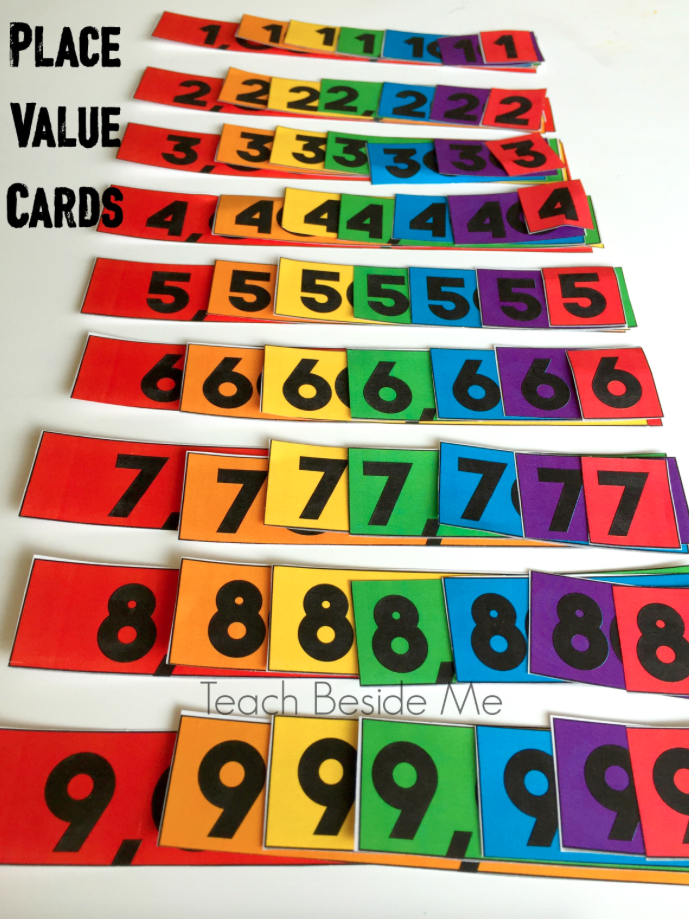
Looking for a hands-on way to teach place value? These printable place value cards help kids understand the value of each digit as they build numbers, practice expanded form, and explore how our number system works.
Each place value is represented by a different color and card length. Students can layer the cards together to create numbers, then pull them apart to see the value of each digit.
It’s a simple but effective way to make an abstract math concept more concrete!
These cards are perfect for elementary math centers, small-group lessons, homeschool math, and extra place value practice.
What Is Place Value?
Place value tells us how much a digit is worth based on its position in a number.
For example, look at the number 4,582.
- The 4 is in the thousands place, so its value is 4,000.
- The 5 is in the hundreds place, so its value is 500.
- The 8 is in the tens place, so its value is 80.
- The 2 is in the ones place, so its value is 2.
We can write this number in expanded form:
4,000 + 500 + 80 + 2 = 4,582
Understanding place value helps children read and write numbers, compare numbers, regroup when adding and subtracting, and eventually work with larger numbers and decimals.
One of the best ways to teach this concept is to let kids physically build and take apart numbers.
That’s exactly what these place value cards are designed to do!
How to Use Printable Place Value Cards
My printable place value cards are colorful, simple to use, and designed to help kids explore numbers through the millions.
Each place value has its own color, and the cards are different lengths so students can overlap them to build numbers.
Step 1: Print and Prepare the Cards
Print the cards and carefully cut them apart. I laminated ours so we could use them again and again, but printing on cardstock works well, too.
Keep the different place values organized so students can easily find the cards they need.
Step 2: Build a Number
Choose a number to build. Start with a smaller number, such as 347.
Find the cards for:
- 300
- 40
- 7
Layer the cards together, lining up the digits by place value, to create the number 347.
Students can see how the hundreds, tens, and ones combine to make one number.
Step 3: Take the Number Apart
Now separate the cards again. Ask your students what each digit is worth.
The number 347 becomes: 300 + 40 + 7
This is called expanded form.
By building and separating numbers, children can see the relationship between standard form and expanded form rather than simply memorizing the steps.
Step 4: Explore Larger Numbers
Once students are comfortable with hundreds, try building numbers in the thousands, ten thousands, hundred thousands, and millions.
The same place value principles apply no matter how large the number becomes!
5 Ways to Practice Place Value with Number Cards
There are so many ways to use these cards beyond simply building numbers. Here are a few easy activities for math lessons and centers.
1. Build the Number
Say a number aloud and have students find the correct cards to build it. For younger students, begin with two- or three-digit numbers. Older students can work with larger numbers. This is great practice for connecting number names with written numerals.
2. Expanded Form Match
Write a number on the board, such as 6,245. Have students build it using the place value cards. Then ask them to separate the cards and read the expanded form:
6,000 + 200 + 40 + 5
You can also reverse the activity. Write an expanded form expression and ask students to build the number.
3. What’s the Value of That Digit?
Build a number with the cards and point to one digit. Ask students to tell you its value.
For example, in the number 7,352, the digit 3 represents 300.
This is especially helpful for children who can identify digits but are still learning that a digit’s position changes its value.
4. Compare Two Numbers
Have students build two different numbers. Which number is greater? Which is smaller? Encourage students to compare the digits beginning with the greatest place value. For an extra challenge, ask them to change one card to make the number larger or smaller.
5. Number Detective
Give students a few clues and challenge them to build the mystery number.
For example:
- My number has 4 thousands.
- It has 2 hundreds.
- It has 6 tens.
- It has 3 ones.
What number am I?
Students build 4,263 using their place value cards.
Once they understand the activity, let them create their own number clues for a partner!

Printable Place Value Cards for Math Centers
[KEEP PHOTO OF YOUR DAUGHTER USING THE CARDS]
My daughter loved these cards when I first made them! She especially enjoyed arranging them in number order and seeing how the different place values fit together.
I love that students can manipulate the cards themselves. They can build numbers, separate them into expanded form, and rearrange the pieces to explore different values.
For classroom use, you could prepare a few laminated sets and keep them in small bags or containers. Students can use them independently, with a partner, or during small-group math instruction.
You can also pair the cards with number-writing activities, place value charts, or math notebooks.
Get the Printable Place Value Cards
Ready to try this hands-on math activity with your students?
My Printable Place Value Cards are available in the Teach Beside Me shop!
The colorful cards help students build numbers through the millions and explore the relationship between standard form and expanded form.
They’re a useful addition to your place value lessons and can be reused throughout the school year.
GET THE PRINTABLE PLACE VALUE CARDS


More Hands-On Place Value Activities
Looking for more creative ways to teach place value? Try these activities next!
A Picture Book for Teaching Place Value
If you enjoy combining math with read-alouds, check out Count to a Million by Jerry Pallotta.

This colorful counting book introduces increasingly large numbers and helps children visualize just how big a million really is.
It’s a fun companion to hands-on place value activities, especially when students are beginning to explore numbers beyond the hundreds and thousands.
Teaching place value doesn’t have to mean endless worksheets. With a few simple manipulatives, kids can build numbers, take them apart, and discover how our number system works.
I hope these printable place value cards make your next math lesson a little more creative and fun!





Very creative. Can’t wait to get the materials. My children will have fun learning with them.
really helpful, thanks 🙂