Edible Animal Cell Model (Made from a Cantaloupe!)
This post may contain affiliate links.
Looking for a hands-on, memorable way to teach kids about animal cells? This edible animal cell model made from a cantaloupe is the perfect blend of science and snack time! It’s simple, fun, and makes abstract biology concepts visual and tangible—even delicious.
Whether you’re a homeschool parent, co-op teacher, or just a curious learner, this edible cell model project brings life science to life in a creative (and healthy) way.

Why Learn About Animal Cells?
Cells are the basic building blocks of life. Every living organism is made of them—from jellyfish to giraffes, and yes, even us! In animal cells, each part has a unique job, and building a model helps us understand how they all work together.
An edible cell model activity like this one reinforces:
-
The names and shapes of major organelles
-
The role each part plays in the cell
-
How animal cells differ from plant cells
-
Cross-disciplinary learning (science, fine motor skills, nutrition!)
Supplies You’ll Need
This model uses mostly whole foods and is semi-healthy, kid-approved, and classroom-friendly.
Along with the list of edible supplies below you will also need the following:
- Toothpicks
- Cutting board
- Knife
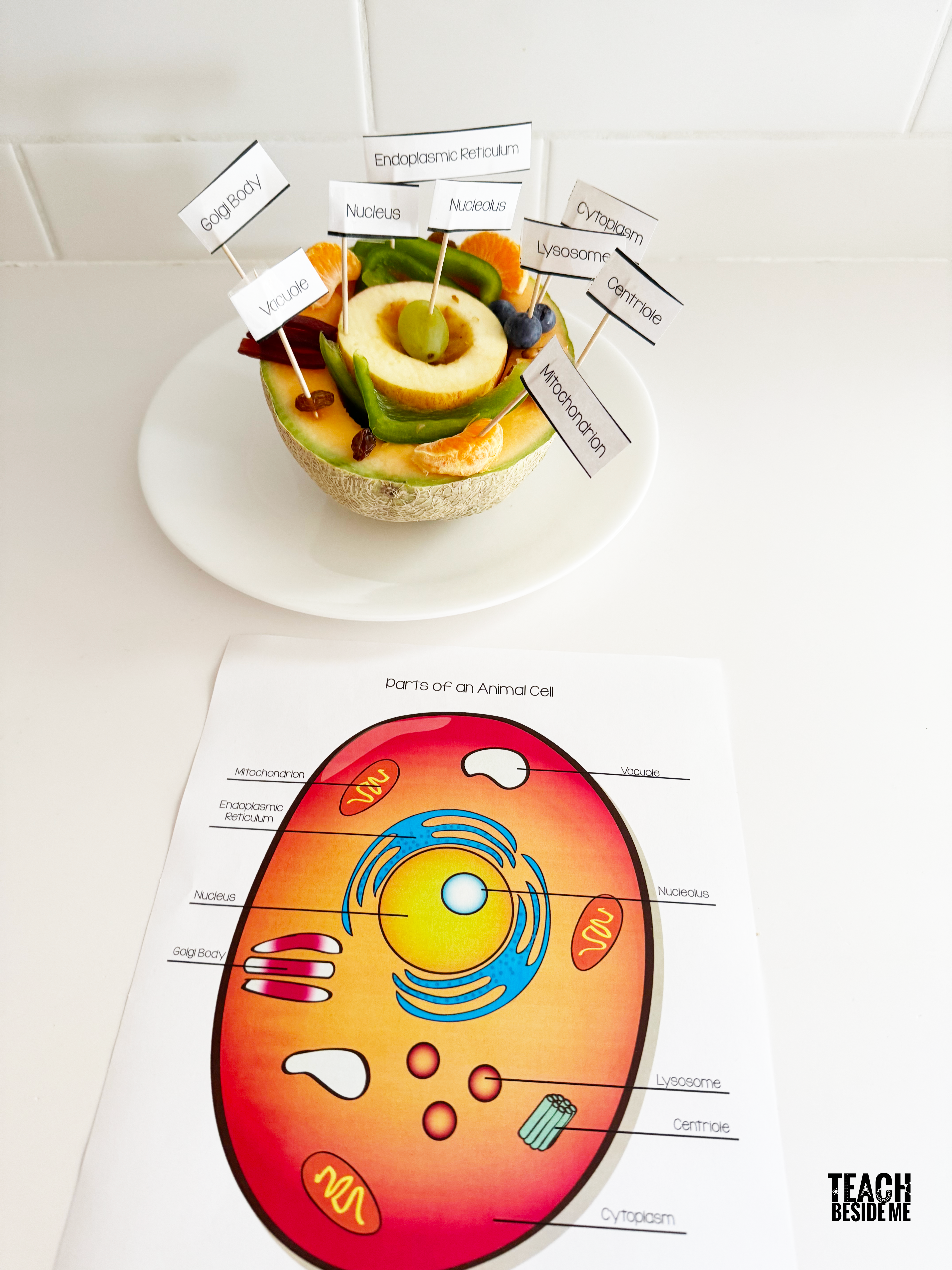
- Cell diagram & labels
- Clear tape
Ingredients by Organelle:
| Organelle | Ingredient | Notes |
|---|---|---|
| Cantaloupe | Base + cytoplasm | Halved and scooped slightly to form a bowl |
| Cell Membrane | Outer layer of cantaloupe | Wrap around the inside edge |
| Nucleus | Half of an apple | Core removed for nucleolus |
| Nucleolus | Grape in apple center | Nested inside the nucleus |
| Mitochondria | Orange slices | Use several for visual repetition |
| Endoplasmic Reticulum (ER) | Bell pepper strips or zucchini ribbons | Curve around the nucleus |
| Golgi Apparatus | Fruit leather or fruit roll up | Fold or layer for shape |
| Ribosomes | Chia seeds | Sprinkle near ER or float freely |
| Lysosomes | Blueberries | Scatter throughout the cytoplasm |
| Vacuole | Raisins or craisins | Small and pouch-like |
| Centriole | Pretzel sticks | Near the nucleus |
Assembly Instructions
Cut a cantaloupe in half and scoop out a shallow bowl in the center.
Slice the apple in half in a cross section and trip out the seeds. Place the apple half (nucleus) in the center with a grape inside (nucleolus).
Arrange organelles around the cell using the chart above as a guide.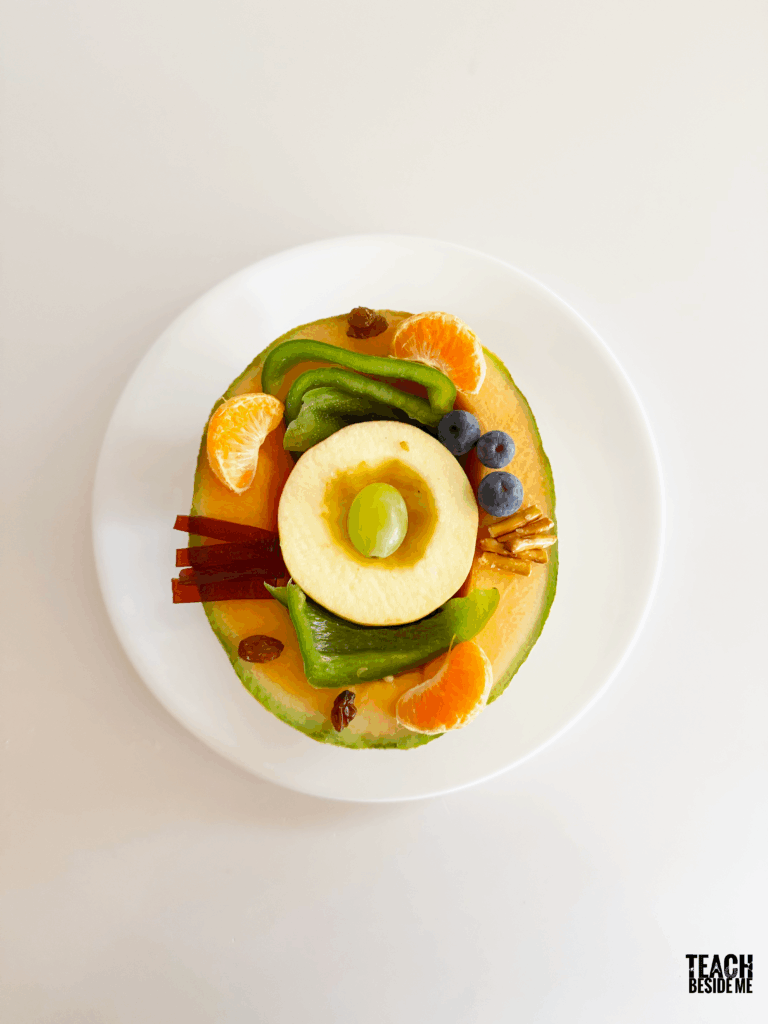
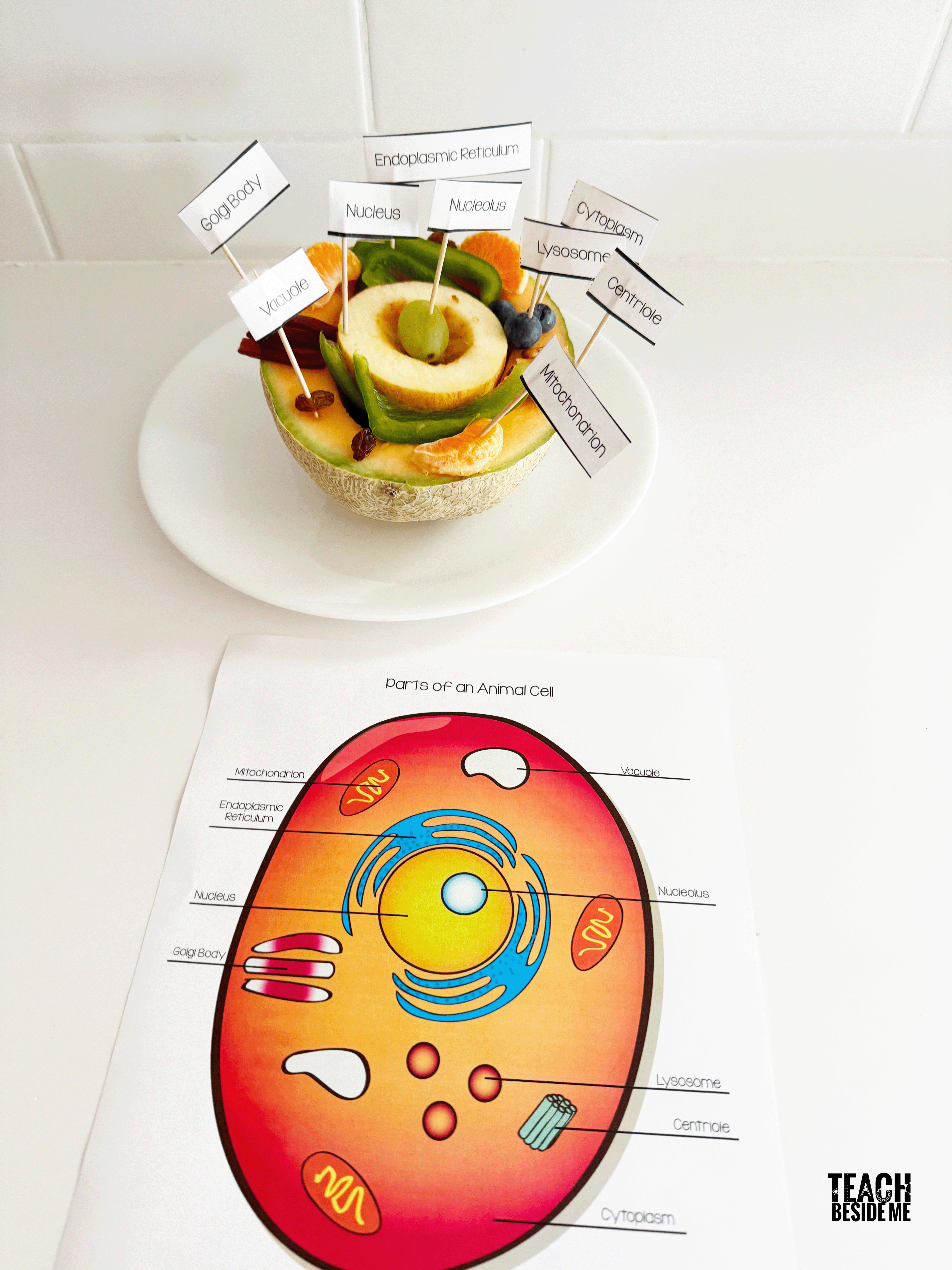
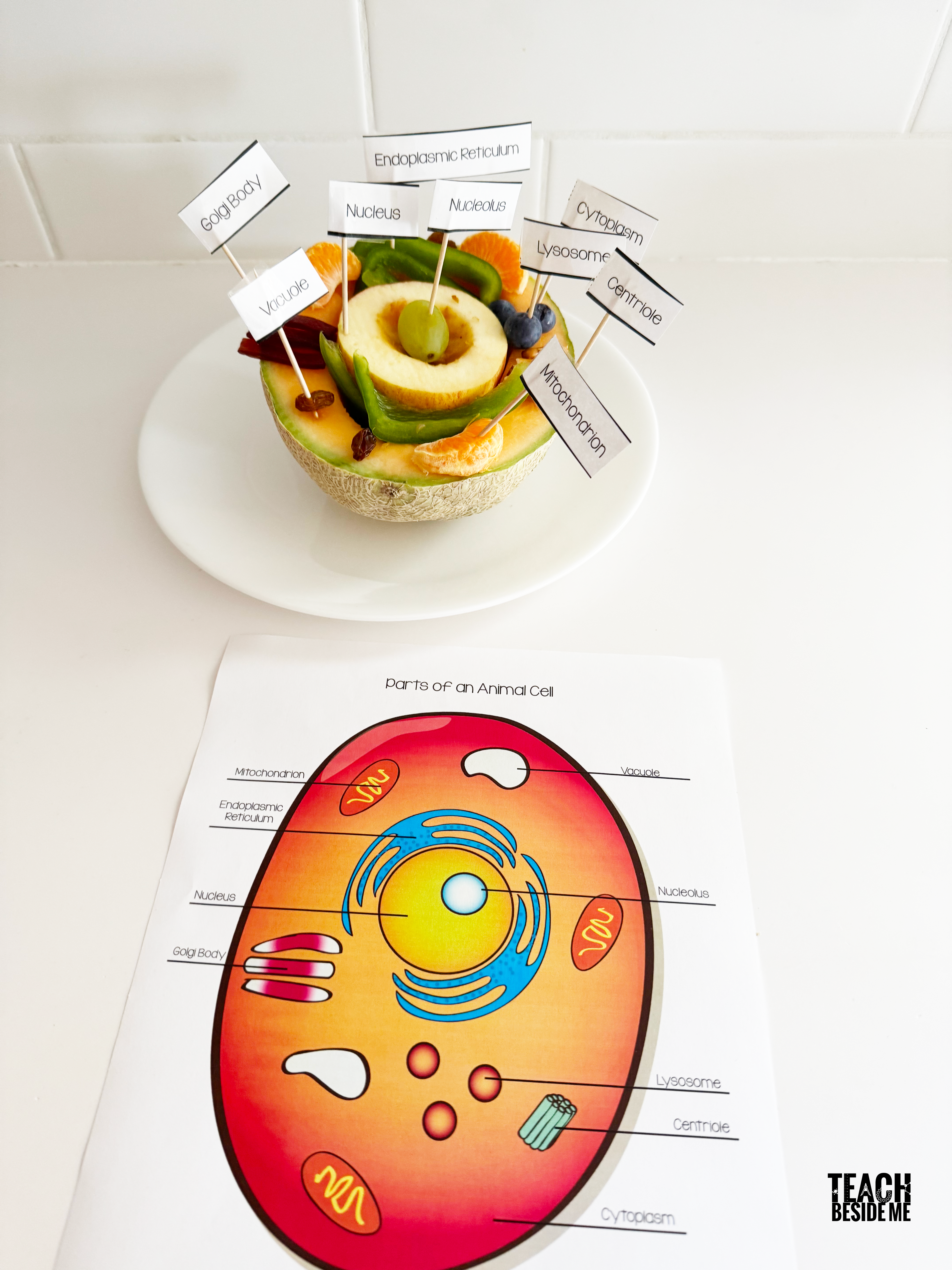
Label with printed flags or toothpicks.
Science Behind the Animal Cell Model
Each part of this model represents an actual structure inside a real animal cell:
-
The nucleus is the control center that holds the cell’s DNA.
-
The nucleolus, inside the nucleus, helps make ribosomes.
-
The cytoplasm is the jelly-like substance that fills the cell and holds the organelles.
-
Mitochondria provide energy, ribosomes build proteins, and the ER and Golgi body help transport and package materials.
-
Lysosomes clean up waste, and vacuoles store water and nutrients.
-
The centriole helps with cell division and is unique to animal cells.


Who This Animal Cell Model Project For?
This activity is great for:
-
Homeschool science units
-
Middle school life science classes
-
Co-op STEM days
-
Visual learners
-
Parents studying anatomy alongside their kids, like me!
It aligns with science standards for grades 4–8, but can easily be adapted for younger or older students.
Want a printable diagram to go along with your edible cell model? Check out my Interactive Cell Diagrams Printable Pack, which includes full-color and black-and-white diagrams of animal and plant cells, vocabulary foldables, and a cut-and-build activity for hands-on learning. It’s a perfect way to extend the lesson and reinforce what each organelle does!
Get the Cell Diagram Printables Here

Making this cantaloupe animal cell was not only a blast—it was educational, even for me! As a visual and tactile learner, this edible science project helped me understand and remember key parts of the cell better than any textbook diagram.
It’s a beautiful example of how learning by doing (and eating!) can reinforce understanding in powerful ways.
Let me know if you try this project, and don’t forget to tag me if you share your cell creation!