
How to Start a Summer Nature School
This post may contain affiliate links.
Have you ever wanted to slow down, get outside more with your kids, and truly explore the natural world around you? That was the heart behind starting our Summer Nature School — a community-based outdoor program that turned into one of the most fulfilling things I’ve ever done.
I live near the edge of a stunning mountain range, just five minutes from a canyon filled with trails, wildlife, and beauty. But like many of us, I found myself not taking advantage of it often enough. So one summer, I decided to change that — not just for my family, but for anyone who wanted to join us.
This post will walk you through how I started a summer nature school from scratch, what worked well, what we learned, and how you can do something similar in your own community — even on a small scale.

Why Start a Nature School?
I’d never run a group like this before, but I felt a deep pull to help kids (and adults!) reconnect with our local plants, animals, and ecosystems. I also wanted to build community and create an environment where learning happened naturally — outdoors, hands-on, and joyfully.
And it worked! I emailed our local homeschool group, invited friends from church and family, and was amazed by the huge response. Parents volunteered to help lead. I created a Facebook group for communication. Each week had a theme, a short lesson, a simple activity, and lots of time to explore and play.

How Our Nature School Was Set Up
-
Length: Weekly sessions, for 12 weeks in summer
-
Participants: Open invite — families came when they could
-
Format: 10–15 minute mini-lesson + themed activity + outdoor play
-
Locations: Rotating local parks, trails, and forest areas
-
Communication: Facebook group + email updates
-
Contribution: Community-led — I taught 3 sessions, others took turns teaching
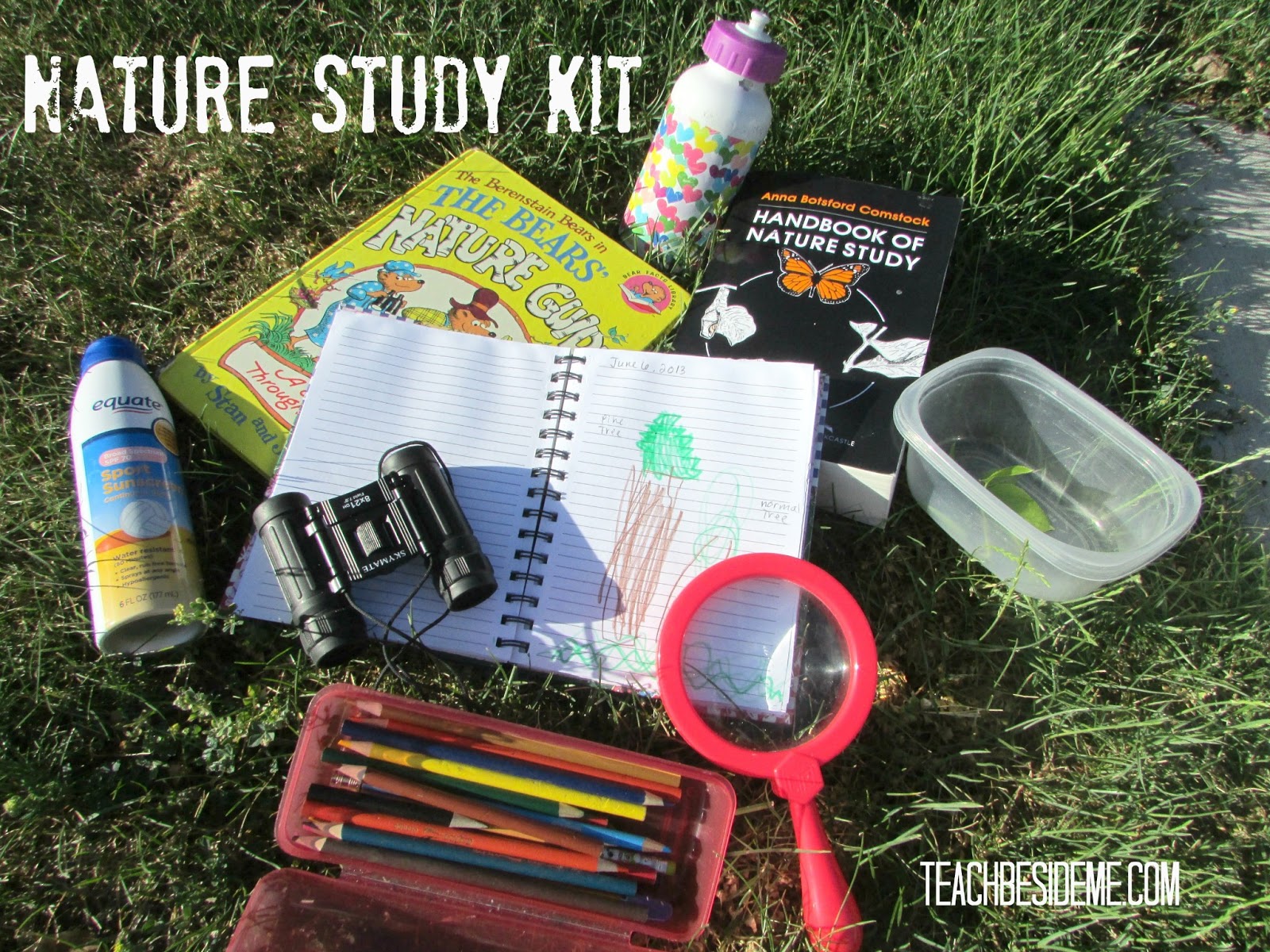
What to Bring: Nature School Supply Kit
Every child brought their own Nature Kit to use each week. Here’s what we included:
-
Nature notebook
-
Colored pencils or crayons
-
Pencil
-
Water bottle
-
Hat + sunscreen
-
Small container for collecting specimens- Check out this cool bug collecting kit for kids!
-
Field guides or nature books
-
Camera (optional)
-
Small trash bag (for clean-up)
Our Summer Nature School Weekly Themes
We built a flexible 12-week nature school schedule that covered a wide range of local topics. Each session included a short teaching moment, a hands-on activity or art project, and plenty of unstructured time outdoors.
Week 1: Introduction to Nature Study + Local History
We kicked things off with quotes from Handbook of Nature Study by Anna Botsford Comstock and talked about why nature matters. We introduced nature journaling, reviewed trail etiquette, and did a nature scavenger hunt near a local reservoir.
Download the scavenger hunt I used here
Also check out my Spring Nature Scavenger Hunt.
Week 2: Birds
I printed and laminated photos of 20 local birds and played their songs using the Chirp app. We identified features and practiced drawing birds.
Resources: All About Birds, The Burgess Bird Book, local field guides.
Week 3: Trees
Nature walk + bark and leaf rubbings, stump ring counting, and basic tree identification.
Week 4: Wildflowers
We observed and sketched flowers, learned their names, and took home seeds to plant (provided, not picked from the wild).
Week 5: Insects
Bug hunt day! Kids brought jars to collect, observe, and release bugs. We compared insect body parts and talked about pollinators.
Week 6: Leaf Art & Scavenger Hunt
We explored leaf shapes, did rubbings, and created leaf art after collecting fallen leaves.
Week 7: Local Animals
We discussed native species, looked at animal tracks, and shared fun animal facts.
Week 8: Rocks
Kids brought favorite rocks to share, and we explored local rock types and did a rock sorting activity.
Week 9: Survival Skills
We practiced basic outdoor skills like building a shelter, identifying safe plants, and water safety.
Week 10: Habitats
We explored different local habitats (wetland, forest, meadow) and how animals adapt to them.
Week 11: Caring for Nature
We did a forest trash clean-up and talked about conservation and stewardship.
Week 12: Water
Stream, river, reservoir and pond exploration — we studied water flow, aquatic bugs, and how clean water impacts ecosystems.
The Berenstain Bears Nature Guide. is another fun resource we love!

Tips for Starting Your Own Nature School
-
Start small – even just one family or a few friends is enough
-
Keep it flexible – open attendance makes it manageable
-
Rotate leadership – invite parents or teens to help lead
-
Use what’s local – parks, trails, ponds, nature centers
-
Keep the focus on wonder, not perfection – let curiosity lead

Starting a Summer Nature School changed the way I see my local landscape — and brought together families who were looking for connection, wonder, and meaningful outdoor learning.
You don’t need a curriculum or a big group to begin. All you really need is a willingness to explore, a notebook, and the desire to learn alongside your children. Nature does the rest.
If this post inspires you to start your own nature school, I’d love to hear about it! Drop a comment below or tag me if you share your adventures online.




What a wonderful idea!!! Please come share this at Eco Kids Tuesday… this week or next!
LOL you did already! Thanks so much!
I can’t say enough about how much I LOVE this! My twins are really little now, but I’d love to organize something like this when they are a bit older. Such a great idea!
I feel so motivated! We are headed to the beach and am planning to put together an exploring pack for my son!
I am so jealous! We are pretty remote so in the summer our 7 year old spends time alone with us he knows a lot about farm life but I think he gets bored. We have him involved in camps (3) so far but they are all only a week, day camp! He leaves for FL with his grandparents tomorrow. Wish we had a summer long camp. Great idea!
This is such a great idea. Kids get so much out of nature studies. I bet it’s nice to have the topics all planned out so everyone knows what to expect!
This is such a great idea to get children outside all over Summer. Short lessons are good – especially if it is too sunny.
Love the idea and topics. Summer is the perfect time to go explore!
This is wonderful!!! I’m going to pin this and convince my friends to join in.
What an awesome idea! I could totally do this, but in the fall, when temps are better here 😀
What a pretty bridge and fun lessons. I love the smiles.
I love this- we are huge nature study fans too! We’ll be watching with interest!!
Isn’t nature study so much fun!! We have an app for birds on my phone that we often use. The whole family enjoys the outdoor time we spend while learning.
What a beautiful area you live in! We enjoy outdoor exploration as much as possible, but we’re in the middle of the desert so you’re natural environment is a lot more green and wet than ours 😀 We may need to take some field trips!
What a wonderful idea! By the end of the summer the kids will know so much about the habitats and animals around them.
I sure hope you plan to do a weekly update on your Nature School! Thanks for sharing your post with us at Eco-Kids Tuesday! I am featuring it tomorrow! Please stop by and link up again! http://likemamalikedaughter.blogspot.com/search/label/Eco-Kids%20Tuesday
This is such a great idea! I can’t wait to try and start my own summer nature school.
What a great idea – we just had so much fun discovering all sorts of new birds at the seaside.
I would love for you to link up at the Mommy Archive – we’re focusing on summer holiday activities this week, Alice x
This is wonderful! Thank you so much for sharing. 🙂
I love this! Where did you get the step-by-step bird drawing page? I would love to have one of those!