Casey at the Bat Poem & Printable Activities
This post may contain affiliate links.
Casey at the Bat is one of America’s most iconic and humorous narrative poems. It’s the perfect blend of literature and sports, making it a fun and educational piece to explore with kids at home or in the classroom.
What Is Casey at the Bat?
Written by Ernest Lawrence Thayer and first published in 1888, Casey at the Bat tells the story of a fictional baseball game in the town of Mudville. The home team is behind, but all hope is pinned on their star player—mighty Casey. With dramatic flair and rhythmic verses, the poem builds suspense as Casey steps up to bat… only to end in one of literature’s most unexpected strikeouts.
It’s a fantastic introduction to narrative poetry, humor, and performance—and because it’s in the public domain, it’s free to use and share!
Historical Background
Ernest Lawrence Thayer was a Harvard-educated writer and humorist who worked as a columnist for The San Francisco Examiner. He originally published Casey at the Bat under the pen name “Phin” on June 3, 1888. At the time, it didn’t receive much attention—until stage actor DeWolf Hopper recited it during a baseball-themed performance in New York. Hopper’s booming, theatrical delivery captivated the audience, and the poem quickly grew in popularity.
Casey at the Bat became a cultural sensation, especially as baseball rose to become America’s favorite pastime. The poem has since been referenced in everything from cartoons to classroom readings, and it’s widely considered the most famous baseball poem ever written.
Though Thayer wrote only a few poems in his lifetime, Casey at the Bat cemented his legacy in American literature and sports lore. Over time, Casey became a symbol of overconfidence and the unpredictability of hero worship—making the poem both funny and meaningful.
Full Text of Casey at the Bat
Casey at the Bat
by Ernest Lawrence Thayer
Published June 3, 1888
The outlook wasn’t brilliant for the Mudville nine that day;
The score stood four to two with but one inning more to play.
And then when Cooney died at first, and Barrows did the same,
A sickly silence fell upon the patrons of the game.
A straggling few got up to go in deep despair. The rest
Clung to that hope which springs eternal in the human breast;
They thought if only Casey could but get a whack at that—
We’d put up even money now with Casey at the bat.
But Flynn preceded Casey, as did also Jimmy Blake,
And the former was a lulu and the latter was a cake;
So upon that stricken multitude grim melancholy sat,
For there seemed but little chance of Casey’s getting to the bat.
But Flynn let drive a single, to the wonderment of all,
And Blake, the much despised, tore the cover off the ball;
And when the dust had lifted, and men saw what had occurred,
There was Jimmy safe at second and Flynn a-hugging third.
Then from five thousand throats and more there rose a lusty yell;
It rumbled through the valley, it rattled in the dell;
It knocked upon the mountain and recoiled upon the flat,
For Casey, mighty Casey, was advancing to the bat.
There was ease in Casey’s manner as he stepped into his place;
There was pride in Casey’s bearing and a smile on Casey’s face.
And when, responding to the cheers, he lightly doffed his hat,
No stranger in the crowd could doubt ’twas Casey at the bat.
Ten thousand eyes were on him as he rubbed his hands with dirt;
Five thousand tongues applauded when he wiped them on his shirt.
Then while the writhing pitcher ground the ball into his hip,
Defiance flashed in Casey’s eye, a sneer curled Casey’s lip.
And now the leather-covered sphere came hurtling through the air,
And Casey stood a-watching it in haughty grandeur there.
Close by the sturdy batsman the ball unheeded sped—
“That ain’t my style,” said Casey. “Strike one!” the umpire said.
From the benches, black with people, there went up a muffled roar,
Like the beating of the storm waves on a stern and distant shore.
“Kill him! Kill the umpire!” shouted someone on the stand;
And it’s likely they’d have killed him had not Casey raised his hand.
With a smile of Christian charity great Casey’s visage shone;
He stilled the rising tumult; he bade the game go on;
He signaled to the pitcher, and once more the spheroid flew;
But Casey still ignored it, and the umpire said, “Strike two!”
“Fraud!” cried the maddened thousands, and echo answered “Fraud!”
But one scornful look from Casey and the audience was awed.
They saw his face grow stern and cold, they saw his muscles strain,
And they knew that Casey wouldn’t let that ball go by again.
The sneer is gone from Casey’s lip, his teeth are clenched in hate,
He pounds with cruel violence his bat upon the plate;
And now the pitcher holds the ball, and now he lets it go,
And now the air is shattered by the force of Casey’s blow.
Oh, somewhere in this favored land the sun is shining bright,
The band is playing somewhere, and somewhere hearts are light;
And somewhere men are laughing, and somewhere children shout,
But there is no joy in Mudville—mighty Casey has struck out.
Teaching Casey at the Bat
Casey at the Bat is a fun poem to read aloud and discuss together. Its strong rhythm, dramatic story, and humorous ending make it especially engaging for kids who may not naturally be drawn to poetry.
It is also a great poem for exploring narrative poetry, rhyme and rhythm, figurative language, characterization, mood, and suspense. The older vocabulary and baseball expressions give students a chance to practice using context clues, too.
One of my favorite discussion points is Casey himself. Is he simply confident—or does his confidence cross over into arrogance? Students can look closely at Thayer’s descriptions and Casey’s actions to form their own opinions.
Casey at the Bat Printable Activities
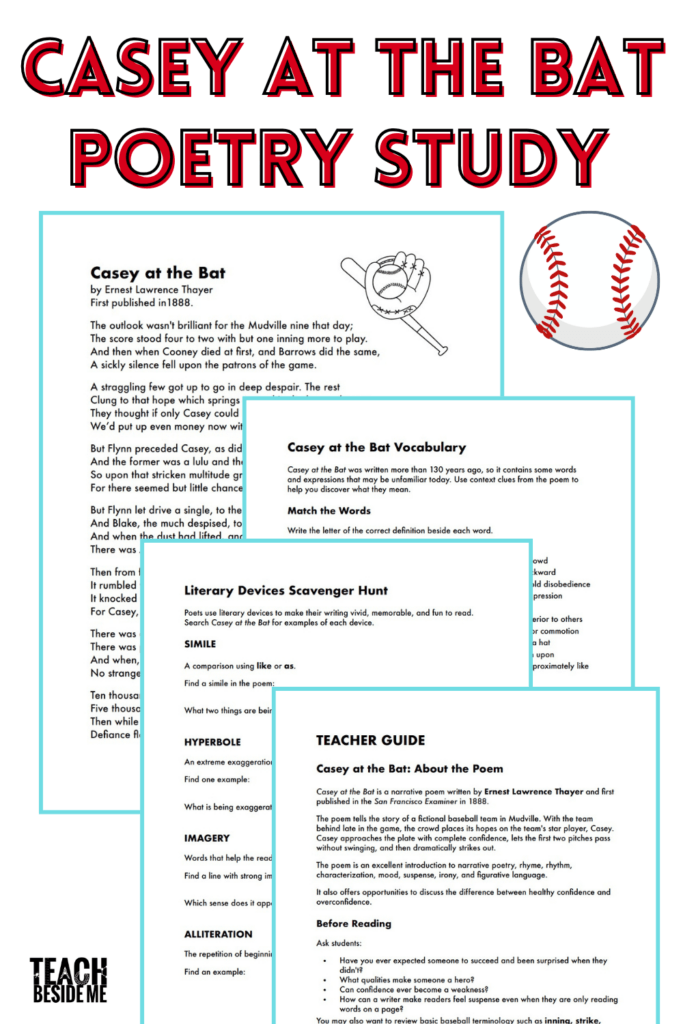
I created a printable poetry study to go along with the poem and make it easy to use at home or in the classroom.
The printable includes:
- Full printable poem
- Vocabulary and baseball language activity
- Poetry analysis
- Literary Devices Scavenger Hunt
- Character and mood analysis
- Creative extension activities
- Teacher guide and answer keys
The activities are designed primarily for upper elementary and middle school students and can be used for homeschool poetry studies, classroom literature lessons, baseball-themed learning, or National Poetry Month.
GET THE CASEY AT THE BAT POETRY UNIT NOW! It is available in my shop.

More Ways to Explore Casey at the Bat
After studying the poem, there are plenty of ways to continue the learning.
Read it dramatically. This poem begs to be performed. Let different students read Casey’s dialogue, the umpire’s calls, and the crowd’s reactions while someone narrates.
Explore baseball history. Find out what baseball looked like in 1888 when Thayer wrote the poem. How was the game—or the experience of watching it—different from baseball today?
Talk about expectations. Why does everyone put so much faith in Casey? What happens when we assume that one talented person will always succeed?
Try some creative writing. Imagine the story from another character’s perspective or think about how the story might change with a different ending.
Whether you’re a baseball fan or simply love a good story, Casey at the Bat is a lively way to explore classic poetry with kids. Its rhythm makes it fun to read aloud, its language provides plenty to investigate, and its famous ending is one students won’t soon forget.
Grab the printable Casey at the Bat Poetry Study to turn this classic poem into a ready-to-use literature lesson for your homeschool or classroom.
See More Poetry of My Activities:
Over the River and Through the Wood Poetry Study Pack
The Raven by Edgar Allan Poe Poetry Study
Poetry Memorization Cards for Kids: Classic Poems Printable
The Spider and the Fly Poem Printable
Motivational Poems for Kids to Memorize