Decoder Wheel Printable: Make Your Own Secret Code Wheels
This post may contain affiliate links.
Have you ever wanted to send a secret message that only your friends could read? With these printable decoder wheels, you can create your own secret codes, send mysterious messages, and challenge others to crack them!
Decoder wheels are a fun way to introduce kids to the world of ciphers, encryption, and secret communication. These simple paper tools have a fascinating connection to history, too. From Julius Caesar’s military messages to the mechanical cipher devices invented centuries later, people have been finding creative ways to protect information for thousands of years.
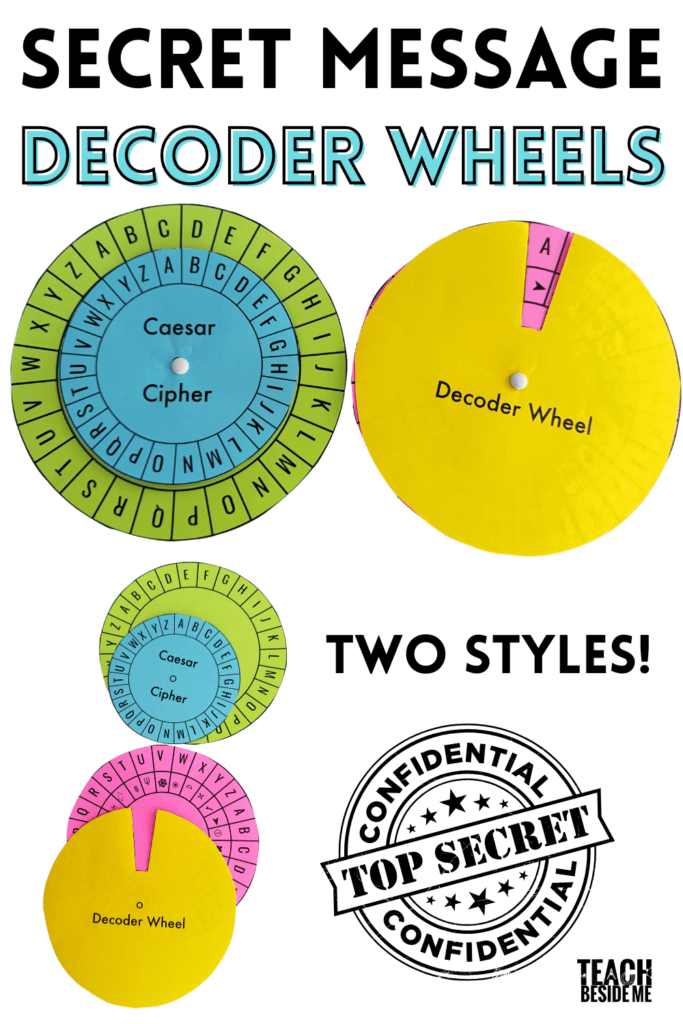
I’ve created a set of free printable decoder wheels that kids can cut out, assemble, and use to write secret messages. The set includes a Caesar cipher wheel, a symbol substitution wheel, and a blank decoder wheel for inventing your own code.
They’re perfect for a history lesson, STEM activity, classroom mystery, secret agent game, or just an afternoon of creative fun!
What Is a Decoder Wheel?
A decoder wheel, sometimes called a cipher wheel or code wheel, is a tool used to encode and decode secret messages.
Most decoder wheels have two or more circular pieces or discs with letters, numbers, or symbols arranged around the edges. Depending on the design, you rotate the pieces to match letters with their secret replacements or use a window to reveal the code.
For example, you might replace every letter with a different symbol, or shift the alphabet so that A becomes D, B becomes E, and C becomes F.
The result is a message that looks like nonsense until someone knows how to decode it!
The secret pattern or setting used to encode and decode the message is called a key.
The History of Secret Codes and Cipher Wheels
People have been using secret codes for thousands of years. Long before computers, encryption relied on clever patterns, shared keys, and sometimes mechanical devices.
Two interesting historical examples help explain how cipher wheels work.
Julius Caesar and the Caesar Cipher
One of the best-known historical ciphers is named after Julius Caesar, the Roman general and statesman.
Caesar used a substitution cipher to protect military messages. Instead of writing the original letters, he replaced each letter with another letter a fixed number of positions farther along in the alphabet.
For example, with a shift of three:
- A becomes D
- B becomes E
- C becomes F
- D becomes G
The word HELLO becomes KHOOR.
Someone who knows the shift can reverse the process to read the message.
This is called a Caesar cipher, or shift cipher.
Caesar didn’t use a paper decoder wheel like ours. However, rotating alphabet wheels are a simple way to demonstrate the same mathematical pattern.
One of the interesting things about a Caesar cipher is that you can change the key. A shift of three creates a different message than a shift of five or ten!
Thomas Jefferson’s Cipher Device
Centuries later, Thomas Jefferson designed a mechanical cipher device that used a completely different approach.
Jefferson’s design featured 36 rotating disks mounted on an axle. Each disk contained the alphabet in a scrambled order. By arranging the disks in a particular sequence and aligning letters across them, users could create encrypted messages.
The device was more complex than a simple Caesar cipher wheel. It demonstrates how inventors developed mechanical tools to make secret communication more sophisticated.
Jefferson’s design was not widely adopted during his lifetime, but a related disk-based cipher system was later used by the U.S. Army.
Our printable decoder wheels are much simpler, but they introduce some of the same big ideas: letter substitution, shared keys, patterns, and hidden messages.
Free Printable Decoder Wheels for Kids
I’ve created three different decoder wheel activities so kids can explore secret codes in several ways.
Each one works a little differently!
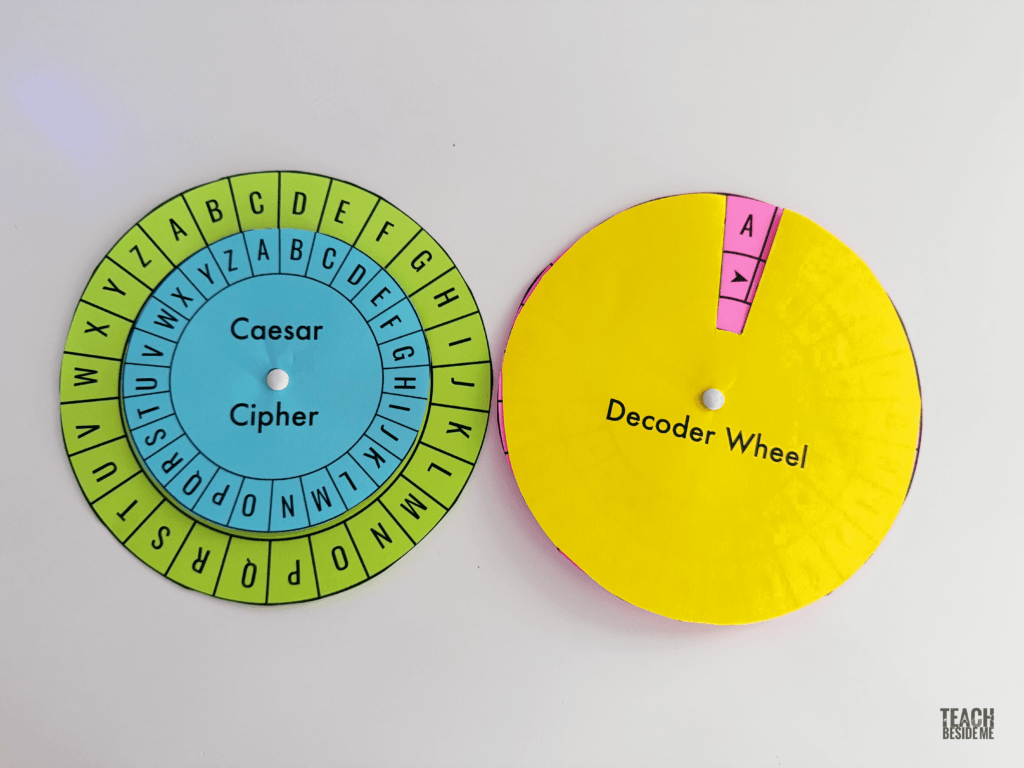
1. Caesar Cipher Wheel
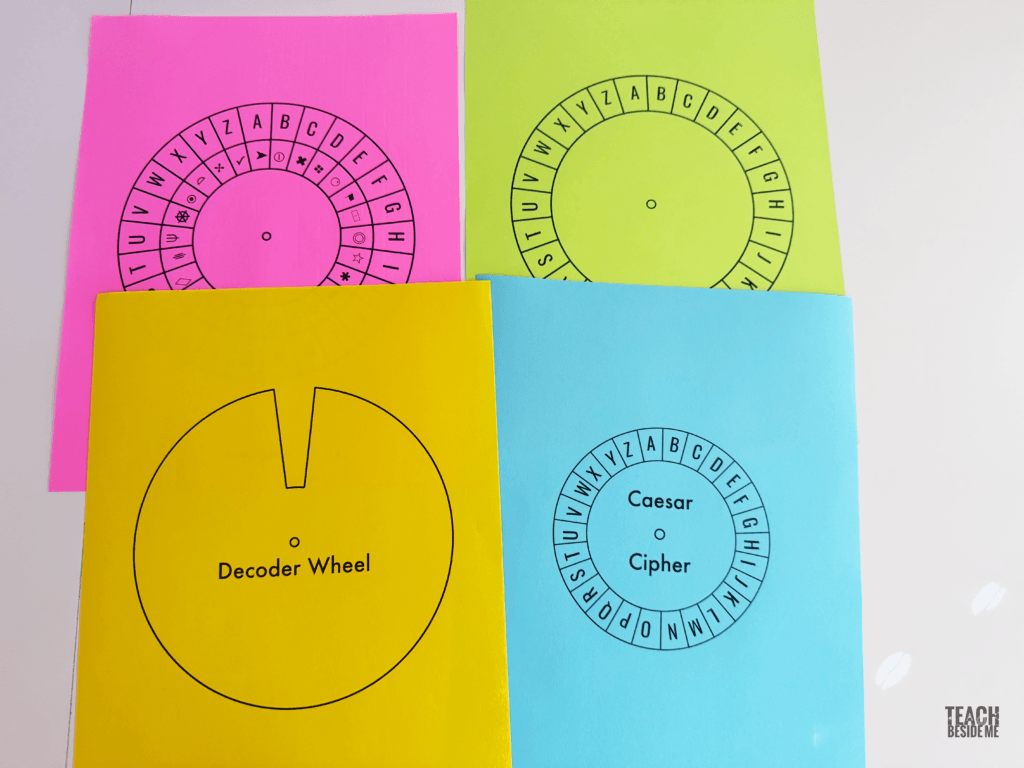
The Caesar cipher decoder wheel uses two alphabets that rotate against each other. One alphabet stays in place while the other turns to create different letter substitutions.
To use it, choose a shift number and rotate the smaller wheel until the alphabets match that setting. For example, if you choose a shift of three, align A on the outside with D on the inside. Now you can encode a message by finding each original letter and writing the corresponding secret letter. Try encoding your name, a favorite animal, or a short message!
The best part is that you can change the shift and create an entirely different code.
2. Symbol Substitution Decoder Wheel
The symbol decoder wheel replaces each letter of the alphabet with a special symbol.
Instead of shifting letters, you use a secret symbol alphabet. This wheel includes a rotating cover with a small window. Turn the cover to reveal the letter and its corresponding symbol. Use the wheel to translate words into symbols, then give the secret message to someone who has the same decoder.
Can they figure out what it says?
This is a fun way to introduce substitution ciphers, where one character is consistently replaced with another.
3. Create Your Own Decoder Wheel
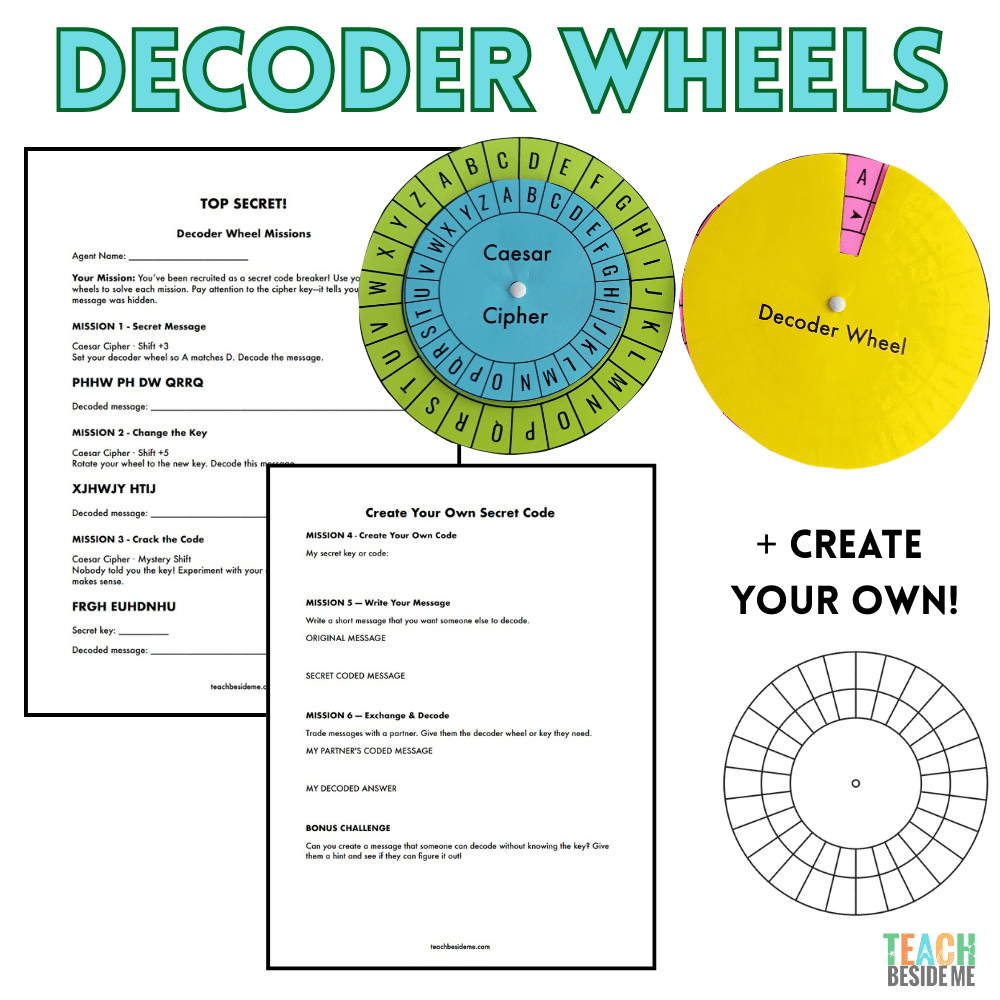
Want to invent a secret code that nobody else knows? Use the blank decoder wheel template to design your own cipher!
You can draw unique symbols for each letter, create a scrambled alphabet, or develop another consistent substitution system. Attach the window cover to reveal one letter and its replacement at a time.
The only rule is that your code should be consistent so someone with the matching key can decode your message.
Challenge a friend to create a different secret alphabet, then exchange messages!
How to Make a Decoder Wheel
These paper decoder wheels are easy to assemble with just a few supplies.
Supplies
- Free printable decoder wheel templates
- Printer and paper or cardstock
- Scissors
- Brass paper fasteners
- Colored pencils or markers (optional)
Cardstock is especially helpful because it makes the wheels sturdier and easier to rotate.
Instructions
Step 1: Print the decoder wheel templates. Choose the Caesar cipher, symbol substitution, or blank decoder wheel.
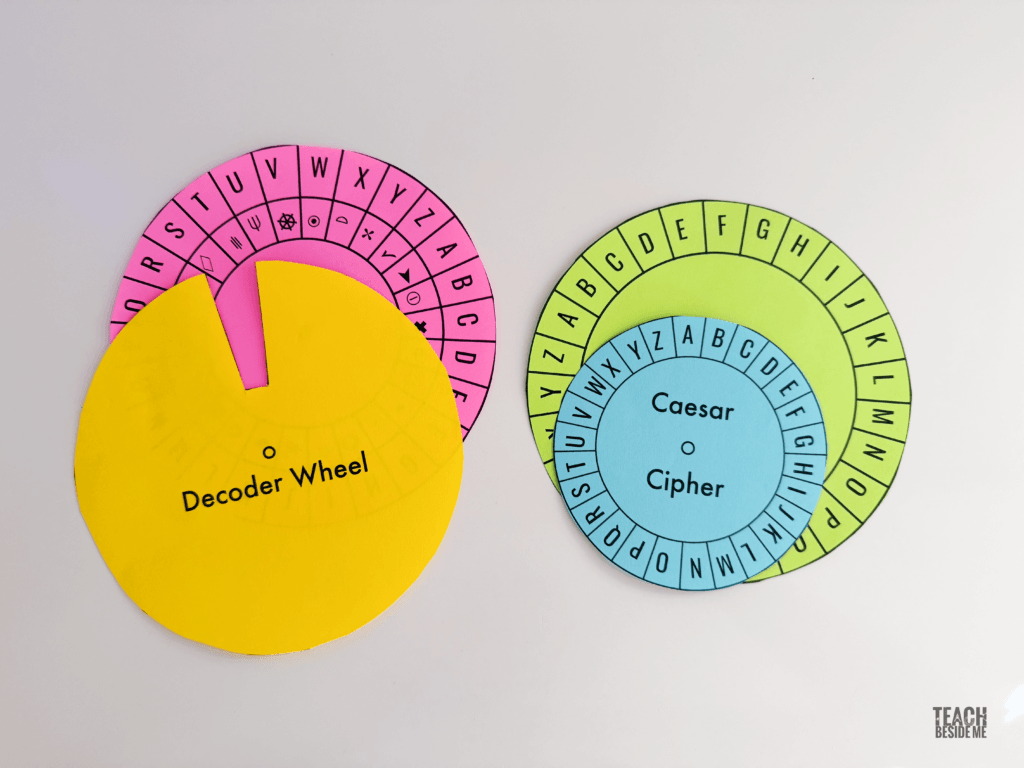
Step 2: Cut out the pieces. Carefully cut around the outside of each wheel. For the symbol and blank versions, also cut out the window in the cover.
Step 3: Assemble your decoder wheel. For the Caesar cipher, place the smaller alphabet wheel on top of the larger wheel, aligning the centers. For the symbol and blank decoder wheels, place the window cover over the corresponding code wheel.
Step 4: Add the fastener. Push a brass paper fastener through the center of both pieces and gently secure it on the back. The pieces should be able to rotate.
Step 5: Start making secret messages! Choose a code, write a message, and challenge someone to decode it.
How to Use a Decoder Wheel to Write Secret Messages
Once your decoder wheel is assembled, you’re ready to become a secret code maker!
Try a Caesar Cipher Message
Set your Caesar cipher wheel to a shift of three. Now encode this message: MEET ME AT NOON
Using a shift of three, the secret message becomes: PHHW PH DW QRRQ
Give the coded message and the key (+3) to a friend. Can they decode it?
Try changing the shift to create a different secret message.
Try a Symbol Cipher Message
Use the symbol substitution wheel to write a short message using only the secret symbols.
Start with something simple, like: FIND THE KEY
Then the messenger sender can challenge another person to use the decoder wheel to translate the symbols back into letters.
Fun Activities Using Decoder Wheels
There are so many ways to turn a simple paper cipher wheel into a learning game.
Secret Agent Mission: Give kids a coded message containing instructions for a mission. They must decode the message to discover what to do next.
Decoder Wheel Scavenger Hunt: Hide clues around the house or classroom. Each decoded message reveals the location of the next clue.
Secret Message Exchange: Have partners choose a cipher key and exchange coded messages.
Crack the Code Challenge: Give students a Caesar cipher message without telling them the shift. Can they experiment with different settings to discover the correct one?
History Connection: After learning about Julius Caesar, challenge students to write a message using the Caesar cipher. Discuss why keeping military messages secret would have been important.
These activities combine problem-solving, language skills, logical thinking, and creativity.
What Do Kids Learn From Decoder Wheels?
Although decoder wheels feel like games, they introduce several important educational concepts.
Math and Patterns
Caesar ciphers use patterns and modular arithmetic. The alphabet has 26 letters, so when you move beyond Z, you wrap around to A again. For example, with a shift of three, X becomes A, Y becomes B, and Z becomes C.
Problem-Solving and Logical Thinking
Decoding a message requires careful observation, following a consistent rule, and checking whether the result makes sense.
History
Cipher wheels connect naturally to lessons about ancient Rome, early American inventions, military communication, and the history of cryptography.
Computer Science and STEM
Encryption is still used today to protect digital information. Although these simple substitution ciphers are not secure by modern standards, they introduce the basic idea of transforming readable information into coded text.
Communication and Language
Writing coded messages gives kids extra practice with spelling, letter recognition, sequencing, and communicating clearly.
Download the Free Decoder Wheel Printable
Ready to create your own secret messages? Download my free printable decoder wheel set and start experimenting with different ciphers!
The printable includes:
- Caesar cipher decoder wheel
- Symbol substitution decoder wheel
- Blank decoder wheel to create your own code
- Decoder wheel activity worksheet
More Secret Codes and Cipher Activities for Kids
If your kids enjoy making and decoding secret messages, there are many other fascinating code systems to explore!
Morse Code
Morse code uses patterns of dots and dashes to represent letters and numbers. Unlike a substitution cipher, Morse code is a communication code that can be transmitted using sound, light, or electrical signals.
Try my Morse Code Alphabet Chart and Activities to learn how to write and send Morse code messages.
Pigpen Cipher
The Pigpen cipher replaces letters with geometric symbols made from grids and X-shaped patterns.
It’s a great next step after using the symbol decoder wheel because kids can compare two different substitution systems.
Braille Alphabet
Braille uses combinations of raised dots to represent letters, numbers, and other symbols.
Unlike secret ciphers, Braille is an accessible reading and writing system designed primarily for people who are blind or have low vision.
Explore my Printable Braille Alphabet and Numbers Chart to learn more.
Egyptian Hieroglyphics
Ancient Egyptian writing used a fascinating combination of signs that could represent sounds, words, and ideas.
Try my Write Your Name in Egyptian Hieroglyphics activity.
Invisible Ink Secret Messages
Want another way to hide a message?
Try my Invisible Ink Secret Messages science activity and discover how chemistry can reveal hidden writing!
Secret codes are a wonderful way to combine history, math, science, and creative play. Whether kids are exploring a Caesar cipher, inventing a symbol alphabet, or solving a mystery, these printable decoder wheels make learning feel like an adventure.