Printable Braille Alphabet and Numbers Chart
This post may contain affiliate links.
Want to introduce your kids or students to the Braille alphabet and numbers? This free printable chart makes it easy to teach the basics of Braille in a fun and engaging way. Whether you’re learning about accessibility, communication, or just exploring different writing systems, this Braille chart is a great hands-on resource.
Braille is a system of raised dots that allows people who are blind or visually impaired to read and write through touch. It’s not a language, but a code — a way of representing letters, numbers, punctuation, and even complex math or computer symbols. In this post, we’ll explore the Braille alphabet, explain how it works, and share a free printable Braille chart for kids to trace with puffy paint or glue for a fun sensory learning activity.

What Is the Braille Code?
Braille is a tactile writing system used by people who are blind or visually impaired. It was invented by Louis Braille in the early 1800s.
The Braille code uses a system of six raised dots arranged in a 2-by-3 cell (called the Braille cell). Each dot within the cell is numbered 1 through 6. By combining these dots in different patterns, Braille can represent the entire alphabet, numbers, punctuation marks, mathematical operations, and even computer commands.
There are several versions of Braille used around the world, but in the United States, most children now learn Unified English Braille (UEB) — a standardized version designed to include print symbols used in books, websites, and daily communication.
Braille can be read by touching the raised dots with your fingertips or, in printed form like this chart, can be used to learn and recognize the patterns visually.
Free Printable Braille Alphabet and Numbers Chart
This printable includes:
-
A chart of all 26 letters of the alphabet (A–Z) and the braille numbers 0-9
-
Flashcards of all the letters and numbers
You can use it to:
-
Introduce Braille in unit studies on accessibility or diversity
-
Pair it with tactile activities to help kids feel how Braille is read
-
Encourage curiosity and empathy around different ways of learning and communicating
Download the Chart Now:
Fill the Braille Alphabet with Puffy Paint
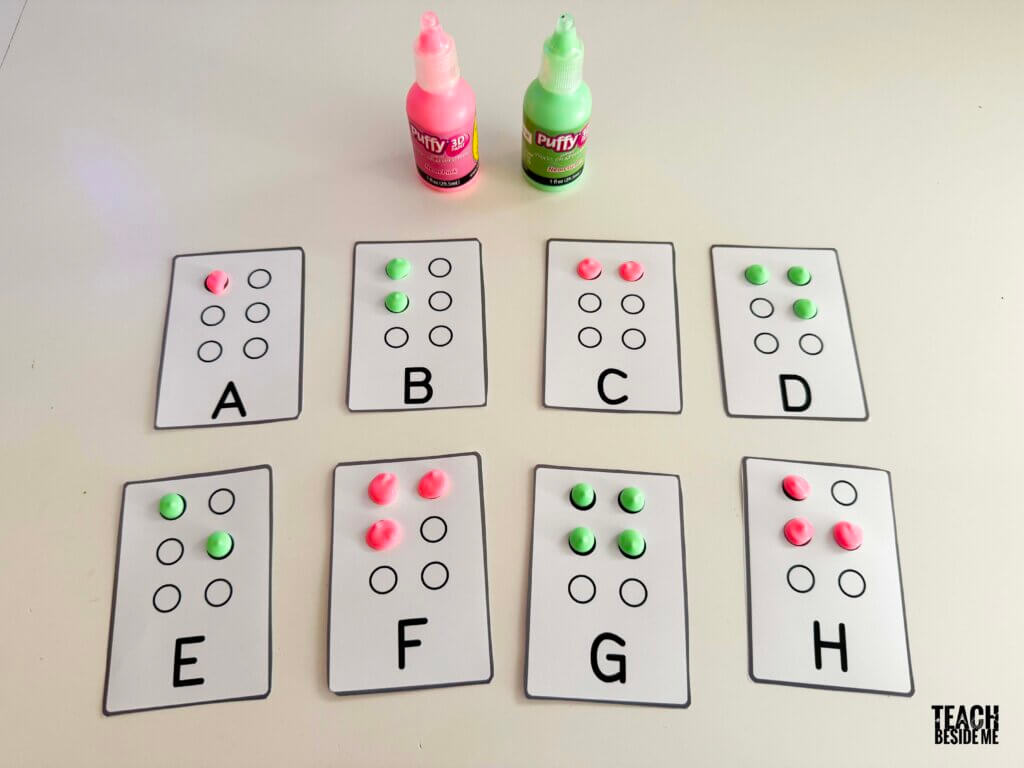
One of the best ways to teach Braille to sighted children is through sensory play. Try this fun project using puffy paint or white glue to create raised dots they can feel!
Materials:
-
Printable Braille alphabet chart or flashcards
-
Puffy paint or white glue
Instructions:
-
Print the Braille chart.
-
Let kids trace over the dots using puffy paint or glue.
-
Let dry overnight for a fully tactile experience.
-
Practice “reading” with their fingers once dry.

Educational Ideas for Using the Braille Chart
Here are a few ways to make learning about Braille meaningful and hands-on:
1. Make Tactile Braille Letters
-
Use glue dots, puff paint, beads, LEGO bricks, or hole punch dots to create raised versions of Braille letters.
-
Kids can trace them with their fingers while matching them to the printable chart.
2. Write Secret Messages in Braille
-
Have students write their names or short words using the Braille dot patterns.
-
Trade and decode each other’s Braille messages using the chart.
3. Braille Scavenger Hunt
-
Hide objects labeled with Braille letters around the room and use the chart to decode clues.
-
Combine it with ASL or Morse code for a multi-code “communication day.”
4. Learn About Louis Braille
-
Add a brief biography or read a children’s book about Louis Braille or the history of Braille.
-
Discuss why inclusive communication methods matter.
Try one of these books:
Six Dots: A Story of Young Louis Braille by Jen Bryant
Out of Darkness: The Story of Louis Braille by Russell Freedman
5. Compare the Alphabet Systems
-
Use alongside my ASL Alphabet Chart
-
Learn about Morse Code
- Learn about alphabets in other languages, like Greek!
- Learn the NATO Phonetic Alphabet
Letters vs. Numbers in Braille
Since the dot patterns for the letters A to J are reused to represent the numbers 1 through 0, Braille includes a special number sign (⠼) to tell the reader that what follows is a number, not a letter.
Similarly, there’s a capital letter sign (⠠) placed before a letter to indicate that it should be read as uppercase.
These special codes — like the number sign and capital sign — help differentiate meaning in a sentence and make reading more accurate.
Learning about Braille not only teaches kids a new form of communication—it opens their minds to the many ways people interact with the world. This Braille Alphabet and Numbers Chart is a simple but powerful way to bring inclusivity and curiosity into your learning environment.