NATO Phonetic Alphabet Chart (Free Printable)
This post may contain affiliate links.
Need a simple NATO phonetic alphabet chart? The NATO Phonetic Alphabet is the standardized system used to clearly communicate letters using words instead of sounds.
You may already be familiar with them. Here are the first few:
- A = Alfa (in the NATO international phonetic alphabet, it is spelled Alfa, not Alpha)
- B = Bravo
- C = Charlie
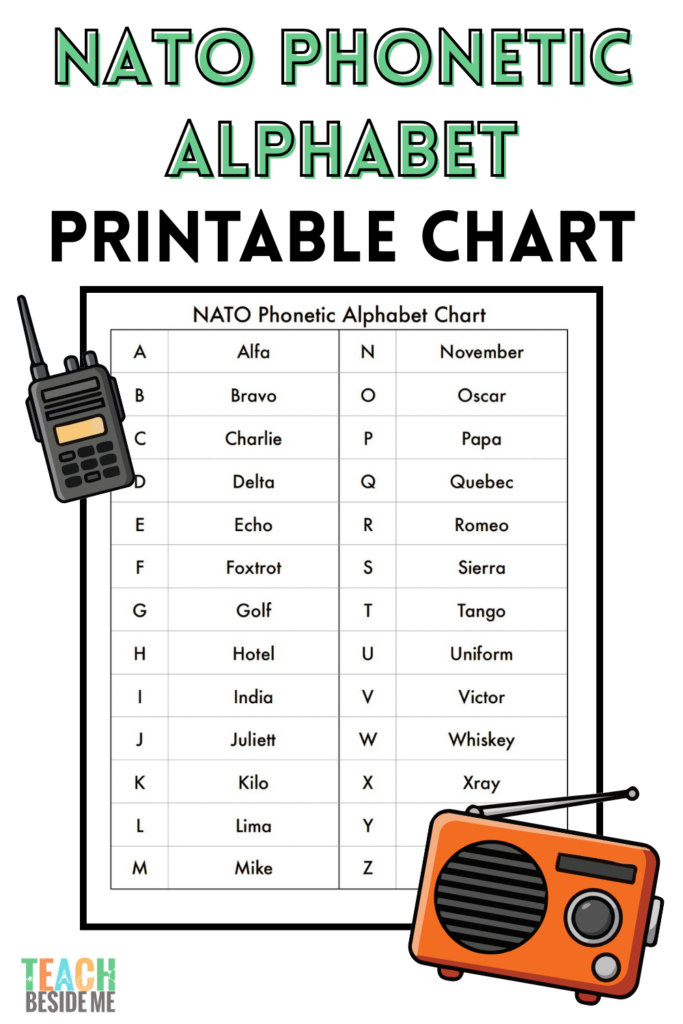
This free printable chart makes it easy to learn, reference, and use in everyday situations.
Perfect for:
- students
- homeschool lessons
- radio communication
- spelling names over the phone
- emergency preparedness
What Is the NATO Phonetic Alphabet?
The NATO phonetic alphabet is a list of code words assigned to each letter of the alphabet. Instead of saying a letter that may be misunderstood, you say the matching word.
For example:
- M becomes Mike
- N becomes November
- B becomes Bravo
- D becomes Delta
This helps avoid confusion when communication is difficult or noisy.
This alphabet was developed to make spoken communication clearer, especially over radio. In the early 1900s, different groups used their own spelling systems, which often caused confusion. As international travel and aviation grew, a standardized system became necessary.
It was standardized in 1956 by international organizations including the International Civil Aviation Organization (ICAO) and adopted by NATO. It is also recognized by the International Telecommunication Union (ITU), which helps coordinate global communication systems.
You may sometimes hear older terms like “Able” and “Baker”—these were part of an earlier phonetic alphabet used before the modern NATO system (Common during WWII). But they updated it so it will be clear across most languages.
Fun Fact: Where Did “Roger” Come From?
You may have heard the word “Roger” in movies, aviation, or radio communication.
“Roger” means “message received and understood,” but it’s not actually part of the modern NATO phonetic alphabet.
The term comes from an older phonetic alphabet used before today’s system, where the letter R stood for “Roger,” meaning “received.” Even though the NATO alphabet now uses “Romeo” for R, the word “Roger” is still used today in real-world communication.
Printable NATO Phonetic Alphabet Chart
This printable chart includes all 26 letters with their NATO code words for quick reference.
NATO Phonetic Alphabet List
| Letter | Code Word |
|---|---|
| A | Alfa |
| B | Bravo |
| C | Charlie |
| D | Delta |
| E | Echo |
| F | Foxtrot |
| G | Golf |
| H | Hotel |
| I | India |
| J | Juliett |
| K | Kilo |
| L | Lima |
| M | Mike |
| N | November |
| O | Oscar |
| P | Papa |
| Q | Quebec |
| R | Romeo |
| S | Sierra |
| T | Tango |
| U | Uniform |
| V | Victor |
| W | Whiskey |
| X | X-ray |
| Y | Yankee |
| Z | Zulu |
Why Is the NATO Phonetic Alphabet Used?
This system is used because many letters sound alike.
Examples:
- B / D / P / T
- M / N
- C / Z
Using code words reduces mistakes and improves clarity.
Where the NATO Alphabet Is Used
The phonetic alphabet is commonly used in:
- aviation
- military communication
- police and emergency services
- amateur radio
- customer service phone calls
- travel and shipping industries
It is also useful for everyday life when spelling names or addresses over the phone.
How to Spell Your Name with the NATO Alphabet
Example:
Karyn
- Kilo
- Alpha
- Romeo
- Yankee
- November
Kids love trying their own names!
Common Radio & NATO Code Phrases
In real-world communication, especially in aviation and radio use, people often use short phrases alongside the NATO phonetic alphabet.
Here are a few common ones:
- Tango Yankee (TY) — Thank you
- Tango Mike (TM) — Thanks much
- Bravo Zulu (BZ) — Well done
- Lima Charlie (LC) — Loud and clear
- Oscar Mike (OM) — On the move
These phrases help make communication faster and clearer.
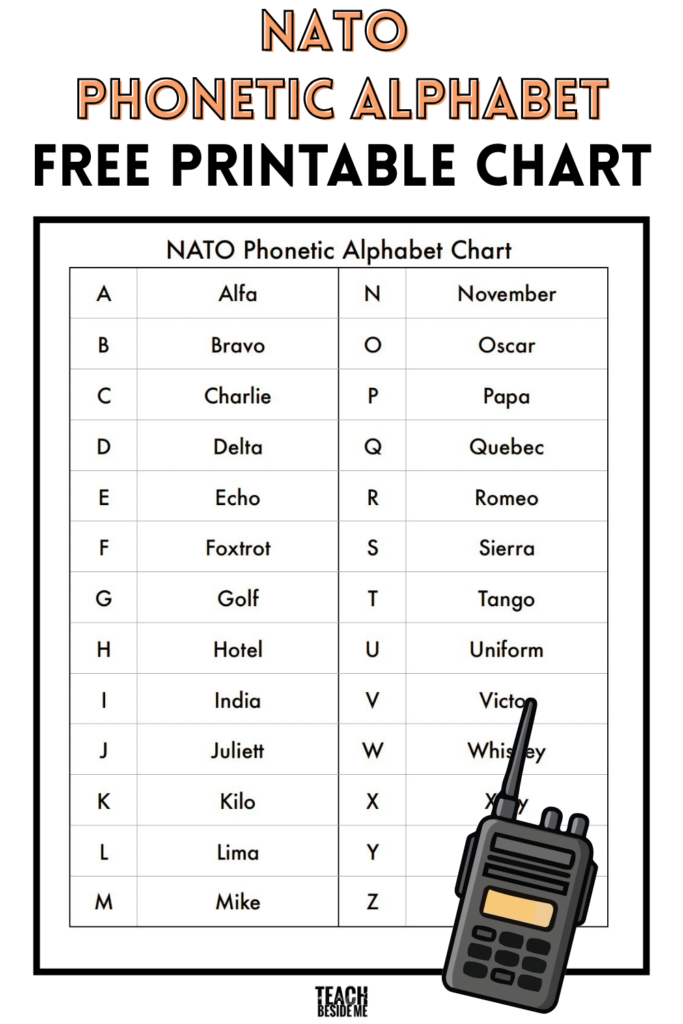
Download the Printable NATO Phonetic Alphabet Chart
This free printable chart is perfect for:
-
- classroom reference
- homeschool lessons
- office desks
- emergency kits
- communication practice
Print it and keep it handy whenever you need to spell clearly.
Fun Ways to Practice
Try these simple activities:
-
-
- Spell family names using code words
- Write and decode secret messages for each other
- Practice during car rides
- Use walkie-talkies for fun communication games
-
FAQ
Why is Alpha spelled Alfa?
In the NATO system, “Alfa” is the official spelling to help speakers around the world pronounce it clearly.
Why is Juliett spelled with two t’s?
The extra t helps avoid pronunciation confusion internationally.
Is this the same as military alphabet?
Yes, many people call it the military alphabet, though it is officially the NATO phonetic alphabet.
More Printable Charts
You may also enjoy:
The NATO phonetic alphabet is a practical and interesting system that helps people communicate clearly.
With this printable chart, kids and adults can learn a real-world skill that is surprisingly fun to use.