Greek Mythology Family Tree Printable: Learn the Greek Gods!
This post may contain affiliate links.

Who is Zeus’s father? How are Poseidon and Hades related? And where do Athena, Apollo, Artemis, and the other Olympian gods fit into the family? Greek mythology has a very complicated family tree!
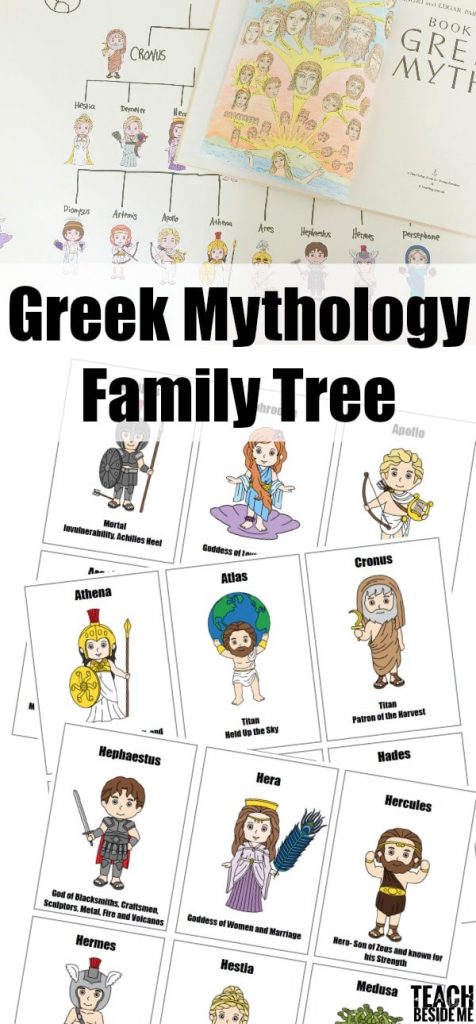
Building a Greek mythology family tree is a fun, hands-on way to help kids understand how the gods, goddesses, and Titans are connected. Instead of trying to memorize a long list of names, kids can actually see the relationships as they arrange and connect the different figures.
We used my printable Greek Gods Trading Cards to build our family tree, starting with the Titans Cronus and Rhea and working our way through the Olympian gods.
Why Learn About Greek Mythology?
Greek myths are much more than entertaining stories about gods, heroes, monsters, and impossible adventures.
References to Greek mythology appear throughout literature, art, history, language, and modern storytelling. Learning some of the major characters and myths can help kids recognize those connections later.
Studying mythology also gives kids opportunities to:
- Explore ancient Greek culture
- Recognize mythological references in literature and art
- Compare characters and their traits
- Discuss themes such as bravery, pride, jealousy, loyalty, and wisdom
- Practice reading and storytelling
- Learn how stories change as they are told and retold
And because the gods appear in one another’s stories constantly, understanding their relationships makes the myths much easier to follow.
Understanding the Greek Gods Family Tree
Greek mythology doesn’t have one perfectly simple family tree. These stories developed over centuries, and different ancient writers sometimes gave different versions of a god’s birth, relationships, or ancestry.
For a basic introduction, however, a great place to begin is with the Titans Cronus and Rhea.
They were the parents of six important figures:
- Hestia
- Demeter
- Hera
- Hades
- Poseidon
- Zeus
From there, the family expands into many of the gods and goddesses kids encounter most often in Greek mythology.
And yes—it gets complicated pretty quickly. That’s exactly why making a visual family tree is so helpful!
Major Greek Gods and Goddesses to Know
My printable Greek Mythology Trading Cards include 23 characters that kids can use as they learn about Greek mythology and build the family tree.
Some of the major figures include:
- Cronus and Rhea – Titans and parents of the first generation of Olympian gods.
- Zeus – God of the sky and thunder and ruler of the Olympian gods.
- Hera – Goddess of marriage and queen of the gods.
- Poseidon – God of the sea.
- Hades – God of the underworld.
- Demeter – Goddess of agriculture and the harvest.
- Hestia – Goddess of the hearth and home.
- Apollo – God associated with music, prophecy, healing, archery, and later the sun.
- Artemis – Goddess of the hunt, wilderness, and childbirth and associated with the moon.
- Athena – Goddess of wisdom, strategy, and crafts.
- Ares – God of war.
- Aphrodite – Goddess of love and beauty.
- Hephaestus – God of fire, metalworking, and the forge.
- Hermes – Messenger of the gods and god associated with travelers, trade, and more.
- Dionysus – God associated with wine, theater, and festivity.
As kids encounter these characters in different myths, they can return to the family tree to see how everyone is connected.
How to Make a Greek Mythology Family Tree
My Greek Mythology Trading Cards make this into an easy hands-on activity.
You’ll need:
- Greek Mythology Trading Cards
- Scissors
- Large poster board or cork board
- Glue, tape, or push pins
- String or yarn, optional
- Greek mythology books for reference
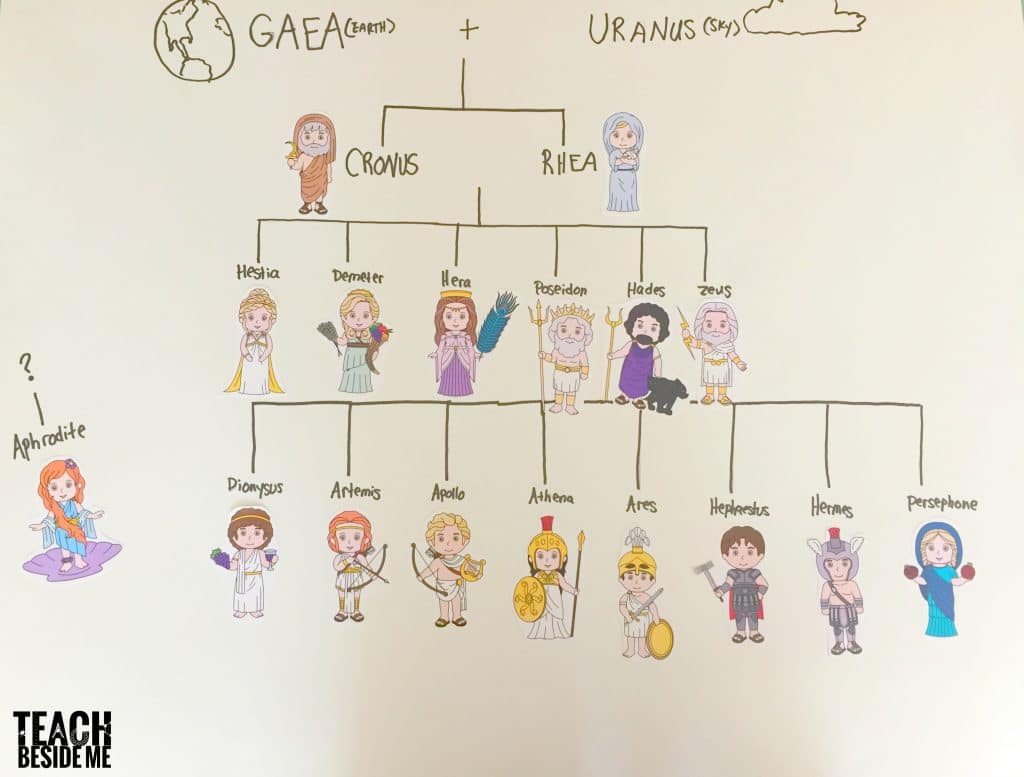
1. Print and Cut Out the Greek Gods Cards
Print the cards and cut them apart.
Each card includes an illustration, the character’s name and title, and a brief description.
Before building the family tree, spend some time looking through the cards and identifying any gods or goddesses your kids already recognize.
2. Start With Cronus and Rhea
Place Cronus and Rhea near the top of your family tree.
Then find their six children and arrange them underneath.
Already, kids can see something that’s harder to remember from reading alone:
Zeus, Hera, Poseidon, Hades, Demeter, and Hestia are siblings.
3. Add the Next Generation
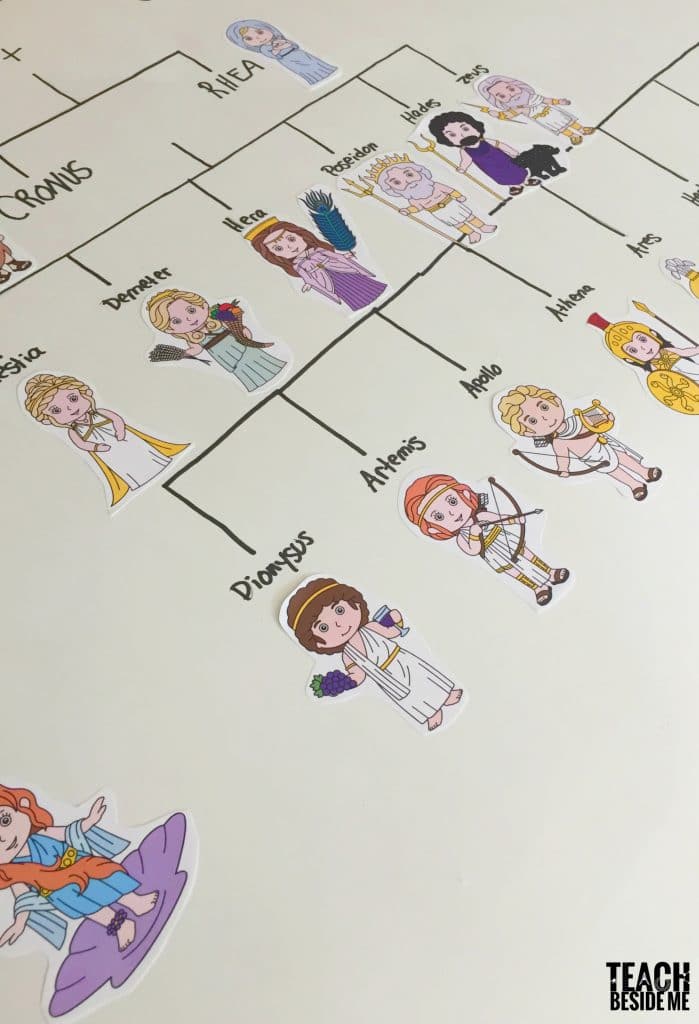
Continue adding the other gods and goddesses beneath or around the first generation.
Use string, yarn, drawn lines, or another method to show the relationships between the characters.
Don’t worry about creating a perfectly neat tree. Greek mythology doesn’t cooperate particularly well with neat family trees!
The goal is to help kids visualize the relationships and make sense of the stories they’re reading.
4. Read the Myths as You Build
Don’t make the family tree a stand-alone memorization exercise.
When you add a character, read one of the myths involving that god or goddess.
Ask:
- Who are this character’s parents?
- Does this character have siblings?
- What is this god or goddess known for?
- Which myths feature this character?
- What symbols are associated with them?
- How does this character interact with others on the family tree?
The tree becomes more meaningful as kids connect each name with actual stories.
Learning Extensions
-
Write a short myth inspired by one of the gods
-
Create a comic strip about a famous myth (e.g., Persephone and Hades)
-
Host a Greek mythology trivia game night with the printable cards
-
Research Roman counterparts of the Greek gods
Greek Mythology Books for Kids
A few books can help bring the family tree to life.
D’Aulaires’ Book of Greek Myths is a classic introduction with memorable illustrations and stories.
Treasury of Greek Mythology by Donna Jo Napoli is another beautifully illustrated collection for exploring individual gods, goddesses, heroes, and myths.
And for older kids who become fascinated with the mythology, Percy Jackson and the Olympians can be a fun modern gateway into recognizing many of the traditional characters and stories.
More Ways to Use the Greek Mythology Cards
You don’t have to stop with the family tree.
Try using the cards for:
- Greek God Research: Have each child choose a card and research that figure in more detail.
- Greek vs. Roman Gods: Find the Roman counterpart for each Greek god or goddess.
- Mythology Timeline: Arrange characters or stories as you study them.
- Write Your Own Myth: Choose several character cards and use them as inspiration for an original myth.
- Mythology Trivia: Use the information on the cards to quiz one another.
- Character Comparison: Choose two gods or goddesses and compare their roles, personalities, symbols, and stories.
You can also use the included blank cards to add other mythological figures as your study expands.
Get the Greek Mythology Trading Cards
Want to build your own Greek mythology family tree?
My printable Greek Mythology Trading Cards include:
- 23 illustrated character cards
- Information about each character
- Bonus activity ideas
- Blank cards for adding your own mythological figures
Use them to build a family tree, study individual gods and goddesses, play learning games, or keep them nearby while reading Greek myths.

If your kids love mythology, try my Mythical Creatures Card Game next to learn about dragons, griffins, unicorns, and other legendary creatures through play.