Scientific Method Worksheets and Posters
This post may contain affiliate links.

Teaching the scientific method is one of the best ways to help kids think like scientists! Instead of simply watching an experiment happen, students learn to ask questions, make predictions, test their ideas, and use evidence to understand the results.
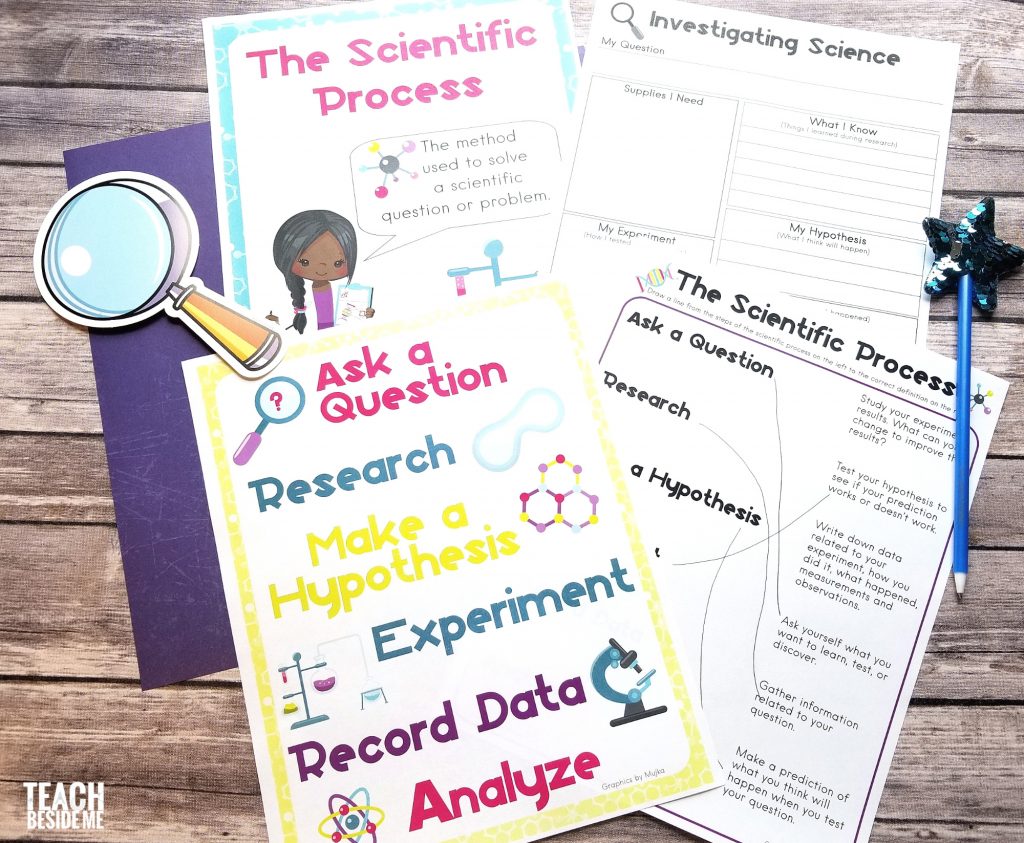
These Scientific Method Worksheets and Posters make it easy to introduce the scientific process in your classroom or homeschool. The printable set includes colorful posters explaining each step, a vocabulary matching activity, and a worksheet students can use to plan and record their own science investigations.
Whether you’re introducing the scientific method for the first time or preparing for a science fair, these resources help students put their curiosity to work!

What Is the Scientific Method?
The scientific method is a process scientists use to investigate questions, test ideas, and learn more about the world around them. It helps us move beyond guessing by gathering evidence through observation and experimentation.
For example, imagine you’re wondering whether plants grow faster in sunlight or shade. Instead of simply guessing, you could design an experiment, measure the plants’ growth, and compare the results.
The scientific method is often taught as six steps:
- Ask a question
- Do background research
- Form a hypothesis
- Conduct an experiment
- Collect and record data
- Analyze results and draw conclusions
These steps give students a helpful framework for planning an investigation. However, real science isn’t always a perfectly straight path. Scientists often repeat experiments, revise their ideas, and ask new questions based on what they discover.

The 6 Steps of the Scientific Method for Kids
1. Ask a Question
Every scientific investigation begins with curiosity! Think of something you’ve noticed or wondered about, then turn it into a question you can test.
For example: Does the amount of sunlight affect how quickly a plant grows?
A good scientific question should be specific enough that you can investigate it and collect measurable results.
2. Do Background Research
Before beginning an experiment, learn what you can about your question. Read books, explore reliable science resources, or investigate what scientists already know about the topic.
For our plant example, you might research how plants use sunlight to make food through photosynthesis.
Research helps you understand the science behind your question and make an informed prediction.
3. Form a Hypothesis
A hypothesis is a proposed explanation or prediction that can be tested with evidence.
For example: If a plant receives more sunlight, then it will grow taller over two weeks because sunlight provides energy for photosynthesis.
Your hypothesis doesn’t have to turn out to be correct! The purpose of the experiment is to gather evidence and discover what actually happens.
4. Conduct an Experiment
Now it’s time to test your hypothesis!
A good experiment changes one factor, called the independent variable, while keeping other conditions as consistent as possible.
In our plant experiment, you could grow the same type of plant under different amounts of sunlight. Keep the soil, container size, water, and growing time the same.
The amount of sunlight is the independent variable. The plant’s growth is the dependent variable because it’s what you measure.
Whenever possible, repeat your experiment to make your results more reliable.
5. Collect and Record Data
Scientists carefully observe and measure what happens during an experiment.
You might record plant height every few days, take photographs, and organize the measurements in a chart or table.
Data can include numbers, measurements, and descriptive observations. Recording results as you go makes it easier to notice patterns and compare outcomes.
6. Analyze Results and Draw Conclusions
Look closely at the information you’ve collected. What patterns do you notice? Did one group of plants grow taller than another? Were the results consistent across your trials?
Use your evidence to explain what happened and whether the results support your hypothesis.
Sometimes experiments produce unexpected results, and that’s part of the fun of science! Those discoveries often lead to even more questions worth investigating.
Printable Scientific Method Worksheets and Posters
Now that you understand the steps of the scientific method, it’s time to put them into practice! I’ve created a set of Scientific Method Worksheets and Posters to help students learn the vocabulary, understand each step, and organize their own science investigations.
The printable set includes:
- Six scientific method posters: A full-page poster explaining each step of the scientific process.
- Scientific method overview: A reference page showing all six steps together.
- Scientific method definition page: A simple explanation of what the scientific process means.
- Vocabulary matching worksheet: Students match each scientific method term with its definition.
- Science experiment worksheet: A recording page for students to work through their own scientific investigation.
These printables work well for introducing the scientific method, creating a science bulletin board, reviewing science vocabulary, or preparing students for a science fair.
Scientific Method Vocabulary Worksheet
Before students begin designing experiments, it’s helpful to make sure they understand the vocabulary.
The matching worksheet gives students practice connecting each step of the scientific method with its meaning. It’s an easy activity to use after introducing the posters or as a quick review before beginning a science investigation.
Scientific Method Experiment Worksheet
This is where students get to put their scientific thinking to work!
The experiment worksheet provides space to record a scientific question, hypothesis, background research, observations, testing procedure, results, and conclusions.
Students can use it to organize their ideas before beginning an experiment and document what they discover along the way. It’s a helpful companion for classroom science investigations, homeschool lessons, and science fair projects.
Get the Scientific Method Printables
Ready to try them with your students? You can find the complete printable set in my Teach Beside Me shop.
Get the Scientific Method Worksheets and Posters Here!


Teaching the Scientific Method with Zoey and Sassafras Books
One of my favorite ways to introduce the scientific method to kids is through the Zoey and Sassafras book series by Asia Citro. These books have been a huge favorite in our house! We’ve loved reading them together, and I love how naturally they introduce scientific thinking through imaginative stories.
If you haven’t discovered these books yet, Zoey is a curious young scientist, and Sassafras is her cat. Together, they help magical creatures who come to them with unusual problems. Each adventure combines fantasy, mystery, and real scientific ideas.
What makes the Zoey and Sassafras books especially wonderful for teaching science is the way Zoey approaches each problem. She asks questions, researches possible explanations, makes predictions, tests her ideas, and records what happens in her science journal.
And things don’t always work the first time! Zoey learns from unsuccessful experiments, adjusts her ideas, and keeps investigating. It’s a wonderful example of how science actually works.
How to Use Zoey and Sassafras to Teach the Scientific Method
These books make a fun read-aloud for elementary students, and they’re also great for independent readers who enjoy science and fantasy.
As you read, encourage students to identify the scientific method in Zoey’s investigations. You might ask:
- What problem is Zoey trying to solve?
- What questions does she ask?
- What does she predict will happen?
- How does she test her ideas?
- What observations does she record?
- What does she learn from her results?
You can even use my Scientific Method Worksheets and Posters alongside the books. Have students follow one of Zoey’s investigations and record the question, hypothesis, experiment, and conclusions on their worksheet.
It’s a fun way to connect reading and science while helping students recognize the scientific method in action.

Zoey and Sassafras Books in Order
If you’re new to the series, I recommend starting with the first book, Dragons and Marshmallows. Each story introduces a new magical creature and a scientific problem to investigate.
Here are the first nine Zoey and Sassafras books in reading order:
- Dragons and Marshmallows
- Monsters and Mold
- Merhorses and Bubbles
- Caterflies and Ice
- The Pod and the Bog
- Unicorns and Germs
- Grumpiest and Pests
- Bips and Roses
- Wishypoofs and Hiccups
Whether you’re using them for a science lesson or simply enjoying a good story together, these books are a delightful way to encourage curiosity, problem-solving, and scientific thinking.
Put the Scientific Method Into Practice!
Now that you’ve learned the steps of the scientific method, it’s time to start experimenting! The best way to understand the scientific process is to use it. Choose something you’re curious about, ask a question, make a prediction, and see what you can discover.
Need some inspiration? I’ve got plenty of science activities to get you started!
- 100+ Science Fair Project Ideas — Find testable science questions and investigation ideas covering chemistry, physics, biology, engineering, and more. These are perfect for practicing the scientific method.
- 200+ Elementary STEM Projects — Explore a huge collection of hands-on science, technology, engineering, and math activities.
- 20 Elementary STEM Science Projects — Discover creative science experiments and projects that make learning fun.
Remember, science isn’t about always getting the answer you expected. It’s about being curious, asking questions, and learning from what happens. So grab your scientific method worksheets, choose an experiment, and start investigating!