Candy DNA Model: Build a Double Helix + Free DNA Diagram
This post may contain affiliate links.
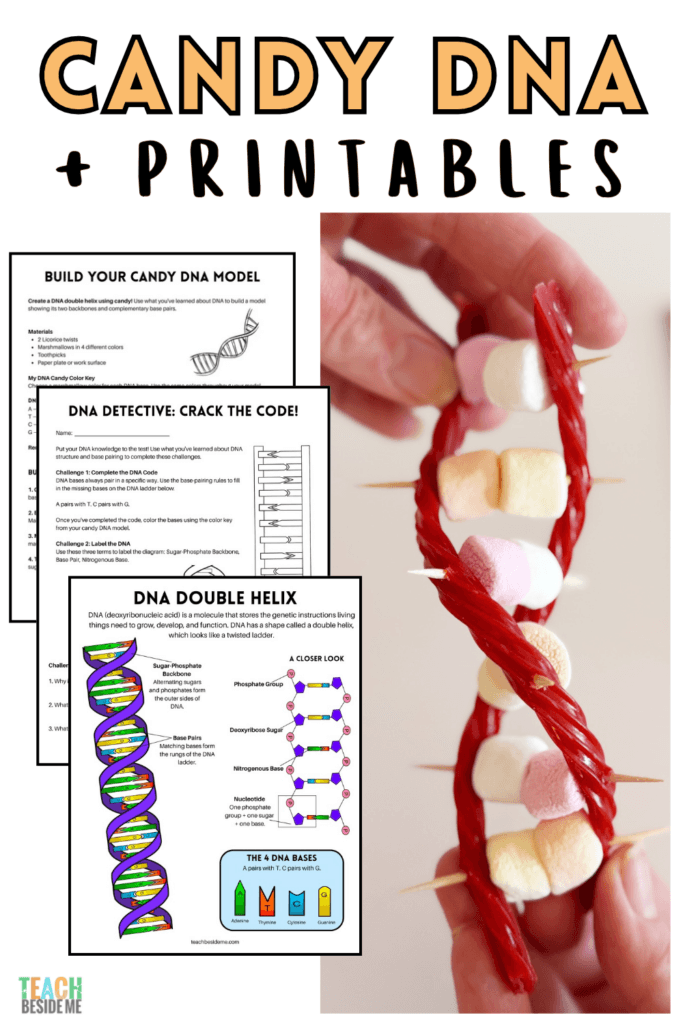
What if you could build a model of your own DNA using candy? This colorful candy DNA model is a fun, hands-on science activity that helps kids understand the structure of DNA, how its bases pair together, and why DNA has its famous twisted ladder shape.
Using licorice, marshmallows, and toothpicks, kids can build a DNA double helix while learning about the molecule that carries genetic information in living things. It’s a great way to turn an abstract science concept into something they can actually see and touch!
I’ve also created a free printable Candy DNA Model Activity Pack with a full-color DNA reference chart, step-by-step building instructions, a DNA codebreaking worksheet, and a teacher answer key.
This activity is perfect for upper elementary and middle school science lessons, genetics units, STEM activities, and DNA Day.
What Is DNA?
DNA stands for deoxyribonucleic acid. It is the molecule that stores genetic instructions in living things. These instructions help cells grow, function, and produce the proteins they need.
Most of the DNA in human cells is found in the nucleus, where it is organized into structures called chromosomes. DNA is made from long chains of smaller building blocks called nucleotides.
One of the most fascinating things about DNA is its shape. DNA has a structure called a double helix, which looks like a ladder that has been twisted into a spiral.
The two sides of the ladder are called sugar-phosphate backbones, and the rungs are formed by pairs of chemical bases. The order of these bases carries genetic information.
Building a candy DNA model helps kids visualize this structure and understand how the different parts fit together.
Understanding the Parts of DNA
Before building your model, it helps to understand the parts of a DNA molecule.
The Sugar-Phosphate Backbone
The two outer sides of the DNA ladder are called the sugar-phosphate backbones. Each backbone is made of alternating deoxyribose sugars and phosphate groups that connect the DNA building blocks together.
In our candy DNA model, the two licorice pieces represent these backbones.
Nucleotides
A nucleotide is one building block of DNA. Each nucleotide has three parts: a deoxyribose sugar, a phosphate group, and a nitrogenous base.
Thousands or millions of nucleotides join together to form long DNA strands. In human chromosomes, these strands contain millions of base pairs.
The Four Nitrogenous Bases
DNA contains four different nitrogenous bases. Each base has a name and a letter abbreviation.
- Adenine (A): One of the four bases that carry genetic information in DNA. Adenine pairs with thymine.
- Thymine (T): A DNA base that pairs with adenine.
- Cytosine (C): A DNA base that pairs with guanine.
- Guanine (G): A DNA base that pairs with cytosine.
The sequence of these four bases is what makes DNA so remarkable. Just as letters can be arranged into different words and sentences, DNA bases can be arranged in different sequences to store different genetic instructions.
In our candy model, four different colors of marshmallows represent these four bases.
DNA Base Pairs
The bases on the two DNA strands connect in specific pairs. This is called complementary base pairing.
Adenine (A) always pairs with thymine (T).
Cytosine (C) always pairs with guanine (G).
These pairs form the rungs of the DNA ladder. In real DNA, the paired bases are held together by hydrogen bonds.
Our candy model uses toothpicks to hold the base pairs together and connect them to the licorice. The toothpicks are a building tool, not an exact representation of the chemical bonds in DNA.
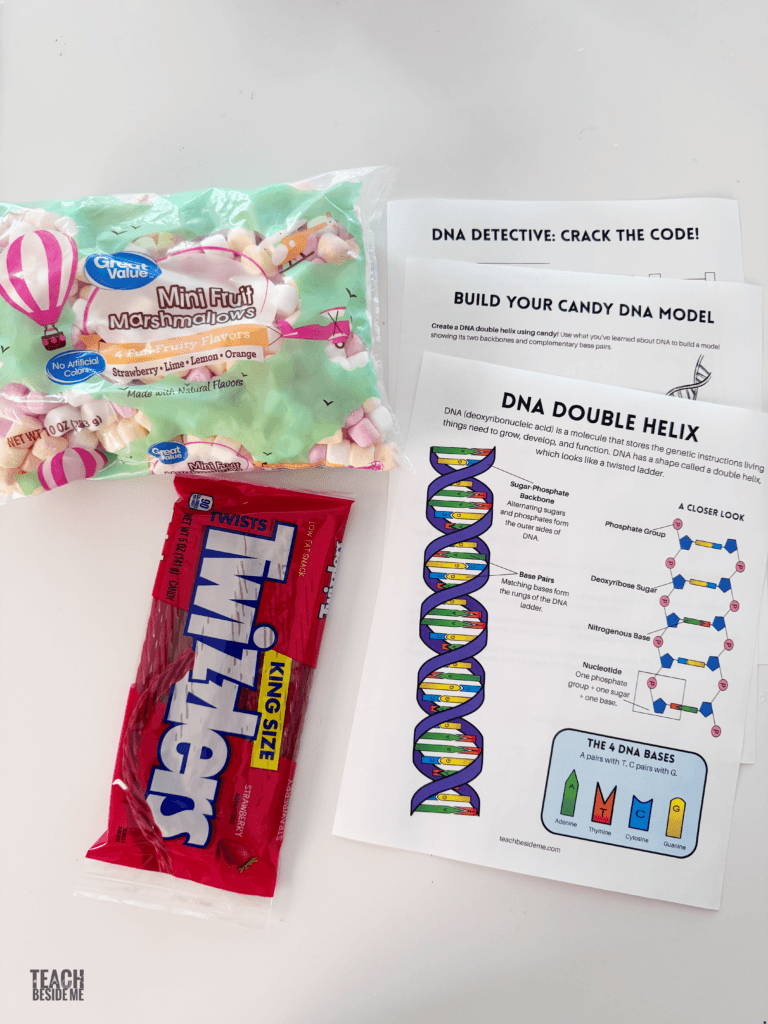
Supplies for a Candy DNA Model
You’ll need:
- 2 licorice twists for each DNA model
- Marshmallows or gumdrops in four different colors
- Toothpicks
- A clean plate, tray, or work surface
- Free printable Candy DNA Model Activity Pack (download below)
The four candy colors do not need to match the colors in the DNA illustrations. DNA bases don’t actually have these colors; scientists and illustrators use different colors to help us tell them apart.
Students will create their own color key before building their models.
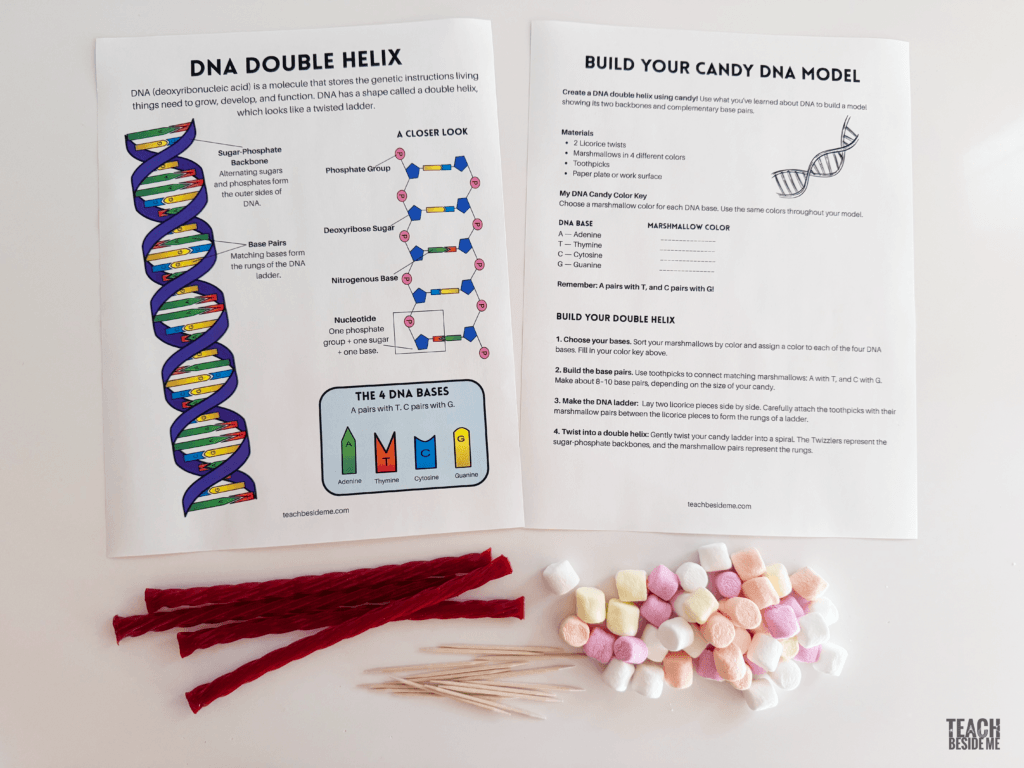
How to Make a Candy DNA Model
Step 1: Choose Your DNA Base Colors
Start by sorting your marshmallows into four different colors. Assign one color to each of the DNA bases: adenine, thymine, cytosine, and guanine.
For example, you might choose red for adenine, yellow for thymine, white for cytosine, and orange for guanine. Your colors can be completely different!
Record your choices in the color key on the printable building guide.
Remember, the colors are just a way to represent the bases. The important part is using the same color for each base throughout the model.
Step 2: Make the DNA Base Pairs
Next, make the rungs of your DNA ladder.
Place two marshmallows on a toothpick to represent a matching base pair. Remember the pairing rules: A goes with T, and C goes with G.
Make approximately 6-8 base pairs for your model, depending on the length of your licorice and the size of your candy.
You can choose your own sequence of bases or use the sequence from the printable DNA activity.
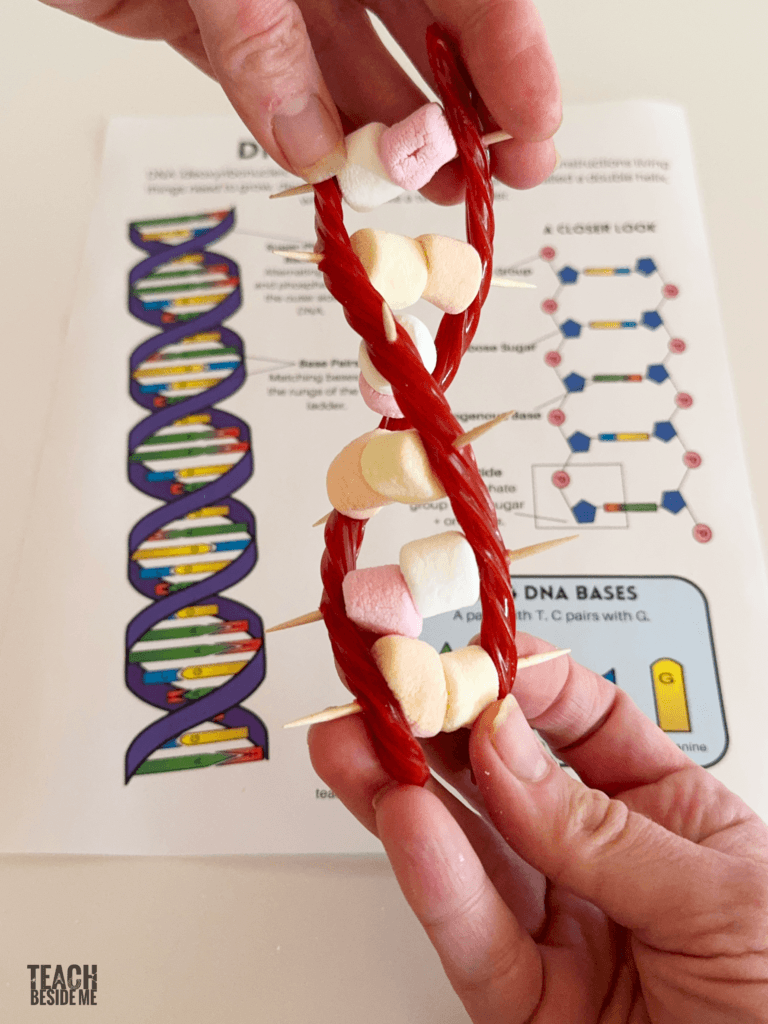
Step 3: Build Your DNA Ladder
Lay two licorice pieces parallel to each other on your work surface. These will represent the two sugar-phosphate backbones.
Carefully attach the toothpicks between the licorice, spacing your base pairs along the length of the candy.
Continue until you’ve connected all your base pairs and created a candy ladder.
Take a moment to examine the model. The licorice form the sides, and the paired marshmallows form the rungs. This is a simplified representation of how the two strands of DNA are connected.
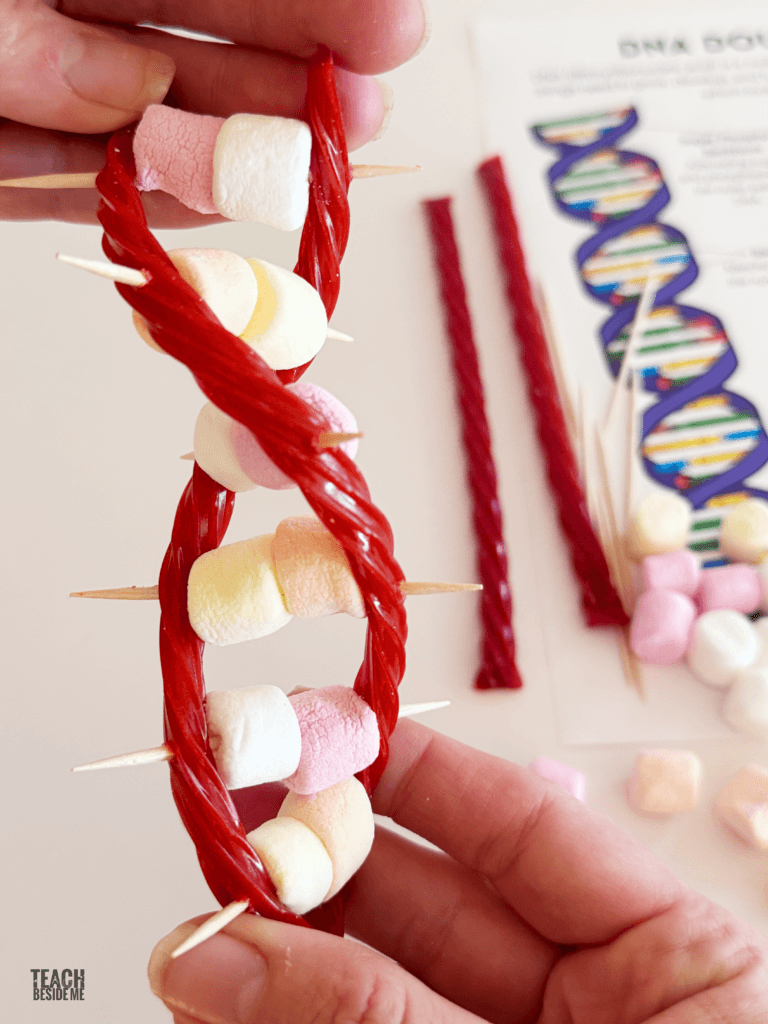
Step 4: Twist the Ladder into a Double Helix
Now for the fun part!
Carefully twist your candy ladder to create the spiral shape of a DNA double helix. The two backbones wind around each other while the base pairs remain connected between them.
Work slowly to avoid pulling the toothpicks out or breaking the candy. A shorter model may be easier to twist and hold in position.
You’ve built a model of one of the most important molecules in biology!
Watch it in action:
What Does Each Part of the Candy DNA Model Represent?
Every part of your model represents something about real DNA.
| Candy Model | DNA Structure |
|---|---|
| Two Licorice | The sugar-phosphate backbones |
| Four marshmallow colors | Adenine, thymine, cytosine, and guanine |
| Matching gumdrop pairs | Complementary DNA base pairs |
| Toothpicks | Supports holding the simplified model together |
| Twisted ladder | The DNA double helix |
Scientific models help us understand things that are too small, too large, or too complicated to observe directly. But every model has limitations.
For example, our licorice don’t show the individual sugar and phosphate groups, and our marshmallows aren’t shaped like real nitrogenous bases. Real DNA is also much smaller than our candy model!
Even with these differences, the candy model helps us visualize how two DNA strands are connected and twisted together.
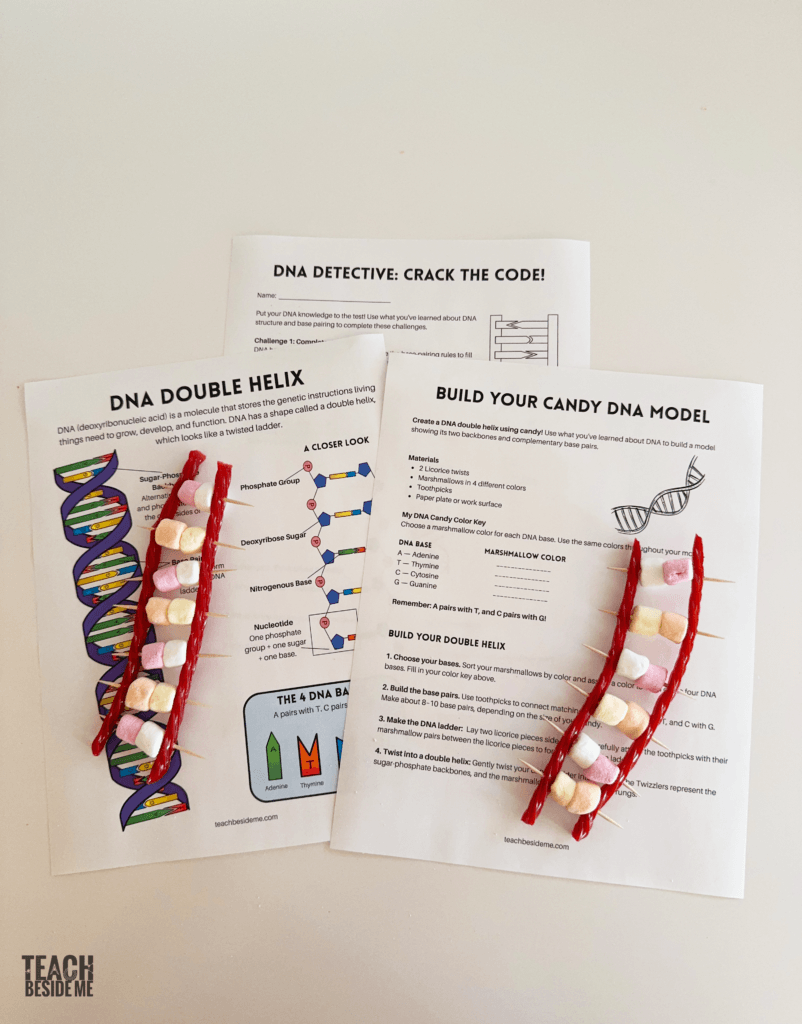
Free Labeled DNA Structure Diagram and Worksheets
To help students understand the science behind their candy DNA models, I’ve created a free printable activity pack that includes a labeled DNA structure diagram. The reference chart shows the double helix, sugar-phosphate backbone, nitrogenous bases, and nucleotides. You’ll also find step-by-step candy model instructions, a DNA base-pairing worksheet, and a teacher answer key.
The four-page PDF includes:
- Inside the Double Helix – DNA structure diagram A full-color teaching diagram showing the structure of DNA, including the sugar-phosphate backbone, nucleotides, nitrogenous bases, and complementary base pairs. Students can use this chart to understand the science before building their model.
- Build Your Candy DNA Model A printable building guide with a supply list, step-by-step instructions, and a blank candy color key so students can assign colors to the four DNA bases.
- DNA Detective – Crack the Code! A black-and-white science worksheet where students complete missing DNA base pairs, label the structure of DNA, and answer questions about what they learned.
- Teacher Answer Key
Teachers can print the reference chart in color and the student worksheet in black and white. The reference chart can also be reused for future genetics lessons.
Download the DNA Activity Pack Now!
DNA Detective: Can You Crack the Genetic Code?
After building your model, try a DNA base-pairing challenge!
Imagine that one strand of DNA contains this sequence: A – T – G – C – C – A – T – G
Can you figure out the complementary strand? Use the pairing rules to find the matching base for each letter. Remember that A pairs with T, and C pairs with G.
The answer is: T – A – C – G – G – T – A – C
This is a simple way to demonstrate that the sequence of one DNA strand determines the sequence of its complementary strand.
For an additional challenge, change one base pair in your candy model. This represents a simplified example of a DNA mutation, which is a change in the DNA sequence. Does the overall shape of the model change? What happens to the sequence of letters?
Not every DNA mutation has a noticeable effect, but changes in DNA sequences can sometimes affect how cells function.
More Ways to Explore DNA and Genetics
Once kids understand the structure of DNA, there are plenty of other ways to explore genetics.
One of my favorite extensions is extracting DNA from plant cells. With a few simple household ingredients, you can actually observe DNA-rich material collected from strawberries, onions, or other plants.
You can also explore inherited traits, learn about chromosomes, or investigate how DNA stores instructions for making proteins.
A Hands-On Way to Learn About DNA
DNA is an incredibly small molecule, but it carries the instructions that help living things grow and function. Building a candy DNA model gives kids a chance to see its structure in a way that diagrams and textbooks alone can’t provide.
As they match the bases, build the ladder, and twist it into a double helix, students discover how DNA is organized and why its structure matters.
And with the free printable reference chart and DNA Detective worksheet, this simple candy activity becomes a complete hands-on science lesson!