Free Printable Place Value Charts for Whole Numbers and Decimals
This post may contain affiliate links.
Understanding place value is one of the most important foundations of elementary math. Once kids understand that a digit’s value depends on its position in a number, they can begin working confidently with larger numbers, decimals, addition, subtraction, and more.
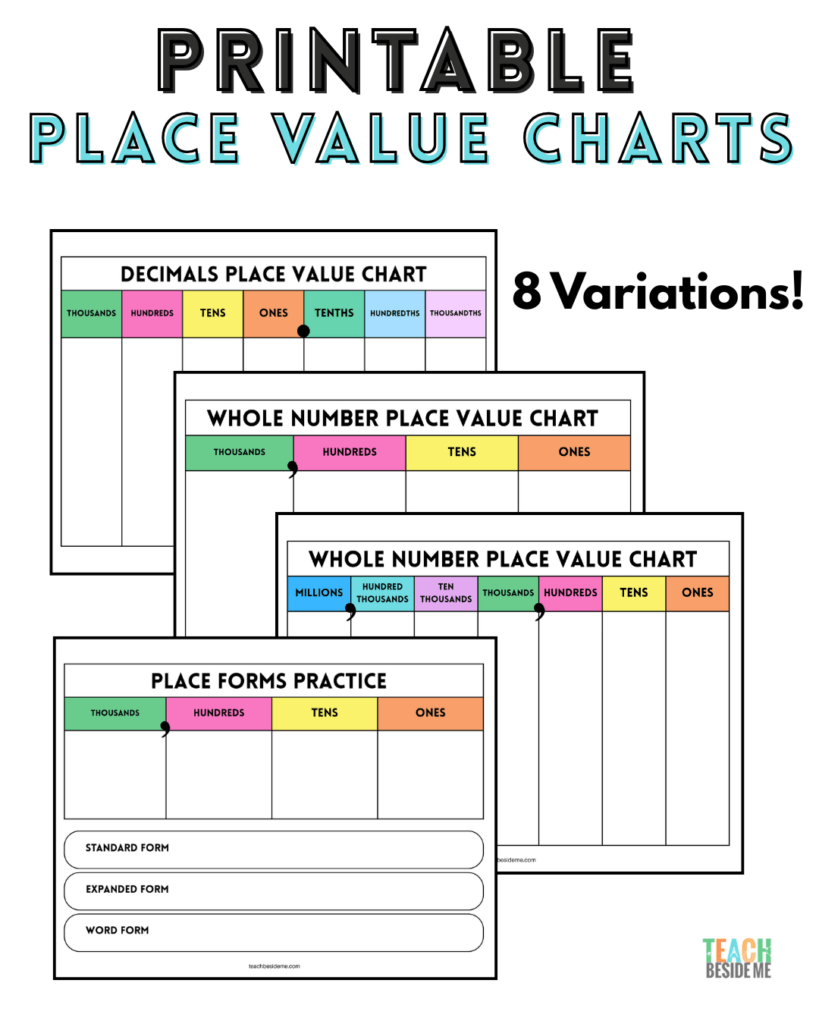
These free printable place value charts make it easy for kids to see how numbers are organized. I’ve created a collection of eight printable pages, from simple tens-and-ones charts to larger numbers and decimal place value charts.
The charts have colorful headings and plenty of blank space for students to write numbers, use manipulatives, or practice with dry-erase markers. They’re great for classroom math centers, small-group lessons, or learning at home.
Free Printable Place Value Charts
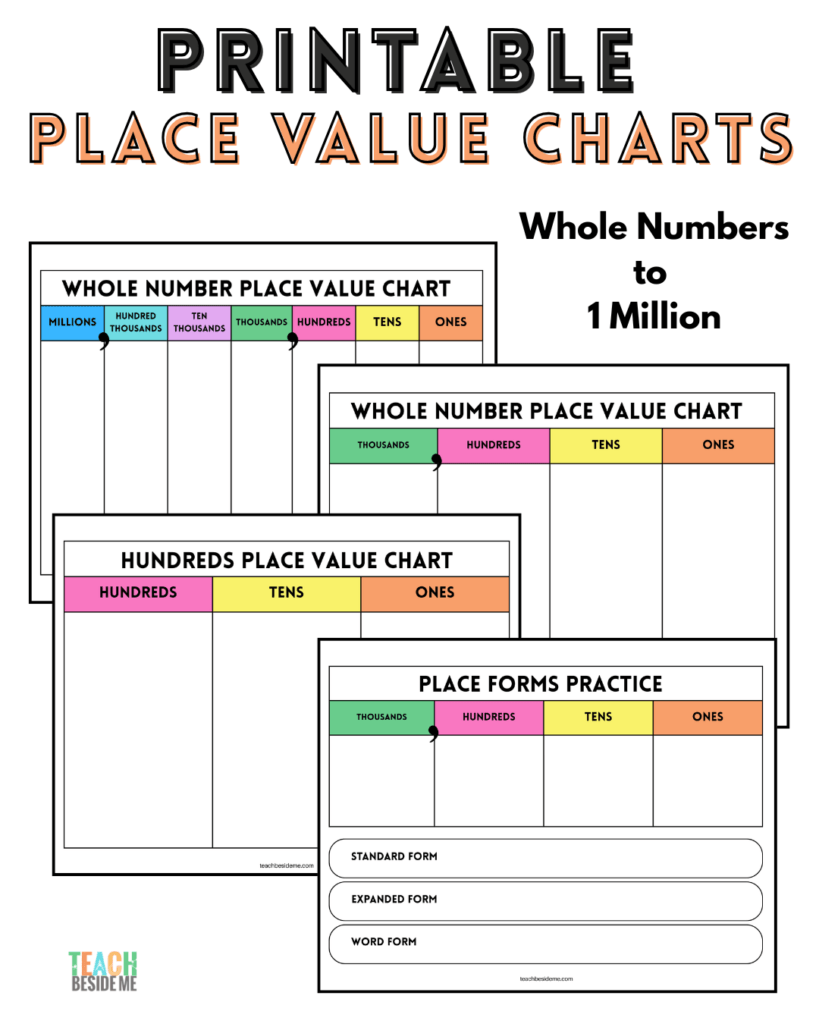
This free printable pack includes eight pages designed for different levels of place value learning.
You’ll find charts for:
- Tens and ones: A simple starting point for learning two-digit numbers.
- Hundreds, tens, and ones: Practice identifying the value of each digit in three-digit numbers.
- Thousands through ones: Build and explore four-digit numbers.
- Millions through ones: Work with larger whole numbers and see how commas separate place value periods.
- Decimal place value: Practice identifying whole-number and decimal places, including tenths, hundredths, and thousandths.
- Place value and number forms: Practice writing numbers in standard, expanded, and word form.
The different charts make it easy to choose the version that matches what your students are learning.
You can print the pages as needed or laminate them for repeated use throughout the school year.
Download Your Free Place Value Charts
Get the complete eight-page printable pack using the form below. Print the charts you need and save the others for future math lessons.
What Is Place Value?
Place value tells us how much a digit is worth based on where it appears in a number.
For example, look at the number 4,826.
- The 4 is in the thousands place, so its value is 4,000.
- The 8 is in the hundreds place, so its value is 800.
- The 2 is in the tens place, so its value is 20.
- The 6 is in the ones place, so its value is 6.
Even though each digit is written as a single number, its position determines its value.
Each place to the left is worth ten times as much as the place immediately to its right.
A place value chart helps students visualize these relationships by organizing digits into labeled columns.
How to Use a Place Value Chart
Using a place value chart is simple!
Start by choosing a chart that matches the numbers your students are learning. For beginners, use the tens-and-ones chart. As students progress, introduce hundreds, thousands, and larger numbers.
Write a number on a piece of paper or say it aloud. Have students place each digit into the correct column.
For example, to represent 352, students write:
- 3 in the hundreds column
- 5 in the tens column
- 2 in the ones column
Then ask questions such as:
- What is the value of the 5?
- How many hundreds are in this number?
- What happens if we change the digit in the tens place?
- Can you build a larger number using the same digits?
These simple questions help children move beyond memorizing place names and begin understanding how numbers work.
Using Base-Ten Blocks
For younger students, try pairing the charts with base-ten blocks.
Use single cubes to represent ones, rods to represent tens, flats to represent hundreds, and larger blocks to represent thousands.
Have students build a number using the blocks and place them in the correct columns.
This is especially helpful for visual and hands-on learners because they can see the difference between ten ones and one ten.
Decimal Place Value Charts
Place value doesn’t stop at whole numbers! The same system continues to the right of the decimal point.
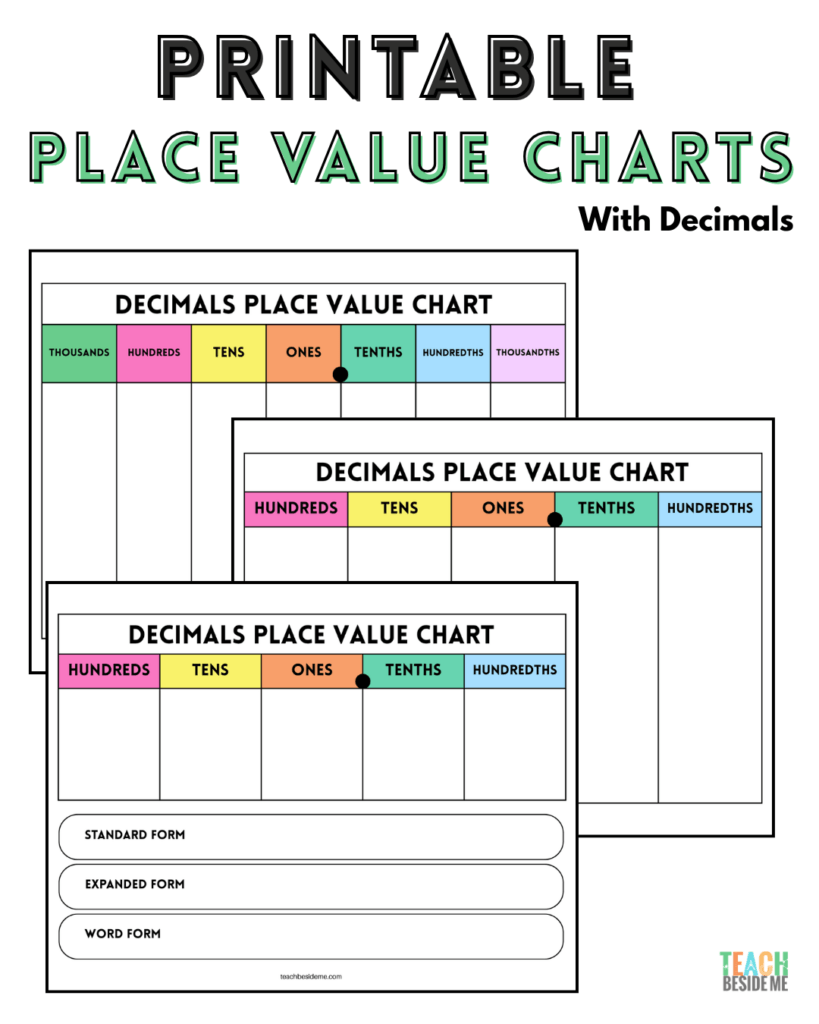
Our printable collection includes decimal place value charts to help students understand tenths, hundredths, and thousandths.
For example, consider the number 23.456.
- 2 represents 2 tens, or 20.
- 3 represents 3 ones.
- 4 represents 4 tenths, or 0.4.
- 5 represents 5 hundredths, or 0.05.
- 6 represents 6 thousandths, or 0.006.
The decimal point separates the whole-number places from the fractional places.
As you move to the right, each place is worth one-tenth as much as the place immediately to its left.
Students can use the blank decimal charts to practice writing numbers, identifying digit values, and comparing decimals.
Standard Form, Expanded Form, and Word Form
The printable collection also includes place value practice mats for working with different number forms.
These are useful for helping students connect the digits in a number with their actual values.
Standard Form
Standard form is the usual way we write numbers using digits.
Example: 4,826
Expanded Form
Expanded form shows the value of each digit as an addition expression.
Example: 4,000 + 800 + 20 + 6
Word Form
Word form writes the number using words.
Example: Four thousand eight hundred twenty-six
Students can build a number on the place value chart and then write it in each form.
You can also reverse the activity! Give students a number in expanded form and challenge them to write it in standard form.
Fun Ways to Practice With Place Value Charts
These printable charts are useful for much more than simply writing numbers. Here are a few easy ways to turn them into hands-on math activities.
1. Roll and Build a Number
Give students dice and a place value chart. Roll one die for each column and write the digits in the chart. Then read the number aloud and identify the value of each digit.
For an extra challenge, have students rearrange the digits to create the greatest or smallest possible number.
2. Mystery Number
Give students clues about a number and have them fill in the chart.
For example:
- My number has 4 hundreds.
- It has 2 tens.
- It has 7 ones.
What is my number?
Students can also write their own mystery number clues for a partner to solve.
3. Build Numbers With Place Value Cards
Use number cards to build different numbers on the charts. Challenge students to change one digit and explain how the number’s value changes.
You can also ask them to create a number with a specific digit in a specific place.
4. Ten Times Greater
Write a digit in the ones column. Then move it one place to the left. What happens to its value?
Repeat with the tens, hundreds, and thousands columns. This helps students discover how our base-ten number system works.
5. Place Value Trading Game
Use base-ten blocks to practice trading ten ones for one ten, ten tens for one hundred, and so on. Students can roll dice, collect blocks, and make trades as they build larger numbers.
This is a fun way to reinforce place value while preparing students for regrouping in addition and subtraction.
More Place Value Activities and Printables
Looking for more hands-on ways to teach place value?
I also have place value cards and a place value flip chart that pair nicely with these free printable charts.
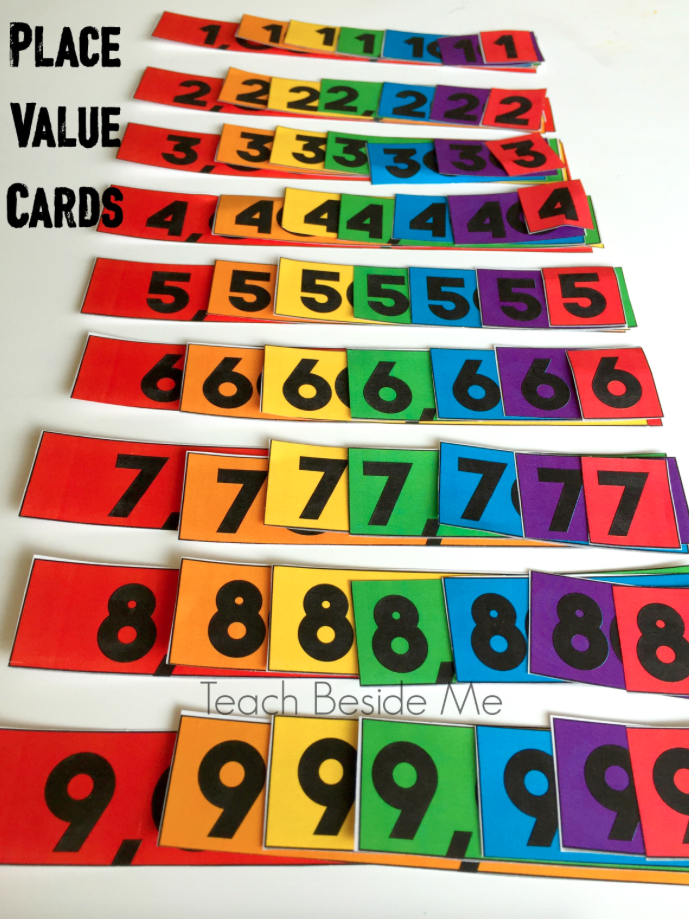
Place Value Cards: Use these cards to build numbers, practice identifying digit values, and explore how numbers are composed.
Place Value Flip Chart: A hands-on tool for building numbers and exploring place value relationships.
You might also enjoy my free Addition Charts and Worksheets and Hundred Chart Learning Activities.