Spool Racers: Make a Homemade Wind-Up Toy
This post may contain affiliate links.
Have you ever made a toy that moves using nothing but a rubber band? These spool racers are one of my favorite homemade toys to make with kids! They’re simple to build, fun to race, and a great hands-on way to learn about potential and kinetic energy.
We have made spool racers many times over the years. Kids love winding them up and watching them race across the floor—and once they understand how they work, there are all kinds of experiments they can try.
Make several and turn it into a race, or use your spool racer for a simple STEM challenge!
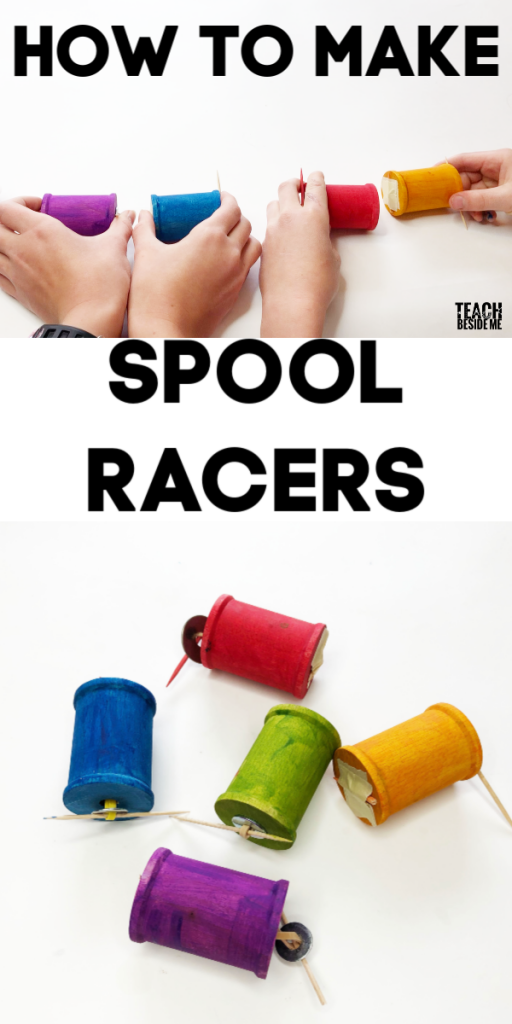
What Is a Spool Racer?
A spool racer is a simple homemade wind-up toy made from a wooden thread spool and a rubber band. Twisting the rubber band stores energy. When you release the racer, the rubber band unwinds and causes the spool to turn.
It looks incredibly simple, but there is quite a bit of science happening inside this little toy!
For even more fun, make several spool racers and see which design travels the fastest or farthest.
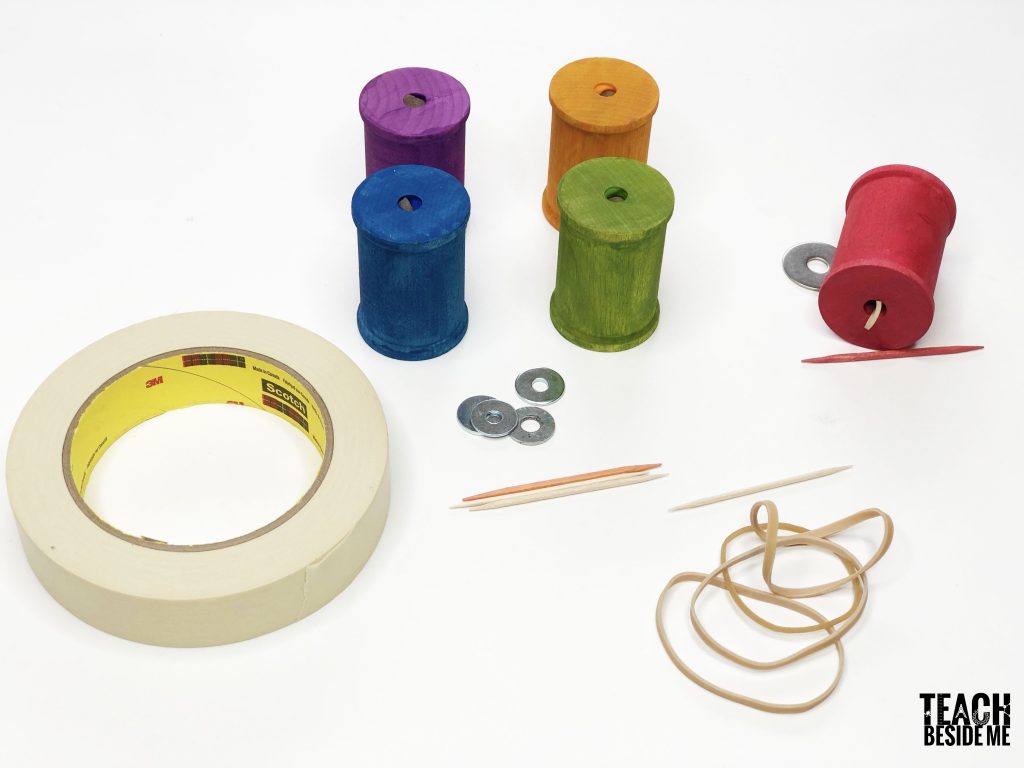
Supplies for a Spool Racer:
Wooden Thread Spool~ we painted ours just for fun. You can get these on Amazon, or save your old thread spools!
Rubber bands
Toothpicks
Masking tape
Metal washers
We painted our wooden spools just for fun. You can buy unfinished wooden spools or reuse old thread spools if you have them.
Tip: Spools, rubber bands, and washers come in different sizes. That’s actually perfect for this project because you can experiment with different combinations once you’ve built your first racer.

How to Make a Spool Racer
Start by threading a rubber band through the center hole of the spool.
This can be a little tricky! I like to use a toothpick to grab the rubber band loop and pull it through the hole. Don’t pull the rubber band all the way through—you need a loop extending from both ends of the spool.
Break a toothpick in half or into thirds, depending on the size of your spool. Slide one piece of toothpick through the rubber band loop on one end. This keeps the rubber band from pulling back through the spool.
Secure the toothpick against the end of the spool with a small piece of masking tape.
On the other end of the spool, thread the rubber band through a metal washer. Then slide another piece of toothpick through the rubber band loop.
Your spool racer is ready to wind!
How to Make Your Spool Racer Go
Hold the spool and turn the loose toothpick to twist the rubber band inside.
Keep winding until the rubber band is tightly twisted, but don’t wind so far that you break it.
Set the spool racer on a flat surface and let it go.
As the rubber band unwinds, the spool will rotate and your little racer will travel across the floor or table!
The direction you wind the rubber band determines which direction the spool travels. If your racer heads the wrong way, simply wind it in the opposite direction and try again.

How Does a Spool Racer Work?
A spool racer is a great way to demonstrate the difference between potential energy and kinetic energy.
When you twist the rubber band, you are doing work on it and storing energy. This stored energy is called elastic potential energy.
The tightly twisted rubber band wants to return to its original shape. When you release the racer, the rubber band begins to unwind and that stored energy is transferred into motion.
Energy of motion is called kinetic energy.
So you can watch an energy transformation happen right in front of you:
Elastic Potential Energy → Kinetic Energy
The more you wind the rubber band, the more elastic potential energy you can generally store—up to the limits of the rubber band. When you release it, some of that stored energy is transferred into the movement of the spool racer.
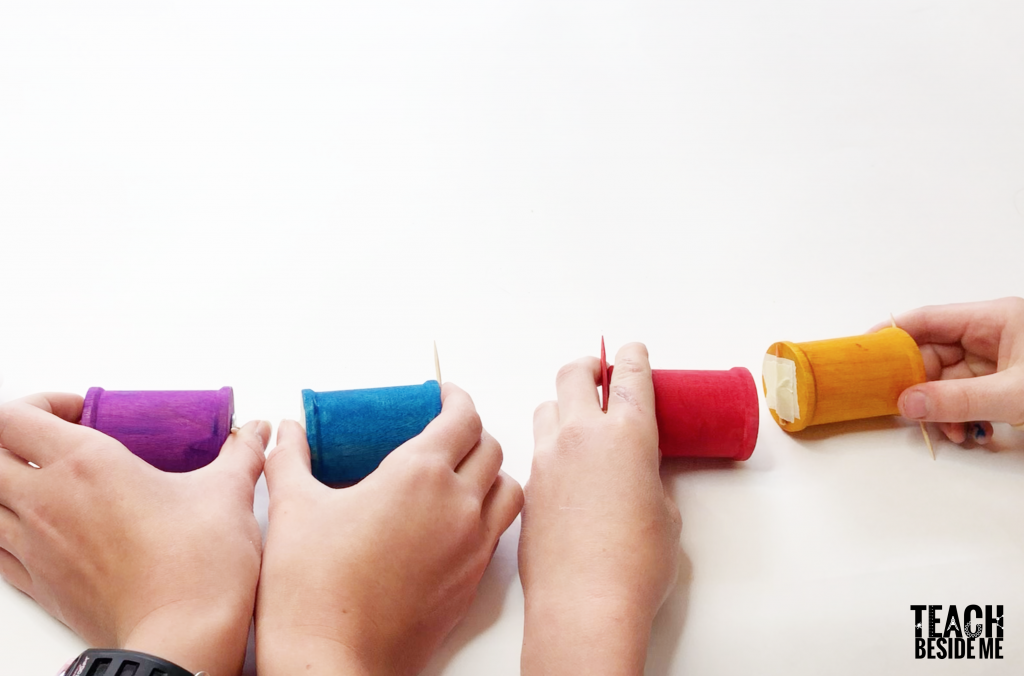
What Does Friction Have to Do With It?
There’s another force at work in your spool racer: friction.
As the spool rotates, friction between the spool and the surface gives it traction. If there isn’t enough friction, the spool may spin or slip instead of traveling forward effectively.
This gives you another easy experiment to try.
Test your spool racer on several different surfaces:
- Hardwood or tile
- Carpet
- Cardboard
- A tabletop
- Concrete or another rough surface
Does it travel the same distance on every surface? Is it faster on some surfaces than others?
Have kids predict which surface will work best before testing the racer. Then compare the results.
Turn It Into a Spool Racer STEM Challenge
Once kids have successfully built a basic spool racer, don’t stop there!
Challenge them to redesign it and see if they can make it faster, travel farther, or move in a straighter line.
Try changing one part of the design at a time:
- Use different sizes of wooden spools.
- Try thicker and thinner rubber bands.
- Change the number of times you wind the rubber band.
- Replace the toothpick with a pencil or another material.
- Test different sizes of washers.
- Race the spool on different surfaces.
- Try sending it up a small ramp.
- See which design travels the farthest.
- See which racer reaches a finish line fastest.
For a fair experiment, remind kids to change only one variable at a time. If you change the spool, rubber band, and racing surface all at once, you won’t know which change affected the results.
This is a simple way to introduce the engineering design process: build, test, observe, change the design, and test again.
Try a Spool Racer Energy Experiment
Here’s an especially easy experiment to do with your racer.
Does winding the rubber band more times make the spool travel farther?
Choose a starting point and test the same racer several times.
| Test | Number of Winds | Distance Traveled |
|---|---|---|
| 1 | 10 | _____ |
| 2 | 20 | _____ |
| 3 | 30 | _____ |
| 4 | 40 | _____ |
Measure the distance after each trial and compare your results.
Ask kids:
What pattern do you notice?
Did more winds always make the racer travel farther?
What variables did you keep the same?
What could have affected your results?
For another experiment, keep the number of winds the same and change the surface instead.
This takes a five-minute homemade toy and turns it into a complete hands-on lesson about energy, motion, friction, variables, measurement, and engineering.
Why Isn’t My Spool Racer Working?
If your spool racer doesn’t take off immediately, don’t give up! Troubleshooting is part of engineering, too.
The spool spins but doesn’t travel very far.
Try a different surface. Your racer may need more traction between the spool and the ground.
The racer barely moves.
Try winding the rubber band more times. You can also experiment with a different rubber band or check that nothing is preventing the spool from rotating freely.
The rubber band isn’t unwinding properly.
Check that it isn’t caught or tangled inside the spool. Make sure the toothpick and washer are positioned correctly.
The racer goes the wrong direction.
That’s an easy fix! Wind the rubber band in the opposite direction.
The rubber band keeps breaking.
You may be winding it too tightly. Try fewer turns or a different size rubber band.
Don’t be afraid to experiment with your design. Figuring out why something didn’t work—and changing the design to fix it—is an important part of STEM learning.
More Homemade STEM Toys for Kids
If your kids enjoyed building a spool racer, try another toy that lets them experiment with forces, motion, and energy:
Try Penny Spinners Next: Make colorful spinning tops with pennies and experiment to see which designs spin the longest.
Shooting Star Spinner
Gravity Spinner Rocket
Homemade Catapult
Bubble Shooter
Cardboard Tube Rocket Blaster
These simple homemade toys are a fun reminder that kids don’t need complicated materials to explore science and engineering.




What size washers did you use?