Gingerbread House Geometry: Edible STEM
This post may contain affiliate links.
Building and decorating gingerbread houses is one of our favorite Christmas traditions. This year we added a fun educational twist by turning it into a Gingerbread House Geometry activity! It’s the perfect Christmas STEM project, combining engineering, math, problem-solving, and of course… a sweet treat at the end.
Kids get hands-on practice measuring, calculating area, finding perimeter, and even determining the volume of their gingerbread structure. It’s festive, creative, and wonderfully educational.
Materials You’ll Need for Gingerbread House Geometry
-
Graham crackers (easy to cut + consistent in size)
-
Royal icing (the “glue” – recipe in my homemade gingerbread post)
-
Ruler or measuring tape
-
Knife for trimming cracker pieces
-
Optional: store-bought gingerbread house kits or homemade gingerbread
How to Do the Gingerbread Geometry Activity
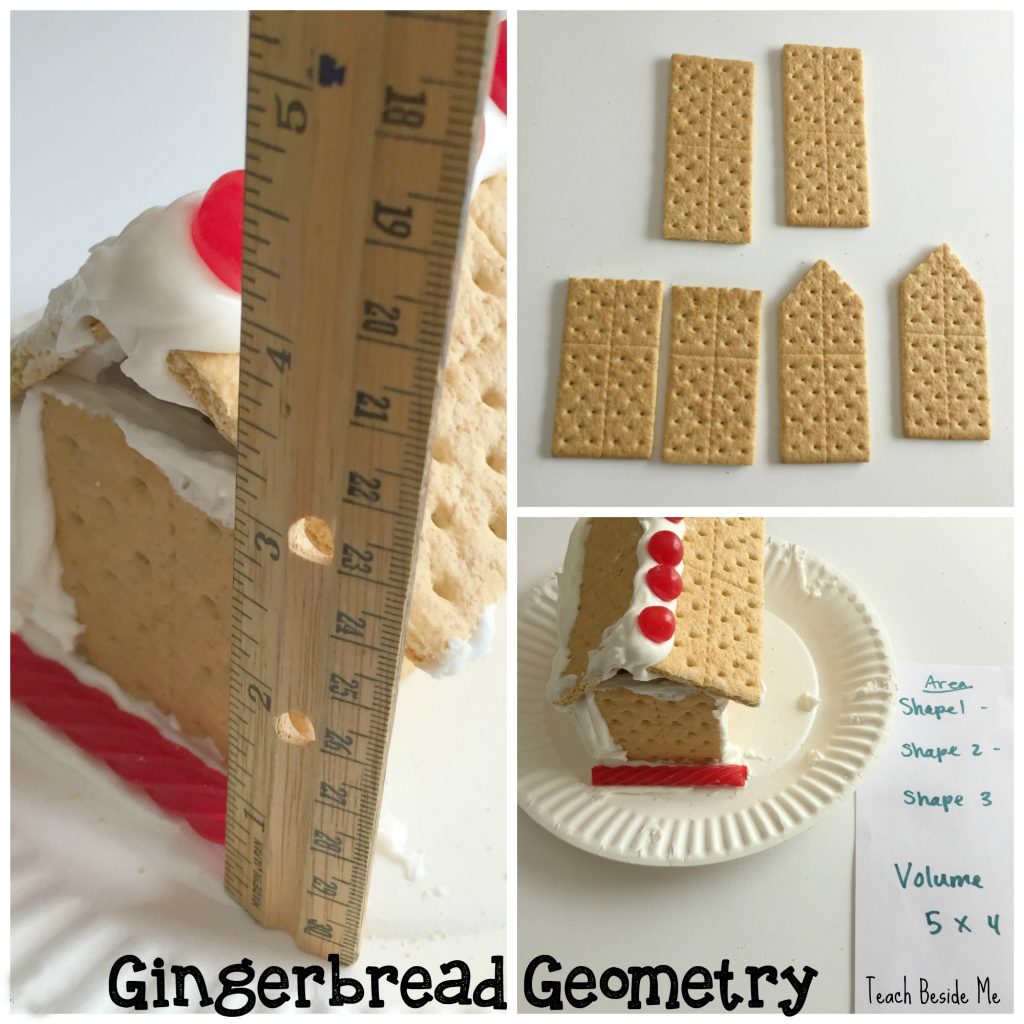
We used six graham crackers for our house. You can absolutely do this with a traditional gingerbread house too, but graham crackers make the measuring portion very easy for kids.

Step 1: Prepare Your Gingerbread House Pieces
Begin by cutting and shaping your graham crackers:
-
Cut 1 inch off the top of two crackers to make shorter sides.
-
We originally cut a peaked roof shape, but after a few structural mishaps (ha!), we switched to simple rectangles — which also made the math much more straightforward for kids.
Feel free to adapt the shapes based on your students’ ages or your lesson goals.

Step 2: Measure the Area of Each Wall
Before assembling the house, have kids measure each cracker:
-
Measure height
-
Measure width
-
Multiply:
Area = height × width
Record the areas for:
-
Front wall
-
Back wall
-
Two side walls
-
Roof pieces
This gives kids real-life practice applying area to actual objects, not just worksheet shapes.

Step 3: Calculate Perimeter
Next, measure the perimeter of each cracker by adding all side lengths:
Perimeter = side + side + side + side
This is a fantastic way to reinforce:
-
Units of measurement
-
The difference between area vs. perimeter
-
How perimeter relates to building and stability
Finally we found the volume of the entire house by multiplying length, width and height.

Step 4: Assemble the Gingerbread House
Use royal icing to “glue” everything together. Let kids problem-solve through:
-
Balancing walls
-
Angle alignment
-
Structural stability
-
How icing behaves as an adhesive
This is pure engineering in action!
Step 5: Determine the Volume
Once the house is constructed, measure:
-
Length
-
Width
-
Height
Then calculate: Volume = length × width × height
You can decide whether to use exterior or interior measurements depending on the age group — both approaches teach valuable skills.
Why This Works as a STEM Activity
This edible project blends:
-
Science: stability, structure, materials
-
Technology: real-world measuring tools
-
Engineering: building a structure that stands
-
Math: area, perimeter, and volume
Kids love that it feels like a holiday craft, but they’re learning solid geometry concepts the whole time.
A Fun Educational Twist on a Holiday Classic
We had so much fun adding geometry to our gingerbread house building this year. It kept kids engaged, made the project last longer, and turned a festive hands-on activity into real applied math.
Plus, edible STEM projects are the best kind of projects.
Love Edible Learning? Try These Next!
We have a huge collection of food-based learning ideas:
➡ Over 100 Edible Education Activities
Looking for more holiday math ideas?
Check out: Christmas Tree Fractions, Pascal’s Triangle Christmas Tree, Snowman Fractions, & Save the Snowman, too!
How about a little more Christmas STEAM ideas? Check out our STEAM Kids Christmas book!