Best Spanish Teaching and Learning Resources for Kids
This post may contain affiliate links.
Looking for fun and effective Spanish teaching resources for kids? Whether you are homeschooling, teaching in a classroom, or simply trying to introduce a second language at home, there are so many wonderful ways to help children learn Spanish naturally through games, music, stories, videos, and conversation.
We have been learning Spanish in our homeschool for several years now using a variety of programs, websites, books, videos, and printable resources. Over time, I have researched and tested many different Spanish learning tools for kids and found some favorites that make language learning much more engaging and approachable.
One of the biggest lessons I have learned is this:
children learn languages best through consistent exposure and enjoyable experiences.
You do not have to be fluent to begin teaching Spanish to your kids.
Even small daily habits can make a huge difference over time.

Why Learn Spanish with Kids?
Spanish is one of the most useful and widely spoken languages in the world, making it an excellent choice for children to begin learning.
Learning Spanish can help kids:
- strengthen communication skills
- improve listening abilities
- build confidence
- increase cultural awareness
- improve memory and comprehension
- develop stronger language-learning skills overall
Young learners are especially good at picking up pronunciation and vocabulary naturally through songs, repetition, stories, and conversation.
Tips for Teaching Kids Spanish at Home
One of the best ways to teach Spanish is to make it part of everyday life rather than treating it like a difficult school subject.
Here are a few things that have worked well in our homeschool:
- listening to Spanish music
- watching Spanish videos
- labeling household objects
- practicing simple phrases daily
- reading bilingual books
- using printable vocabulary games
- learning through stories and songs
- practicing conversational Spanish naturally
Consistency matters much more than perfection.
Even just a few minutes each day can help children gradually build vocabulary and confidence.
Free Spanish Teaching Resources for Kids
There are so many wonderful free Spanish teaching resources available online.
These are some of our favorite free websites and programs for learning Spanish with kids.
Free Spanish Learning Websites
Salsa Spanish
Salsa is a free children’s Spanish TV series that teaches conversational Spanish through stories and repetition.
The episodes are entirely in Spanish, but each episode also includes a printable PDF transcript with translations and activities.
This is a fantastic immersion-style resource for younger learners.
Mi Vida Loca
Mi Vida Loca is a free online Spanish video series designed more for older kids and teens.
The lessons follow a mystery storyline while teaching conversational Spanish in context.
The site also includes:
- printable activities
- teacher guides
- lesson plans
- learning activities
Rockalingua
Rockalingua combines Spanish songs, videos, worksheets, and games for kids.
While there is a subscription option, they also offer many free Spanish learning resources and videos online.
Music-based learning is incredibly effective for helping kids remember vocabulary and pronunciation.
123 Teach Me
This free website includes:
- Spanish games
- worksheets
- flashcards
- quizzes
- printable resources
It is especially useful for beginner vocabulary practice.
OnlineFreeSpanish
A large collection of free printable Spanish activities and lessons for kids.
Spanish Playground
Spanish Playground is one of my favorite Spanish teaching blogs because it focuses on helping kids learn through:
- songs
- stories
- games
- movement
- cultural learning
They have many wonderful free resources for elementary learners.
StudySpanish.com
This website includes both free and paid Spanish lessons and grammar resources. It works especially well for older learners and parents learning alongside their children.
Spanish 411
Spanish 411 includes:
- printable lessons
- grammar explanations
- vocabulary help
- online dictionary resources
Spanish Videos and YouTube Channels for Kids
Videos and songs are one of the easiest ways to introduce Spanish naturally.
Some fun Spanish learning videos for kids include:
- Basho & Friends
- El Perro y El Gato
- Body Parts in Spanish Songs
- Days of the Week Songs
- Favorite cartoons in Spanish (such as Peppa the Pig!)
Once you begin exploring Spanish videos on YouTube, many other helpful channels and songs begin appearing as recommendations.
Printable Spanish Learning Activities
Hands-on activities make Spanish much more memorable for kids.
One of our favorite ways to practice vocabulary is through games and matching activities.
You can grab my: FREE 3-Part Spanish Vocabulary Puzzles
These printable Spanish puzzles help kids practice vocabulary through matching and visual learning.
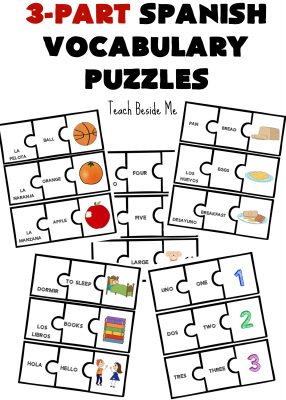
Printable games, flashcards, puzzles, and matching activities are excellent for:
- visual learners
- younger children
- independent practice
- homeschool learning centers
Spanish Curriculum for Homeschoolers
If you want a more structured approach, there are many excellent Spanish curriculum options available for homeschool families.
We have personally used several of these over the years and enjoyed different aspects of each one depending on the ages and learning styles of my kids.
Foreign Language for Kids
This program uses videos, stories, and engaging lessons to introduce conversational Spanish in a very natural way.
Song School Spanish
This gentle curriculum teaches Spanish through songs, chants, and simple vocabulary lessons.
It is especially great for younger elementary students.
Spanish for You
Spanish for You combines conversational phrases, grammar, vocabulary, and cultural learning in a homeschool-friendly format.
Homeschool Spanish Academy
This program offers online Spanish classes with native-speaking teachers.
It is a wonderful option for families who want more conversational speaking practice.
Whistlefritz
Whistlefritz uses music, movement, and immersion-style learning to teach Spanish naturally through videos and songs.
Younger kids especially enjoy this style of learning.
Mango Languages
Many libraries offer Mango Languages for free through their digital resources. It works similarly to Rosetta Stone and focuses heavily on conversational language learning.
Definitely check whether your local library includes free access.
Rosetta Stone
Rosetta Stone is one of the best-known language learning programs and uses immersive language instruction without relying heavily on translation.
Little Pim Spanish
Little Pim is designed specifically for younger children and introduces Spanish vocabulary through short videos and repetition.
It works especially well for preschoolers.
iTalki
iTalki connects students with language tutors for conversational practice. This can be a fantastic option for older students wanting more speaking confidence.
Pimsleur Spanish
Pimsleur focuses heavily on conversational listening and speaking skills through audio lessons.
Older children and teens may especially benefit from this style of learning.
52 Weeks of Family Spanish
This is one of our favorite family-style Spanish learning resources because it encourages natural language learning together as a family.
We still regularly pull this one out for practice.
Spanish for You
Spanish for You is a homeschool-friendly Spanish curriculum that combines conversational Spanish, vocabulary, grammar, songs, games, and cultural learning in a gentle and approachable way for families. I especially appreciate how flexible and engaging the lessons are for elementary students and mixed-age homeschool settings. You can read my full review here.
TalkBox.Mom
TalkBox.Mom is a family-centered Spanish learning program that focuses on helping parents and kids begin speaking Spanish naturally during everyday routines. Instead of relying heavily on worksheets or memorization, the program teaches practical conversational phrases that families can use throughout the day, making language learning feel much more natural and interactive. It is especially helpful for beginners who want to build speaking confidence together as a family.
Sonrisas Spanish
Sonrisas is a full elementary Spanish curriculum often used in schools and homeschool settings.
Flip Flop Spanish
Flip Flop Spanish is a fun Spanish curriculum for kids that combines printable lessons, audio, songs, stories, games, and hands-on activities to make learning Spanish engaging and approachable. The program is designed especially for homeschool families and elementary learners, with a gentle pace that helps kids build vocabulary and conversational confidence in a playful way.
Talkpal
Talkpal is an AI-powered language learning app that helps learners practice conversational Spanish through interactive speaking activities and real-time feedback. It is especially helpful for older students and parents who want more speaking practice and conversational confidence in a flexible, low-pressure format.
Preply
Preply connects students with live online Spanish tutors for one-on-one lessons and conversational practice. This can be a wonderful option for older kids, teens, or parents wanting personalized instruction and regular speaking practice with native speakers.
Coursera
Coursera offers online Spanish courses from universities and educational institutions around the world. While many courses are geared more toward older students and adults, motivated teens and parents learning alongside their children may enjoy the structured lessons and cultural learning opportunities available there.
How to Keep Kids Interested in Learning Spanish
One of the most important parts of language learning is keeping it enjoyable.
Kids are much more likely to stick with Spanish if learning feels:
- interactive
- playful
- low-pressure
- meaningful
Try:
- Spanish music during breakfast
- labeling household items
- themed vocabulary games
- Spanish storybooks
- short daily practice sessions
- watching favorite shows in Spanish
- celebrating small progress
Language learning is a long-term process, and consistency matters much more than speed.
Our Favorite Spanish Learning Approach
Over the years, we have found that combining multiple types of Spanish teaching resources works best.
We enjoy using:
- videos
- songs
- printable games
- curriculum
- conversational practice
- books
- online learning tools
This keeps language learning fresh and engaging while helping different types of learners succeed.
Most importantly, we try to make Spanish feel like a natural part of our homeschool life rather than just another school subject.





Great list. will pin to my Spanish Board. I liked an app called Gus on the Go, designed for young kids; and Mindsnack has a Spanish app for older kids.
These are some great homeschooling resources to help our children learn Spanish. I will have to pin this post to look at again next year for my kids. Thank you for linking up this week to the Thoughtful Spot Weekly Blog Hop 🙂
I am always looking for some great Spanish homeschooling resources! Thank you so much for sharing. Thanks for linking up with the Thoughtful Spot Weekly Blog Hop, you were featured as one of my favorites last week 🙂
What a great list! I’ve been thinking about teaching my kids Spanish and it looks like this is the place to start! Featuring on this coming Thursday’s Hearts for Home blog hop. Thanks!
I just ran across this today. Thank you so much for linking to my Teaching and Learning Spanish blog. Since I’m also a homeschooling mom, I don’t have as much time to devote to it as I would like, but it is something I truly love to do – share resources with homeschool and classroom teachers.
This is awesome! Gracias!
Thanks for the post! We particularly like whistlefritz. 🙂
I have some videos (songs) that maybe useful to for teaching Spanish. http://youtube.com/user/mindymarissa. I have videos for teaching:
farm animals
Numbers
vowels
Months of the year
Colors
A birthday song
I have videos that I will soon upload to teach
Up and down
Days of the week
A song about bunnies
🙂
I really hope that somebody will find them helpful. Thanks!
Mindy
I am looking for a program I can use at home to teach my 10 year old daughter how to write Spanish. She is a fluent speaker and also can read it. I am not a teacher, but I am fluent in Spanish and want to invest the time in teaching her, but with so many programs, I don’t know which one would be best for my needs. Has anyone run into this? and what did you guys use? I don’t mind paying for a good program that I can use for a while.
thanks!
Great share you have here. Thanks for sharing those links.
Do you, in any way, know of an app that can help teach Spanish to kids as well? Preferably one with a kids voice as well. We at schools are slowly gearing towards adding e-learning in our curriculum and we would appreciate as much assistance and help with learning materials.
Thanks for the share!.
We have an online program where kids 6 years or older can be tutor one on one with native teachers via skype. You can review the program at:
http://www.1to1languages.com/spanish/spanish-for-children-online
Regards.
Great ideas- thank you! The link you have posted for the “Feelings” linguarock video is actually linked to the “Transporation” video, by the way. Still many helpful ideas that I can’t wait to delve into.
This site provides online vocabulary and immersive lessons helping kids learn Spanish, it offers free vocabulary practice and payed lessons at a low yearly cost. mykidslearnspanish.com is interactive and has an advertisement free environment for kids. it works on our samsung note3 but not on our Ipad.
Thanks for sharing! I will check it out.
Thanks for the great ideas!!
Hi Karyn, thanks so much for your service to the homeschool & early language learning communities with this post! I am a homeschool mom, Spanish teacher, language education blogger, and curriculum developer and thought I’d share a couple of things-
My Spanish teacher friend and fellow bilingual mami Elisabeth over at SpanishMama has collected a series of resources to help learners navigate and get the most of the Mi Vida Loca videos and I thought you might find them helpful: http://spanishmama.com/mi-vida-loca/
Also, Calico Spanish asked me a few years ago to think through with them what a curriculum for homeschool families who don’t speak Spanish would look like and I’ve greatly enjoyed developing Calico Spanish Homeschool – three levels so far! In my work with the company I’ve done a ton of research on the various programs available for homeschoolers and we’re about to launch a series of pages that compares the ones I’ve investigated in-depth, including Foreign Languages For Kids By Kids, Whistlefritz, Rosetta Stone Homeschool, and even Duolingo and Babbel. I’m the author on the Calico Spanish program so I readily admit there will be bias! But I feel like the comparisons could be a really good resource for the community since I’ve seen so many questions like “Can anyone weigh in on —- vs. —-?” but no one has really done the research yet to provide that answer.
If you’d like to see the curriculum you can check out an activity sheet in this blog post “Adapting activity sheets for preliterate learners” https://calicospanish.com/preliterate-activities/ or to see the whole curriculum, you can get a free 7-day trial at CalicoSpanish.com/homeschool. Cathy Duffy also just published her review: http://cathyduffyreviews.com/homeschool-reviews-core-curricula/foreign-language/spanish/calico-spanish
Hi, the links to your reviews are not working. Please update 🙂
Oh no! Thanks for letting me know. They are all updated now!
Hello,
I recently visited yours page, and I found yours article language educational tools hitns and noticed that you had linked Livemocha. As you may have heard, Livemocha is no longer in a business and that link no longer works. In case you want to replace it I suggest you our site LingQ, which is an web and mobile language learning tool as same as Livemocha.
We would be glad if LingQ made it into any of yours educational articles.
I’m sure it will be a nice addition to your page.
Let me know if you would like more information or access to try it out. Either way, just wanted to let you know about the broken link.
Regards,
Dan Lee
LingQ
LingQ – a web and mobile platform for learning languages from content you love.
Hi, I need help. I’m going to study Spanish but don’t know how to start. Most of forums and my classmates recommended me to look for spanish teacher at https://preply.com/en/skype/spanish-tutors. I’ve read about this pltaform and comments are very good. What do you know? What can you recommend?