Words & Phrases Shakespeare Invented That We Still Use Today
This post may contain affiliate links.
Did you know that many common English words and phrases we use every day actually came from William Shakespeare? Shakespeare’s writing shaped the English language more than almost any other writer in history. In fact, many experts believe he introduced or popularized over 1,700 words! Researchers estimate Shakespeare used over 30,000 different words, an extraordinary vocabulary even by today’s standards.
Kids are often surprised to discover that expressions they hear all the time—like “break the ice” or “wild goose chase”—actually originated in Shakespeare’s plays hundreds of years ago.
Learning about Shakespeare’s words and phrases is such a fun way to combine literature, vocabulary, history, theater, and language arts all together. It also helps students realize that Shakespeare’s work still influences modern English today.
Did Shakespeare Really Invent These Words?
Before we jump in, it’s important to understand something interesting: Shakespeare may not have technically invented every single word or phrase on these lists. In some cases, he was simply the first known writer to record them in print. In other cases, he helped popularize words and phrases that were not commonly used before.
Either way, Shakespeare had a massive impact on the English language and helped shape many expressions that are still commonly used today.
The Oxford English Dictionary frequently credits Shakespeare with some of the earliest recorded uses of many words that later became part of everyday speech.
How Many Words Did Shakespeare Invent?
Experts estimate that Shakespeare used over 20,000 different words in his writing and may have introduced more than 1,700 words into the English language.
Some words may have existed informally before Shakespeare used them, but his plays and poems helped make them popular and widely recognized throughout English literature.
Because dictionaries were not standardized during the Elizabethan era, writers had much more freedom to experiment creatively with language. Shakespeare constantly played with prefixes, suffixes, verbs, and poetic combinations to invent exciting new ways of expressing ideas.
How Shakespeare Helped Shape Modern English
During Shakespeare’s lifetime, the English language was rapidly evolving. Writers and playwrights experimented with language in ways that would seem unusual today. Shakespeare became especially famous for creatively adapting Greek and Latin roots, combining prefixes and suffixes, and turning nouns into verbs.
Many of the words he used eventually became part of modern English and are now found in dictionaries all over the world.
His influence on the English language is one reason Shakespeare’s work continues to be studied in schools today.
Common Words Shakespeare Invented
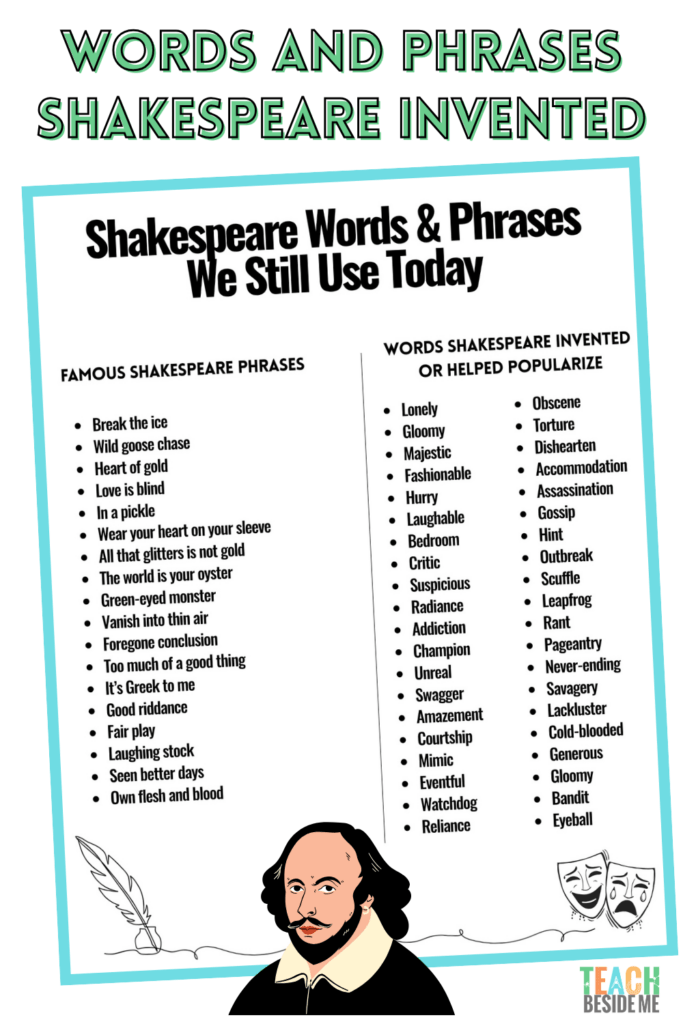
Here are some common English words often credited to Shakespeare:
- lonely
- gloomy
- majestic
- fashionable
- hurry
- laughable
- bedroom
- critic
- suspicious
- radiance
- addiction
- champion
- unreal
- obscene
- torture
- eventful
- dishearten
- accommodation
- swagger
- assassination
Many of these words sound completely modern, which makes it surprising to discover that they first appeared in Shakespeare’s plays and poems hundreds of years ago.
More Words Shakespeare Popularized
Shakespeare also helped popularize many other words we still use today, including:
- gossip
- hint
- outbreak
- scuffle
- reliance
- courtship
- amazement
- leapfrog
- watchdog
- mimic
- rant
- pageantry
- laughable
- never-ending
- savagery
- lonely
These words appeared throughout Shakespeare’s work, including plays like Romeo and Juliet, Troilus and Cressida, Antony and Cleopatra, and Love’s Labour’s Lost.
Famous Phrases Shakespeare Invented
Shakespeare also gave us many idioms and expressions that we still use regularly today.
“Break the Ice”
Meaning: To begin a conversation or help people feel comfortable.
From: The Taming of the Shrew
“Wild Goose Chase”
Meaning: A hopeless search.
From: Romeo and Juliet
“Heart of Gold”
Meaning: A kind and generous person.
From: Henry V
“Love is Blind”
Meaning: Love causes people to overlook faults.
From: The Merchant of Venice
“In a Pickle”
Meaning: In a difficult situation.
From: The Tempest
“Wear Your Heart on Your Sleeve”
Meaning: To show emotions openly.
From: Othello
“All That Glitters Is Not Gold”
Meaning: Appearances can be deceiving.
From: The Merchant of Venice
“The World Is Your Oyster”
Meaning: The world is full of opportunities.
From: The Merry Wives of Windsor
“Green-Eyed Monster”
Meaning: Jealousy.
From: Othello
“Vanish Into Thin Air”
Meaning: To disappear suddenly.
From: Othello
“Foregone Conclusion”
Meaning: Something already decided.
From: Othello
“Too Much of a Good Thing”
Meaning: Excess can become harmful.
From: As You Like It
“It’s Greek to Me”
Meaning: Something difficult to understand.
From: Julius Caesar
“Good Riddance”
Meaning: Relief that someone or something is gone.
From: Troilus and Cressida
More Common Shakespeare Phrases
Other phrases connected to Shakespeare’s work include:
- fair play
- good luck
- laughing stock
- faint-hearted
- tower of strength
- seen better days
- own flesh and blood
Many of these phrases are so common today that people do not even realize they originated in Shakespeare’s plays.
Why Shakespeare’s Language Matters
At first, Shakespeare can seem difficult to understand. But once students realize they already use many of his words and expressions every day, his writing suddenly feels much more familiar.
Studying Shakespeare’s language helps kids:
- strengthen vocabulary
- understand idioms
- improve reading comprehension
- recognize figurative language
- appreciate poetry and rhythm
- understand the history of English
- connect literature to modern language
Even students who think they “don’t like Shakespeare” are often fascinated once they realize how many familiar words and phrases came from his writing.
Fun Ways to Teach Shakespeare Words & Phrases
Teaching Shakespeare vocabulary does not need to feel intimidating. Here are some creative ways to make it fun for kids:
- create matching games
- play idiom charades
- illustrate Shakespeare phrases
- use quote copywork pages
- act out famous scenes
- compare modern meanings
- memorize short passages
- create comic strips
- write modern versions of scenes
- find Shakespeare phrases in movies and books
Middle school and high school students especially enjoy discovering how often Shakespeare’s words appear in modern movies, television, songs, and theater.
Shakespeare Vocabulary Activities
Shakespeare Phrase Matching Game
Match the phrase to its modern meaning.
Example:
- “Break the ice” → Begin a conversation
- “Wild goose chase” → A hopeless search
Shakespeare Idiom Illustration Activity
Choose a Shakespeare phrase and draw a literal illustration of it. These often turn out hilarious and memorable.
Shakespeare Quote Copywork
Practice handwriting and memorization using famous Shakespeare quotes and passages.
Shakespeare Vocabulary Poster
Create a classroom or homeschool wall display featuring Shakespeare’s most famous words and phrases.
Shakespeare Theater Activity
Act out scenes from plays like Romeo and Juliet, Comedy of Errors, or A Midsummer Night’s Dream. Performing Shakespeare aloud helps students understand the humor, emotion, and rhythm of the language much more naturally.
Free Shakespeare Words Printable
I created a free one-page printable featuring some of the most popular words and phrases Shakespeare invented. This printable works well as:
- a classroom poster
- notebook page
- literature binder insert
- bulletin board display
- homeschool room decoration
Grab the free printable below!
Shakespeare’s Influence on Modern Culture
Shakespeare’s work continues to influence:
- movies
- books
- theater
- poetry
- television
- storytelling
- modern language
Many modern movies are directly inspired by Shakespeare’s plays.
More Shakespeare Activities for Kids
Looking for even more fun ways to teach Shakespeare to kids? I have an entire post filled with creative ideas for introducing Shakespeare through stories, memorization, theater, and hands-on learning activities. It includes tips for teaching different age groups, recommended books, Shakespeare memory cards, and ways to make classic plays feel approachable and engaging for students.
Be sure to check out my full post on Teaching Shakespeare to Kids for even more literature and language arts inspiration!
Once students begin noticing Shakespeare’s influence, they start seeing his work everywhere.
Shakespeare’s language is far more connected to everyday life than most students realize. Exploring the words and phrases Shakespeare invented is a fun and approachable way to introduce kids to classic literature without making it feel overwhelming.
Whether you are teaching elementary students, middle schoolers, or high school learners, Shakespeare’s creative use of language can become a memorable and engaging part of your literature studies.
And who knows? After learning how many words and phrases Shakespeare invented, your kids may start quoting Shakespeare without even realizing it!