Teaching Shakespeare to Kids
This post may contain affiliate links.
Did you know that William Shakespeare was born on April 23rd? Shakespeare may seem intimidating at first, but introducing Shakespeare for kids can actually be one of the most rewarding and memorable parts of a literature education. His stories are full of adventure, humor, mistaken identities, drama, friendship, love, and unforgettable characters that still connect with modern readers today.
I have taught Shakespeare to middle school students in our homeschool co-op, helped students perform scenes and productions, and introduced Shakespeare’s plays to my own kids at home over the years. I’ve even attended a Shakeseare play in the Globe Theater. One of the biggest things I have learned is this:
Shakespeare does not have to feel scary or overwhelming.
In fact, when kids are introduced to Shakespeare through stories, theater, games, performances, and memorable lines, they often love it far more than adults expect!

Why Teach Shakespeare to Kids?
There is a reason Shakespeare’s work has lasted for hundreds of years. His plays and poems continue to influence:
- literature
- movies
- theater
- storytelling
- language
- culture
Many common phrases we still use today came from Shakespeare’s plays!
Studying Shakespeare helps kids:
- build vocabulary
- strengthen comprehension
- understand plots and character development
- appreciate poetry and rhythm
- improve speaking confidence
- experience live theater and performance
- develop critical thinking skills
Even young children can begin enjoying Shakespeare through stories and playful activities.
Why Shakespeare Still Matters Today
Even hundreds of years after his death, William Shakespeare continues to influence books, movies, theater, music, and storytelling all around us. Many modern films and stories are inspired by Shakespeare’s plays, even when people do not realize it. Themes like friendship, jealousy, courage, love, revenge, family conflict, and ambition are timeless and still connect deeply with kids and teens today.
Shakespeare’s work also shaped the English language itself. His stories are quoted constantly in modern culture, and many phrases we still use every day actually came from Shakespeare’s plays. Teaching Shakespeare helps students better understand literature, storytelling, poetry, theater, and even modern entertainment.
Most importantly, Shakespeare teaches kids that classic literature can be exciting, emotional, funny, dramatic, and surprisingly relatable.
Words & Phrases Shakespeare Invented
One of the most fascinating things about Shakespeare’s work is how many words and phrases he either invented or helped popularize in the English language. Kids are often amazed to discover that they already use Shakespearean expressions without even realizing it!
Some famous Shakespeare phrases include:
- “Break the ice”
- “Wild goose chase”
- “Heart of gold”
- “Love is blind”
- “In a pickle”
- “All that glitters is not gold”
- “Wear your heart on your sleeve”
- “The world is your oyster”
Shakespeare also helped introduce hundreds of words into English, including:
- lonely
- majestic
- gloomy
- hurry
- bedroom
- excitement
Learning Shakespeare can actually help students grow their vocabulary and better understand the roots of modern English. Check out my post on Words & Phrases Shakespeare Invented.
A fun activity is to challenge kids to spot Shakespeare quotes or phrases in movies, songs, books, or everyday conversation.
Best Ways to Introduce Shakespeare for Kids
One of the best ways to teach Shakespeare to kids is to begin with the stories first before jumping into the original language.
Start with Simplified Shakespeare Stories
For younger children, I highly recommend using adapted story versions of Shakespeare’s plays. These help kids become familiar with the plots, characters, and humor without getting overwhelmed by the language.
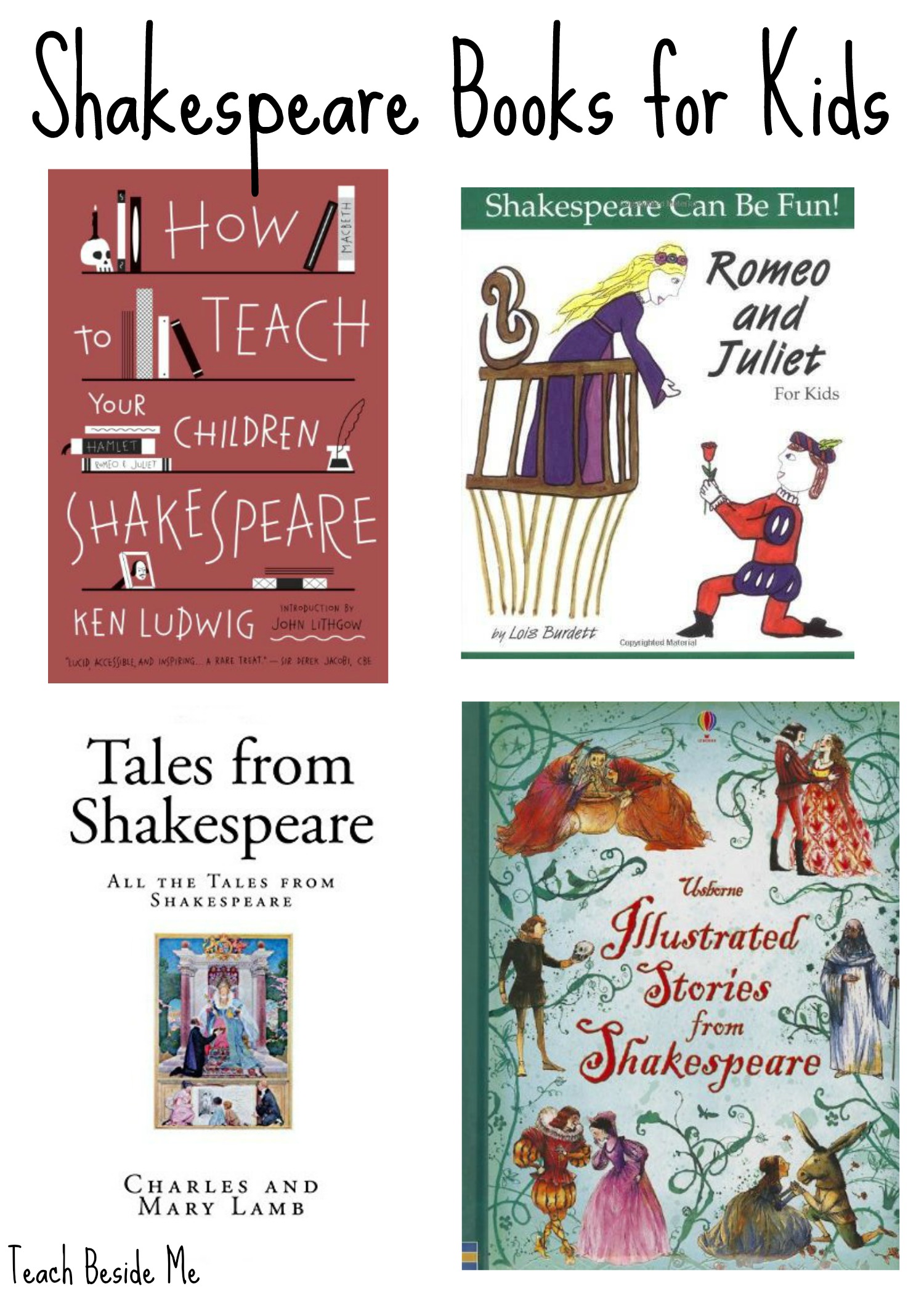
Some favorite Shakespeare books for kids include:
- Usborne Illustrated Stories from Shakespeare
- Tales from Shakespeare by Charles and Mary Lamb
- Shakespeare Can Be Fun series by Lois Burdett
These versions make Shakespeare approachable and enjoyable for elementary students.
Best Shakespeare Plays for Different Ages
Not every Shakespeare play is equally accessible for kids. Some are much easier and more enjoyable for younger learners.
Shakespeare Plays for Younger Children
These are often the easiest introductions:
- A Midsummer Night’s Dream
- Twelfth Night
- The Tempest
These comedies include:
- fairies
- magic
- mistaken identities
- funny plots
- playful characters
They are often much easier for kids to follow than the tragedies.
Shakespeare for Middle School & High School
Older students may enjoy:
- Romeo and Juliet
- Julius Caesar
- Macbeth
- Hamlet
Middle school and high school students are often ready to discuss:
- themes
- motivations
- plots
- tragedies
- historical context
- character flaws
What Was Shakespeare’s Life Like?
Kids are often much more interested in Shakespeare once they learn about the fascinating world he lived in. Shakespeare was born in 1564 in Stratford-upon-Avon, England and later became both an actor and playwright in London.
His plays were performed in famous theaters like the Globe Theatre, where audiences stood outside watching live performances. Theater during Shakespeare’s time was loud, interactive, and exciting. Audience members cheered, laughed, and sometimes even shouted during performances!
One interesting historical fact that kids always find surprising is that boys and men played all of the female roles in Shakespeare’s plays because women were not allowed to act on stage at the time.
Shakespeare wrote:
- comedies
- tragedies
- histories
- poems
Some of his most famous tragedies include Hamlet, Macbeth, and Romeo and Juliet. His comedies like A Midsummer Night’s Dream and Twelfth Night are often especially enjoyable for younger learners.
Learning about the history and theater culture of Shakespeare’s time helps make his work feel much more alive and accessible.
Creative Ways to Teach Shakespeare
Kids learn Shakespeare best when they experience it actively instead of simply reading it silently. Shakespeare’s plays were written to be performed, and bringing them to life makes them much more engaging and understandable for students of all ages.
For younger children, try:
- puppet shows
- coloring pages
- simplified storybooks
- acting out scenes
- fairy crafts for A Midsummer Night’s Dream
- matching characters and quotes
- listening to audio versions
Middle school and high school students often enjoy more in-depth Shakespeare activities such as:
- performing scenes or monologues
- rewriting scenes in modern English
- creating comic-strip summaries
- comparing movie adaptations
- designing costumes or stage sets
- writing diary entries from a character’s perspective
- holding mock trials for characters
- memorizing famous passages
- creating Shakespeare-themed escape rooms
When I taught Shakespeare in our homeschool co-op, students gained so much confidence through performance and group activities. Theater-based learning made Shakespeare far less intimidating and much more memorable. Students especially loved reading scenes aloud and discovering that Shakespeare’s plays were often much funnier than they expected.
Watching live or filmed theater performances can also dramatically improve comprehension and help students connect emotionally with the stories.
Understanding Shakespeare’s Language
One of the biggest fears parents and students have about Shakespeare is the language. At first glance, the old-fashioned wording can feel difficult or confusing. But the good news is that kids do not need to understand every single word in order to enjoy Shakespeare.
In fact, Shakespeare’s plays were written to be heard and performed, not silently analyzed.
A few simple tips can make Shakespeare’s language much easier to understand:
- read passages aloud
- focus on emotion and action first
- watch performances while reading
- use simplified story versions first
- learn a few common Shakespearean words
- don’t stop for every unfamiliar word
Kids quickly begin recognizing words like:
- thou = you
- thee = you
- thy = your
- art = are
Once students hear the rhythm and emotion behind the language, Shakespeare becomes much more approachable and enjoyable.
Reading Shakespeare aloud together is often one of the best ways to build confidence and comprehension.
Memorizing Shakespeare Passages
One of our favorite Shakespeare resources has been How to Teach Your Children Shakespeare by Ken Ludwig.
This book focuses on helping kids:
- memorize passages
- understand Shakespeare’s plays
- learn about the Globe Theater
- appreciate rhythm and poetry
- gain confidence speaking Shakespeare aloud
What I especially love is how approachable Ludwig makes the process feel. He removes the fear and helps parents and teachers feel capable of introducing Shakespeare successfully.
Memorizing passages may sound intimidating at first, but kids are often surprisingly good at it when they learn through repetition, rhythm, and performance.
I made a set of Printable Shakespeare Memory Cards with 12 favorite passages. Grab them below!
Use Movies, Audio, and YouTube
Watching performances can dramatically improve comprehension for kids.
Helpful resources include:
- filmed theater productions
- audiobook versions
- animated Shakespeare adaptations
- YouTube scene performances
- Shakespeare documentaries
Hearing the language spoken aloud makes Shakespeare’s work much easier to understand.
Best Shakespeare Movies for Kids & Teens
Watching Shakespeare performed is one of the best ways to improve comprehension and help students connect with the stories. Seeing facial expressions, costumes, movement, and emotion makes the language much easier to understand.
Some family-friendly Shakespeare movie and video options include:
- animated Shakespeare adaptations
- BBC Shakespeare productions
- filmed Globe Theatre performances
- Gnomeo & Juliet
- The Lion King (inspired by Hamlet)
- 10 Things I Hate About You (inspired by The Taming of the Shrew)
- She’s the Man (inspired by Twelfth Night)
YouTube can also be a fantastic resource for:
- scene performances
- monologues
- summaries
- theater clips
- educational explanations
Watching a performance before reading a play often helps students better understand the plots and characters.
Famous Shakespeare Quotes for Kids
Many of Shakespeare’s most famous quotes are beautiful, memorable, and surprisingly meaningful for kids and teens.
Some favorite Shakespeare quotes to memorize include:
“All the world’s a stage.”
“Though she be but little, she is fierce.”
“To thine own self be true.”
“We are such stuff as dreams are made on.”
“The better part of valor is discretion.”
“Love all, trust a few, do wrong to none.”
You can turn these into:
- copywork pages
- memory cards
- art projects
- calligraphy practice
- classroom posters
- recitation activities
Memorizing short passages and quotes helps students become more comfortable with Shakespeare’s language over time.
Printable Shakespeare Memory Cards
I created a set of Printable Shakespeare Memory Cards featuring 12 memorable passages from Shakespeare’s plays and poems. Some are inspired by passages recommended in Ken Ludwig’s book, along with several additional favorites.
These cards are perfect for:
- memorization practice
- homeschool morning time
- theater clubs
- co-ops
- classroom activities
- speech and recitation
- literature studies
Grab the printable Shakespeare memory cards in my shop!

Grab this printable in my shop!

Teaching Shakespeare to kids does not need to feel intimidating. Start slowly, focus on the stories first, and make the experience interactive and enjoyable.
Whether your children are listening to funny Shakespeare comedies, memorizing short poems, watching a movie adaptation, or performing scenes on stage, Shakespeare’s work can become one of the richest and most memorable parts of a literature education.
And who knows? You may end up loving Shakespeare even more alongside your kids.