A Christmas Carol Lesson Plan Ideas & Activities for Kids
This post may contain affiliate links.
A Christmas Carol by Charles Dickens is one of my favorite Christmas classics to use for meaningful holiday learning. It’s a story filled with memorable characters, mysterious visitors, and important lessons about generosity, compassion, and second chances.
And while the story takes place at Christmas, there is so much more to explore than the holiday itself! Students can investigate Scrooge’s transformation, discover what life was like in Victorian England, compare the three Christmas spirits, and think about how their own choices affect others.
Whether you’re planning a literature unit for your classroom, reading the story with your family, or looking for a few creative Christmas lessons, these A Christmas Carol activities will help bring Dickens’s classic to life.

How to Teach A Christmas Carol to Kids
A Christmas Carol was first published in 1843 and tells the story of Ebenezer Scrooge, a wealthy but miserly man who is visited by four supernatural figures on Christmas Eve: the ghost of his former business partner, Jacob Marley, and the Ghosts of Christmas Past, Present, and Yet to Come.
Through these visits, Scrooge sees the consequences of his choices and discovers that it isn’t too late to change.
The original book is fairly short, but Dickens’s Victorian language can be challenging for younger readers. You can read the original aloud, choose an illustrated adaptation, or pair the story with a movie version.
For elementary students, I’d focus on the characters, events, and themes. Older students can dig deeper into symbolism, social criticism, and the historical context.
Where to Find A Christmas Carol
- An illustrated young reader’s adaptation
- A Kindle edition
- The original text at Project Gutenberg, available to read for free
You don’t have to complete every activity below. Choose a few that fit your students’ ages and interests, or combine them into a weeklong Christmas literature study.
1. Investigate Scrooge’s Character Transformation
One of the most interesting parts of A Christmas Carol is watching Ebenezer Scrooge change. At the beginning, he’s cold, selfish, and dismissive of the people around him. By the end, his behavior is almost unrecognizable.
Have students become character investigators! Fold a piece of paper in half and label the sides Scrooge Before and Scrooge After.
As you read, collect evidence of his character. Look for the way he speaks to others, how he responds to people in need, and what he values most. Students can record quotations, draw scenes, or write short descriptions.
When you finish the story, compare the two sides. Which changes are the most significant? What events caused those changes? Does Scrooge simply feel differently, or does he actually behave differently?
For older students, challenge them to support their conclusions with specific evidence from the text.
A Christmas Carol Literary Investigation Printable
Want to take your A Christmas Carol literature study a little further?
I’ve created a printable The Case of Ebenezer Scrooge Literary Investigation for grades 5–8!
Students become literary detectives as they examine Scrooge’s character, gather clues, evaluate evidence, and develop their own theories about his remarkable transformation.
The 17-page printable includes five connected case files, a Final Case Report, and a Teacher’s Guide.
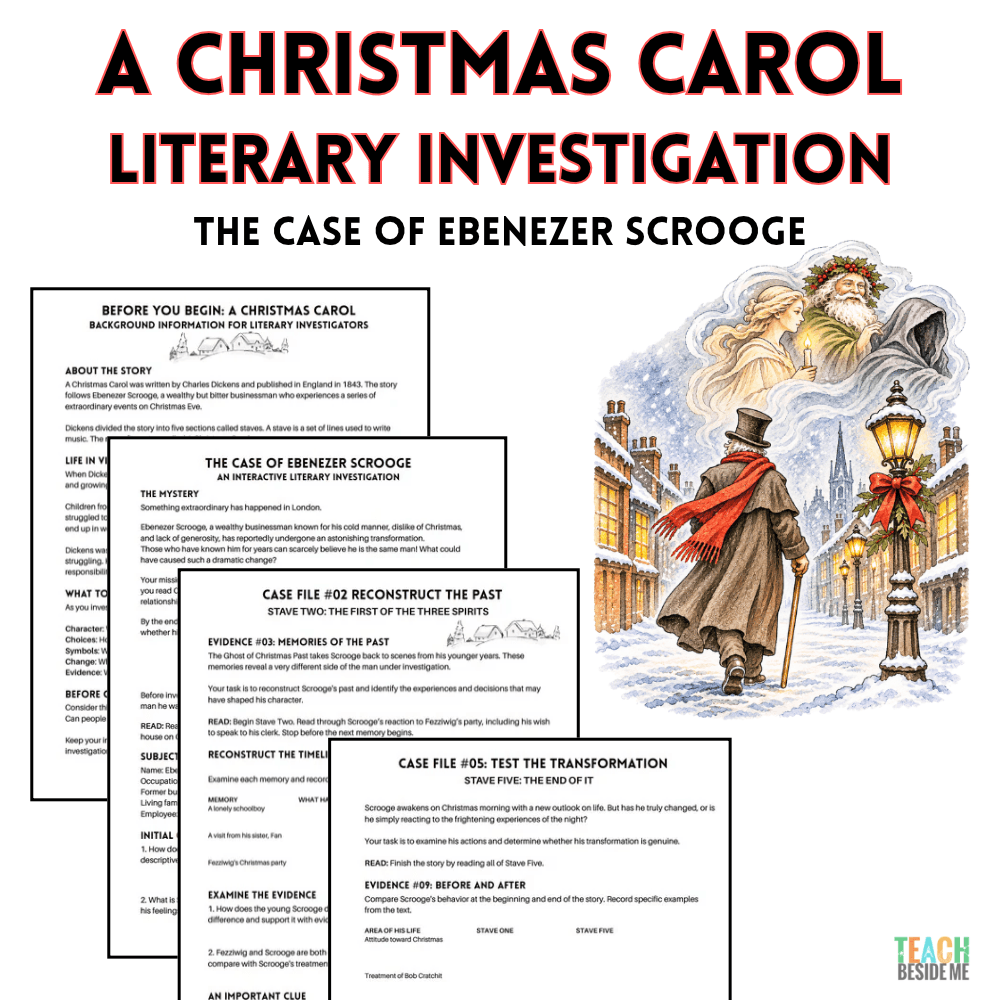
Explore the A Christmas Carol Literary Investigation here!
2. Compare the Three Christmas Spirits
Each of the three Christmas spirits teaches Scrooge something different, and comparing their visits is a great way to practice literary analysis.
Divide a large sheet of paper into three columns labeled Christmas Past, Christmas Present, and Christmas Yet to Come.
As students read, record the scenes each spirit shows Scrooge, how he reacts, and what he learns.
The Ghost of Christmas Past reveals memories and choices that helped shape Scrooge’s character. Christmas Present shows him the lives and struggles of people around him. Christmas Yet to Come confronts him with a possible future.
For a more hands-on version, write important scenes on separate cards and have students sort them beneath the correct spirit. Then discuss which visit seems to have the greatest impact on Scrooge.
There’s no need for everyone to agree! The interesting part is hearing students explain their reasoning.
3. Create a Christmas Past, Present, and Future Timeline
Dickens doesn’t tell Scrooge’s life story in chronological order. Instead, we discover pieces of his past, see what’s happening around him in the present, and glimpse what might happen in the future.
Give students a long strip of paper and have them construct a timeline of Scrooge’s life. Include his lonely childhood, his relationship with Belle, his years in business with Marley, and the events of Christmas Eve.
Add important moments from the present and possible future, using different colors to distinguish them.
Once the timeline is complete, ask students to identify the turning points. Which moments were outside Scrooge’s control? Which resulted from his own decisions? At what points could he have chosen a different path?
This activity works especially well for visual learners and helps students understand the story’s unusual structure.
4. Learn About Charles Dickens and Victorian England
Understanding a little about Charles Dickens and the world he lived in makes A Christmas Carol even more meaningful.
Dickens grew up in England during the Industrial Revolution. When he was twelve, his father was imprisoned for debt, and young Charles was sent to work in a factory. His experiences with poverty and child labor influenced much of his writing.
By the time A Christmas Carol was published in 1843, industrial cities had grown rapidly, and many families lived in difficult conditions. Dickens used the story to draw attention to poverty, inequality, and the responsibility people have toward one another.
Have students research one aspect of Victorian life, such as factory work, workhouses, schools, clothing, transportation, or Christmas celebrations.
They can create a small museum display with drawings, captions, and historical facts. Then look for connections between what they discovered and the experiences of the Cratchit family, Scrooge, or other characters.
For further reading, visit the Charles Dickens Museum or explore The Charles Dickens Page.
5. Explore the Symbols in A Christmas Carol
Dickens uses symbolism throughout the story to communicate ideas that go beyond the events themselves.
For example, Marley’s heavy chain represents the burden of his selfish choices. Light and darkness appear repeatedly, often connected to knowledge, hope, and fear. Ignorance and Want, the two children revealed by the Ghost of Christmas Present, represent serious problems in society.
Choose three or four symbols and have students create illustrated symbol cards. On one side, draw the object or character. On the other, explain what it represents and where it appears in the story.
For younger children, focus on more concrete examples, such as Marley’s chain. Older students can investigate the more complicated social symbolism.
Display the finished cards and discuss how Dickens uses images to communicate his message.
6. Act Out A Christmas Carol with Reader’s Theater
A Christmas Carol is a wonderful story to perform because it includes dramatic scenes, expressive characters, and plenty of dialogue.
Reader’s theater is one of my favorite ways to help students experience literature. Rather than memorizing an entire play, students read their parts aloud, practicing expression, pacing, and character voices.
Assign roles such as Scrooge, Marley, Bob Cratchit, Fred, the three spirits, and a narrator. Students can rehearse selected scenes or work together to perform a shortened version of the entire story.
Simple props can make the experience even more memorable. A paper chain for Marley, a nightcap for Scrooge, or a clock striking midnight can help set the scene without requiring elaborate costumes.
Afterward, discuss how performing a character changes the way students understand that character’s feelings and motivations.
Coming soon: We’re developing a printable A Christmas Carol reader’s theater script to make this activity even easier to use with a classroom, co-op, or homeschool group.
7. Watch and Compare A Christmas Carol Movies
There have been many movie adaptations of A Christmas Carol, and comparing them with the book makes a wonderful literature activity.
Choose a movie version that fits your students’ ages and watch it after reading the story, or compare selected scenes as you go.
Have students look for differences in the characters, dialogue, settings, and events. Which scenes are included or omitted? Does the movie portray Scrooge the way students imagined him? How does music or lighting affect the mood?
You could even compare the same scene from two different adaptations. The appearance of Marley’s ghost or the arrival of the Ghost of Christmas Yet to Come would be especially interesting choices.
For a simple writing assignment, ask students to explain which version of a particular scene they prefer and why.
There are several adaptations available to rent or purchase through Amazon. Be sure to preview your chosen version, since some scenes may be frightening for younger viewers.


8. Make Victorian-Inspired Spiced Apple Cider (Wassail)
One of the fun ways we brought A Christmas Carol to life in our own home was by making spiced apple cider, sometimes called wassail.
Wassailing has a long history in England, with traditions involving warm drinks, singing, and visiting neighbors or orchards. The customs changed over time, but a warm, fragrant drink is a wonderful way to add a little historical atmosphere to your Christmas literature lessons.
We made this easy slow cooker version, and it was delicious!

Spiced Apple Cider (Wassail) Recipe
Ingredients
- 1 gallon apple cider
- 1 teaspoon cinnamon
- 1/8 teaspoon nutmeg
- 1/2 teaspoon cloves
- 1 apple, peeled, cored, and sliced
- 1 orange, sliced with peel left on
- 1/2 cup sugar
- 2 tablespoons brown sugar
Instructions
Combine all the ingredients in a slow cooker. Heat on low or high until the cider is hot and the flavors have had time to blend. I cooked mine on high for about three hours, but the timing doesn’t need to be exact.
Serve warm and enjoy!
This is a fun activity to pair with a discussion of Victorian Christmas traditions. You could also explore the history of wassailing and compare historical customs with the ways families celebrate Christmas today.
9. Discuss the Themes of Generosity, Compassion, and Redemption
A Christmas Carol offers plenty of opportunities for thoughtful conversations, and students often notice different details depending on their ages.
Here are some questions to explore together:
- Why does Scrooge believe money is so important at the beginning of the story?
- How do the Cratchits experience happiness despite their financial struggles?
- Why does Fred continue inviting Scrooge to Christmas dinner?
- What does Marley regret most about his life?
- Which spirit teaches Scrooge the most important lesson?
- Does Scrooge change because he’s afraid of the future, because he cares about others, or both?
- How do we know that Scrooge’s transformation is genuine?
- What does Dickens want readers to understand about how we treat other people?
For a creative extension, ask students to write a letter from the older, transformed Scrooge to his younger self. What advice would he give? What mistakes would he encourage himself to avoid?
Another option is to create a Christmas kindness challenge. Have students brainstorm small ways they can show generosity and compassion in their own homes, schools, or communities.
10. Try Our Christmas Carol Literary Investigation!

Planning a Week of A Christmas Carol Lessons
You can use these activities individually or combine them into a short Christmas literature unit.
| Day | Lesson Focus | Suggested Activity |
|---|---|---|
| Day 1 | Meet Scrooge | Begin reading and open the character investigation |
| Day 2 | Christmas Past | Build Scrooge’s life timeline |
| Day 3 | Christmas Present | Explore Victorian England and the Cratchit family |
| Day 4 | Christmas Yet to Come | Examine symbolism and predict Scrooge’s future |
| Day 5 | Scrooge’s Transformation | Finish the story, compare evidence, and perform or watch selected scenes |
You can stretch the lessons across two weeks if you’re reading the original Dickens text or want more time for historical research and creative projects.
However you use the story, I hope these ideas help your students discover why A Christmas Carol has remained such a beloved Christmas classic. It’s a wonderful reminder that our choices matter, kindness makes a difference, and it’s never too late to become a better person.
More Christmas Learning Activities
Looking for more creative ways to bring learning into the Christmas season? Here are a few other activities you might enjoy:
- Gingerbread House Geometry — explore math through a favorite Christmas tradition.
- Symbols of Christmas Scavenger Hunt — discover the meaning behind familiar Christmas symbols.
- Christmas Pattern Block Templates — hands-on holiday geometry activities.
- Cups & Classics: December Homeschool Curriculum — literature, art, music, and more.
- Christmas Family Feud Game Printable — a fun activity for Christmas parties and family gatherings.
- Guess the Christmas Carol: Worksheet & Charades






This is a great list of resources Karyn! Thanks for sharing!
Oh, thanks for this great post and sharing it with Afterschool. My favorite movie version of Christmas Carol is Muppet Christmas Carol, and I think this year our seven year old might be ready for it.
Love all these resources! We’re so glad you shared at After School.
I really love your unit studies, Karyn. I love how you get into classic literature and really get to the essence of it.
Thank you for sharing this!
This was so helpful to me as I plan a Victorian Christmas unit for my kiddos this year. Thank you!