
Perler Bead Tangrams: DIY Math Puzzle Activity for Kids
This post may contain affiliate links.
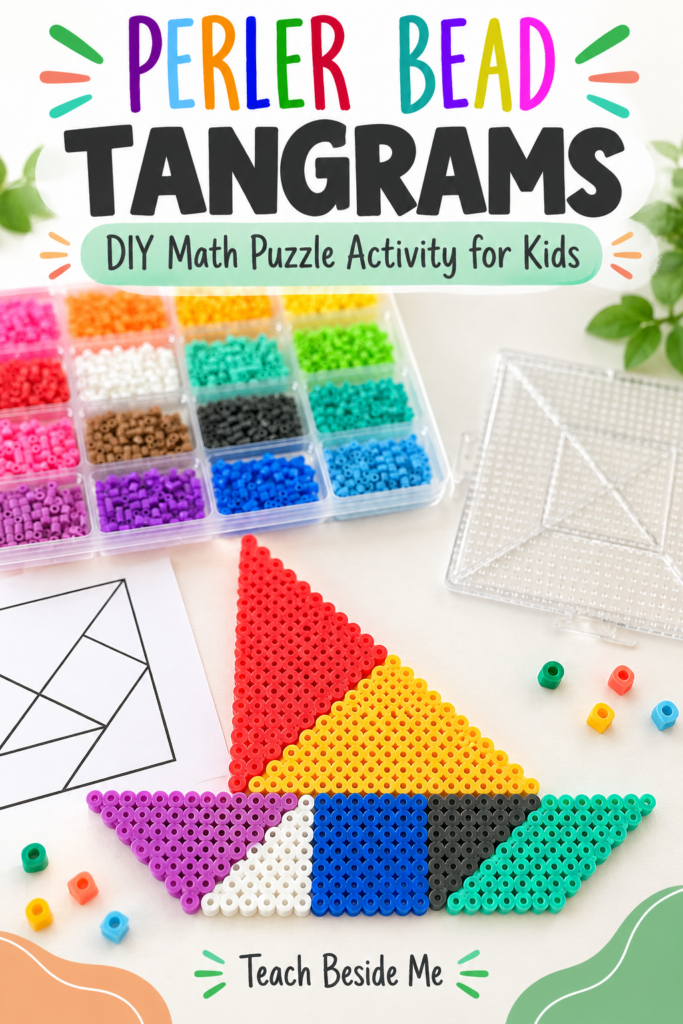
Looking for creative Perler bead ideas that combine crafting with learning? Try making your own Perler bead tangrams!
This fun project turns colorful Perler beads (also called melty beads or fuse beads) into a reusable set of geometric puzzle pieces. Once you’ve made your tangrams, kids can use them to build animals, numbers, letters, people, and all kinds of interesting shapes.
I love activities that combine art and math, and this one is especially fun because children get to make their own learning materials!

What Are Tangrams?
Tangrams are a traditional Chinese geometric puzzle made from seven shapes, called tans.
A complete tangram set includes:
- 2 large triangles
- 1 medium triangle
- 2 small triangles
- 1 square
- 1 parallelogram
The seven pieces fit together to form a square, but they can also be rearranged to create hundreds of different pictures and designs. The challenge is usually to use all seven pieces to recreate a picture without overlapping the shapes.
Tangrams are wonderful for practicing geometry, spatial reasoning, problem-solving, and creative thinking. And making the pieces with Perler beads adds another layer of hands-on learning!
Why Make Tangrams with Perler Beads?
My kids have always loved Perler beads. They’re constantly coming up with new designs and asking me to get more beads! We’ve made all kinds of pictures and crafts with them, but I wanted to try something a little different.
I thought it would be fun to make something they could actually play with after finishing the craft. That’s when I decided to create a set of Perler bead tangrams!
The geometric shapes are relatively simple to make, and once they’re finished, kids have their own colorful puzzle pieces to use for math activities. You can even make each shape a different color to help younger children identify and manipulate the pieces.
Supplies for Perler Bead Tangrams
You’ll need:
- Perler beads or other compatible fuse beads in assorted colors
- Clear square perler bead pegboards
- A printed tangram template
- Perler bead ironing paper or parchment paper approved for fuse beads
- An iron (adult use only)
- A flat, heat-safe ironing surface
We used a clear square pegboard measuring approximately 5¾ × 5¾ inches.
A transparent pegboard is especially helpful because you can place the printed tangram template underneath it and follow the shapes.
Safety note: Fuse beads are small parts and can be a choking hazard for young children. Keep loose beads away from children who may put them in their mouths. An adult should handle the hot iron and heated bead projects. Follow the bead manufacturer’s ironing instructions.

How to Make Perler Bead Tangrams
Making the seven geometric shapes is pretty simple once you have your template ready.
Step 1: Print the Tangram Template
Start by printing a traditional seven-piece tangram pattern. You can use the template shown below as a guide. I printed my template and adjusted the size until it matched my square Perler bead pegboard.
For my printer and pegboard, the image ended up at approximately 83% of its original size. Your printing percentage may be different depending on the image dimensions, printer settings, and pegboard. The important thing is to make sure the shapes fit the pegboard before you begin placing beads.
Step 2: Choose Your Perler Bead Colors
Decide which colors you’d like to use for your tangram pieces. We chose a different color for each shape, which made our finished tangrams bright and easy to distinguish.
You could also use matching colors, rainbow patterns, or whatever beads you already have available.
Step 3: Arrange the Beads on the Pegboard
Place your clear pegboard over the printed tangram template. Follow the outlines of the shapes as closely as possible, filling each one with Perler beads.
Important: Make only one or two shapes at a time, leaving plenty of empty space between them. If two shapes touch while you’re ironing, they may fuse together instead of remaining separate puzzle pieces.
We made our tangrams in several rounds, but the basic geometric shapes were fairly quick to assemble.
Step 4: Fuse the Perler Beads
Once you’ve arranged the beads, have an adult cover them with ironing paper and fuse them according to the manufacturer’s directions. Let the shapes cool before handling them.
I like to carefully fuse both sides of our Perler bead projects because it helps make them sturdier. If you choose to iron both sides, follow the manufacturer’s instructions and be careful not to overheat the beads.
Repeat the process until you have all seven tangram pieces.
Step 5: Start Building Tangram Puzzles!
Once all seven shapes are finished and completely cool, you’re ready to play! Try putting the pieces together to form the original square. Then challenge your kids to use the shapes to create different pictures.
The fun part is discovering how many designs can be made with just seven geometric pieces!
Tangram Patterns and Puzzle Ideas
Once we finished our Perler bead tangrams, I gathered a collection of tangram pictures for the kids to try.
There are so many possibilities! You can use the seven pieces to create animals, numbers, letters, people, and geometric designs.
Keep in mind that Perler bead tangrams won’t fit together quite as perfectly as traditional wooden or paper tangrams. The edges of the fused beads are slightly rounded and uneven, so small gaps between the pieces are normal.
That doesn’t prevent kids from having fun creating the different designs!

Animal Tangram Puzzles
Animal pictures are some of my favorite tangram challenges.Kids can arrange the pieces to create recognizable animal shapes.
We made the following animals:
- Camel
- Goose
- Bear
- Whale
- Horse
- Giraffe
- Turtle
- Cat
- Fish
- Dog
- Swan
- Vulture
Try having children recreate the animals from the examples pictured, then challenge them to invent their own. You could even turn it into a guessing game!
One child creates an animal using the tangrams, and another tries to guess what it is.
Now for Some Number Tangrams:

Number Tangram Puzzles
You can also use the tangram pieces to build numbers. This is a fun way to combine geometry with number recognition. Have children build a number, identify it, and then try creating another.
Older kids can experiment with how different arrangements of the same seven pieces can create recognizable number shapes.
Letters, People, and Other Tangram Designs
Once your kids understand how tangrams work, encourage them to try more challenging designs.
Some ideas include:
- Alphabet letters
- People in different poses
- Houses and buildings
- Boats and other vehicles
- Birds and other animals
- Abstract geometric pictures
You can also challenge children to create their own tangram silhouettes for someone else to solve.
What Math Skills Do Tangrams Teach?
Tangrams are much more than a fun puzzle!
They offer opportunities to explore several important math concepts through hands-on play.
Geometry and Shape Recognition
Children work with triangles, squares, and parallelograms.
They can compare the shapes, count sides and corners, and learn to recognize shapes in different orientations.
Spatial Reasoning
Tangram puzzles challenge children to visualize how shapes fit together.
They practice turning, flipping, and rearranging pieces to create larger pictures.
Problem-Solving
Sometimes a piece doesn’t fit where children expect it to.
They have to try a different arrangement, test an idea, and adjust their approach.
This makes tangrams a great activity for practicing persistence and flexible thinking.
Fractions and Area
Tangrams can also introduce some interesting fraction concepts.
For example, in a traditional tangram set:
- Each large triangle represents 1/4 of the complete square.
- The medium triangle represents 1/8.
- The square represents 1/8.
- The parallelogram represents 1/8.
- Each small triangle represents 1/16.
These relationships are based on the areas of the original geometric tangram pieces. Your Perler bead versions will only approximate them because of the bead shapes and spacing.
Older children can explore which combinations of pieces have equal areas.
For example, two small triangles have the same area as the square in a traditional tangram set.
Tangram Challenges for Different Ages
One thing I love about tangrams is that you can make them as simple or challenging as you like.
- Younger elementary children: Start with identifying the seven shapes and copying simple pictures with the pieces clearly outlined.
- Older elementary children: Challenge kids to recreate tangram silhouettes without individual piece outlines.
- Middle school students: Explore area relationships, fractions, symmetry, transformations, and geometric reasoning.
You can also have children design their own puzzles and challenge family members or classmates to solve them.
Fun Ways to Use Your DIY Tangrams
After making your Perler bead tangram set, try some of these activities:
- Tangram puzzle station: Keep the pieces in a small container with printed tangram pictures for independent math practice.
- Timed challenges: See how quickly children can recreate a picture, then encourage them to try again and improve their time.
- Create your own puzzle: Have children invent a design, trace its outer outline, and challenge someone else to solve it.
- Symmetry exploration: Experiment with creating symmetrical designs and identifying lines of symmetry.
- Tangram storytelling: Build an animal, person, or object and make up a story about it.
- Tangram art: Arrange the shapes into a design and draw the finished picture on paper.
I especially love that this activity begins as a craft and turns into a learning game children can return to again and again.
Frequently Asked Questions About Perler Bead Tangrams
Can you make tangrams with Perler beads?
Yes! You can use a square Perler bead pegboard to create the seven geometric shapes in a traditional tangram set. Once fused and cooled, the shapes can be used to solve tangram puzzles.
How many pieces are in a tangram set?
A traditional tangram set contains seven pieces: five triangles, one square, and one parallelogram.
Do Perler bead tangrams fit together perfectly?
Not quite. The rounded edges of fused Perler beads make the pieces slightly less precise than traditional tangrams, but they still work well for many puzzle designs.
Are tangrams good for learning math?
Yes! Tangrams provide opportunities to explore geometry, spatial reasoning, shape recognition, problem-solving, and area relationships.
Can kids make their own tangram puzzles?
Absolutely! Once children understand how to arrange the seven pieces, they can create original pictures and challenge others to recreate them.
More Perler Bead and Math Activities
If your kids love creating with Perler beads, try our Perler Bead Tic-Tac-Toe Game!
It’s another fun way to turn a simple craft into a reusable game.
You can also explore more hands-on math activities throughout Teach Beside Me.
I love finding creative ways to help children see that math can be something they build, touch, and play with.
These DIY Perler bead tangrams are a perfect example. They’re colorful, fun to make, and provide so many opportunities for geometric exploration.
Have fun creating your own set!




This is genius! My boys loved perler beads for a while but they haven’t used them in a couple months. I’m thinking this is just the thing to get their interest going again!
My daughter loved Perler Beads but I never thought of using them this way. What a brilliant idea!