Shark Life Cycle Spinner Activity for Kids (Free Printable!)
This post may contain affiliate links.
It’s Shark Week, and what better way to celebrate than with a fun and educational shark life cycle activity? Whether you’re homeschooling, teaching a marine biology unit, or just have a shark-obsessed kid at home, this shark life cycle spinner is a hands-on way to explore shark development in a memorable way.
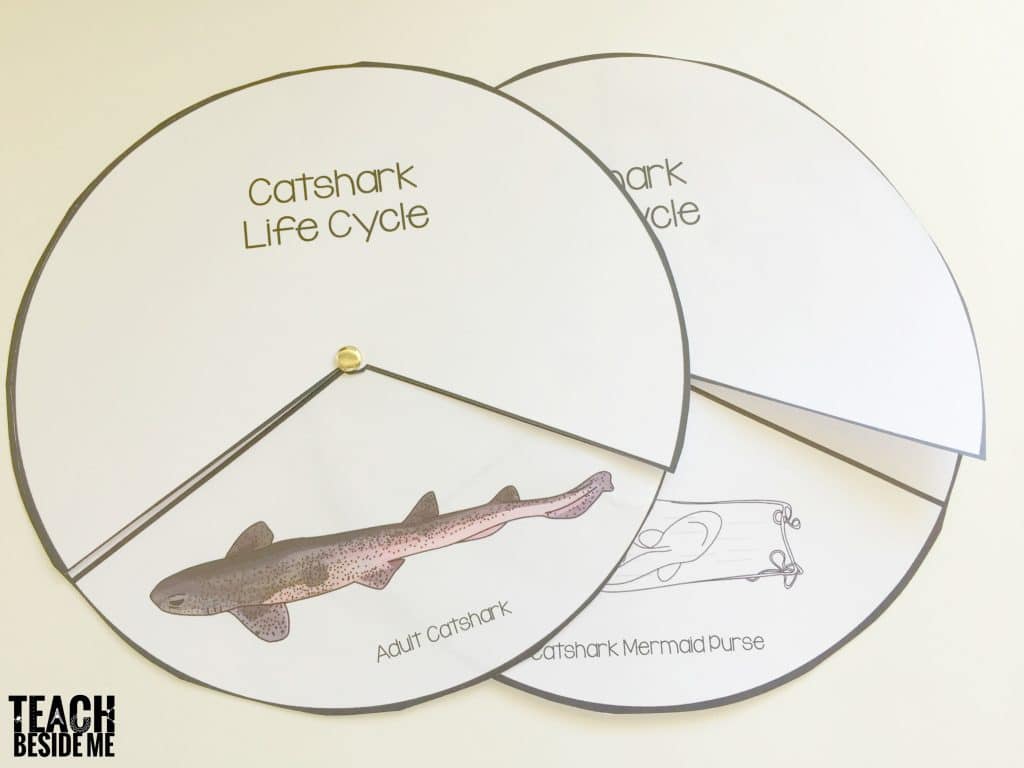
This printable activity features the life cycle of a catshark, including its early stage inside a mermaid’s purse (egg case). It’s easy to assemble, comes in color and black-and-white, and is perfect for science centers, ocean units, or Shark Week fun!

What’s Included in the Shark Life Cycle Spinner
-
Printable spinner featuring three key stages of the catshark:
-
Mermaid’s purse (egg case)
-
Baby shark
-
Adult shark
-
-
Available in both color and black-and-white for coloring or low-ink printing
-
Easy to assemble with just scissors and a metal brad
How to Assemble the Shark Spinner
-
Print the two spinner pages (color or B&W).
-
Cut out the circle pieces.
-
Layer the top page with the window over the full circle.
-
Fasten with a metal brad in the center.
-
Spin and learn as you review each stage of the shark’s life cycle!
This craft is perfect for preschool, kindergarten, or elementary-aged learners.
Download the Shark Life Cycle Spinner Now!
Learn About the Shark Life Cycle
This activity features the catshark, a small species of ground shark found worldwide in tropical and temperate waters.
Mermaid’s Purse (Egg Case)
-
Catsharks lay fertilized eggs encased in a tough, collagen-based pouch called a mermaid’s purse.
-
These egg cases often have curly tendrils that attach to seaweed or ocean plants to anchor them.
-
Embryos grow inside the egg case for 9–12 months or more, depending on the species.
-
After hatching, the empty egg cases sometimes wash up on beaches—a special find for beachcombers!
Baby Shark
-
Once hatched, baby catsharks are fully formed but small.
-
They begin hunting right away, feeding on tiny invertebrates.
Adult Catshark
-
Catsharks are nocturnal and use their cat-like eyes to see in the dark.
-
They grow up to 31 inches (80 cm) and are harmless to humans.
-
Catsharks live along the bottom of the ocean and feed on fish, crabs, and other small creatures.
Extend the Learning
Here are a few ways to make this shark activity even more educational:
Science Connection
-
Compare the shark life cycle to other animals like frogs, butterflies, or mammals.
-
Discuss the differences between egg-laying sharks and live-bearing sharks.
Vocabulary to Introduce
-
Embryo
-
Mermaid’s purse
-
Hatchling
-
Collagen
-
Nocturnal
-
Cartilage
Creative Add-Ons
-
Let kids color their own spinner if using the black-and-white version.
-
Use clay or playdough to model a mermaid purse or baby shark.
-
Watch a short educational video about shark reproduction or catsharks.
Read Shark-Themed Books
Here are a few kid favorites:
10 Fun Shark Facts for Kids:
1. Sharks don’t have bones!
Instead of bones, sharks have skeletons made of cartilage—the same stuff that’s in your ears and nose. It helps them stay light and bendy in the water.
2. Some sharks lay eggs, and some give live birth!
Not all sharks lay eggs. Some species—like catsharks—lay egg cases called mermaid’s purses, while others carry their babies and give live birth.
3. Sharks lose thousands of teeth!
Sharks can go through 30,000 teeth in their lifetime. They’re always losing and growing new ones, like a never-ending conveyor belt of teeth!
4. Sharks have been around longer than dinosaurs!
Sharks have existed for more than 400 million years, long before the first dinosaurs ever walked the Earth.
5. A group of sharks is called a “shiver”!
How cool is that? You can say, “Look at that shiver of sharks!”
6. Sharks have super senses.
They can detect tiny movements in the water and even sense electrical signals from other animals. This helps them hunt—even in the dark!
7. Whale sharks are the biggest fish in the sea.
They can grow to be over 40 feet long—but don’t worry, they only eat plankton and tiny creatures.
8. Hammerhead sharks have 360° vision!
Thanks to their wide, flat heads, hammerhead sharks can see all around them at once.
9. Sharks can’t swim backward.
Their fins only work for moving forward—so once a shark swims past something, it has to turn around to go back.
10. Sharks are important for the ocean!
They help keep the ocean in balance by eating sick or injured fish and controlling populations. That makes them ocean superheroes!
Want more ocean learning ideas?
Check out this Shell Science experiment!
Also, check out the Frog Life Cycle Snack we made!
This shark life cycle spinner activity is the perfect way to blend science and creativity during Shark Week—or any time you’re studying ocean animals. It’s simple to set up, full of science, and fun for all ages.





thanks for your free printable