Exploring the Volume of 3D Shapes: A Hands-On Math Activity
This post may contain affiliate links.
Want a fun way to measure volume of 3D shapes? Understanding volume is a crucial math concept that connects to real-world STEM applications, including engineering, architecture, and physics. This hands-on volume experiment allows kids to explore different 3D shapes while learning key mathematical formulas in an interactive way.
We have this cool set of geometric shapes that my kids love to play with. Thy play with them on our light table, fill them with rice and fill them with water. They were wondering one day which one would old the most rice or water, so I decided it was time to test it out. I love it when my kids thoughts and ideas inspire projects and learning activities.

Why Is Understanding Volume Important?
Volume is the measure of the amount of space a 3D object occupies. This concept is essential in various real-life applications, including:
- Cooking & Baking – Measuring liquids accurately in containers.
- Engineering & Design – Calculating fuel capacity, construction materials, and product dimensions.
- Physics & Science – Understanding displacement, density, and fluid dynamics.
- Architecture & Construction – Ensuring correct material usage in buildings and infrastructure.
- Everyday Problem-Solving – Packing, pouring liquids, and organizing spaces efficiently.
-
Geometry Applications – Understanding the relationship between surface area, radius, diameter, and total space in 3D objects.
Teaching children about volume through fun, hands-on activities will help them develop strong problem-solving and mathematical reasoning skills.
See also: How Many Cups in a Gallon? Teaching Activity & How Many Centimeters In an Inch?
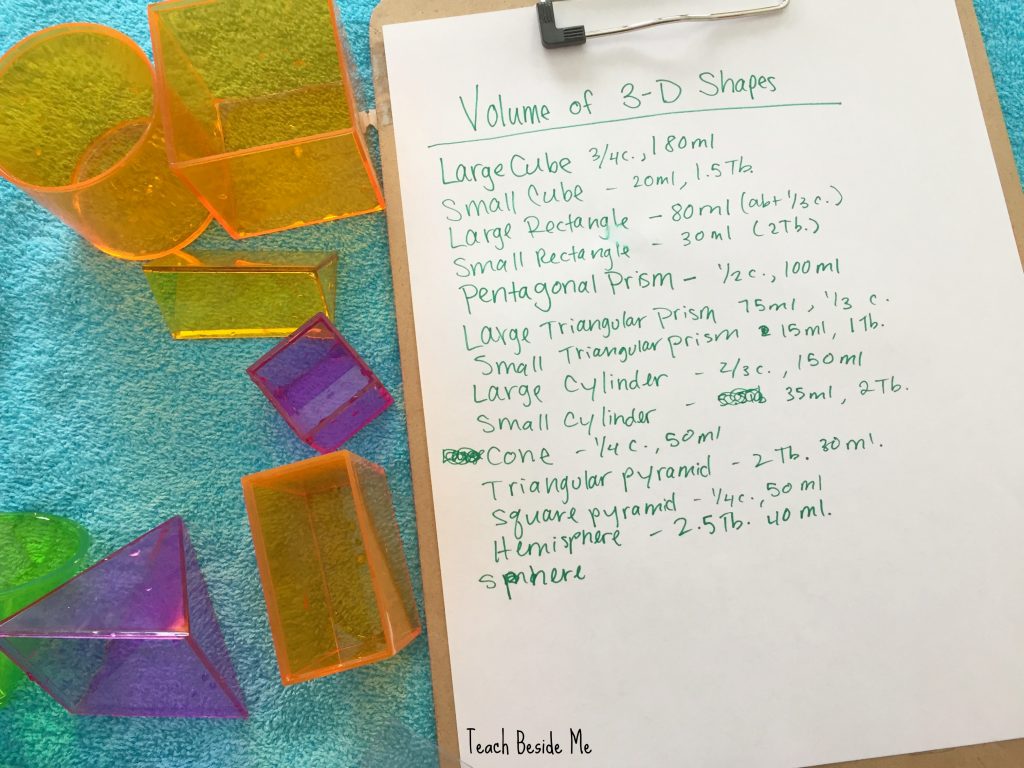
How to Find the Volume of 3D Shapes Using Water
For this experiment, we used a set of geometric shapes that my kids love playing with. They often fill them with rice, water, and other materials and were curious about which one would hold the most. So, we turned their curiosity into a science-based learning activity!
Materials Needed:
- A set of geometric 3D shapes (cones, cubes, cylinders, pyramids, spheres, rectangular prisms, etc.)
- Measuring cup (to record volume)
- Pitcher of water
- Notebook and pencil (for predictions and results)
- Optional: Dry rice (for an alternative way to measure volume)

Steps to Measure Volume with Water:
- Identify the Shapes – We wrote down the names of each 3D shape to help reinforce geometric vocabulary.
- Make Predictions – Before measuring, we estimated which shapes would hold the most and least amount of water.
- Fill with Water – Using a pitcher, we carefully poured water into each shape until it was full.
- Measure the Volume – We poured the water into a measuring cup and recorded the measurements.
- Compare Results – Some outcomes surprised us! Cones and pyramids, for example, held less than expected due to their tapered tops.
This simple experiment reinforced key STEM concepts while making volume measurement fun and engaging! This can be a difficult topic to understand, but this activity can make it doable for younger kids!

It was so much fun to see how much each would hold. Some were surprising to us! Not all were the way we guessed. Appearances can be deceiving!

The cones and pyramids seemed like they would hold more than they did in particular. But my kids did not consider the fact that they were tapered at the top.
Volume Formulas for Common 3D Shapes
1. Volume of Cube
Formula: V = s³ (Side × Side × Side)
2. Volume of Rectangular Prism (Cuboid)
Formula: V = l × w × h (Length × Width × Height)
3. Volume of Cylinder
Formula: V = πr²h (π × Radius² × Height)
- Radius (r) is the distance from the center of the circular base to the edge.
- Diameter is twice the radius: d = 2r.
4. Volume of Cone
Formula: V = (1/3)πr²h (1/3 × π × Radius² × Height)
- The circular base of a cone plays a significant role in determining its volume.
5. Volume of Sphere
Formula: V = (4/3)πr³ (4/3 × π × Radius³)
- The volume of a sphere is calculated using the radius, which measures from the center to the surface.
6. Volume of Pyramid
Formula: V = (1/3) × Area of the Base × Height
- Pyramids have different base shapes, affecting how their volume is calculated.
By applying these formulas, kids can learn how to calculate volume mathematically while confirming their findings with hands-on water measurements.
Best Measurement Units for Volume Experiments
The appropriate measurement unit depends on the method used to find the volume:
- Milliliters (mL) and Liters (L) – Best for measuring liquid volume when using water to fill 3D shapes.
- Cubic Centimeters and Cubic Inches – Ideal for mathematical volume calculations using formulas.
- Grams (g) and Kilograms (kg) – Useful when measuring dry rice or sand, converting weight to volume.
- Ounces (oz) and Cups – Helpful for household-friendly measurements with kitchen tools.
Encouraging kids to compare different measurement units enhances their understanding of unit conversions and real-world applications of geometry.
Benefits of This Volume Measurement Activity
This experiment helps children:
- Develop spatial awareness – Understand how 3D objects relate to volume and capacity.
- Improve math fluency – Reinforce multiplication, division, and geometric concepts.
- Enhance problem-solving skills – Make predictions and analyze results.
- Learn real-world STEM applications – See how volume applies to everyday situations.
- Engage in hands-on learning – Active participation leads to better retention and understanding.
- Connect Geometry to Real Life – Recognize how radius, diameter, circular bases, and surface area influence measurements.
Alternative Ways to Measure Volume
- Using Dry Rice: Instead of water, fill each shape with rice and pour it into a measuring cup. This avoids spills and helps visualize volume in a solid form.
- Using a Scale: Weigh each container before and after filling to determine volume by mass.
- Applying the Formulas: Have students calculate volume mathematically and compare with the experimental results.
- Surface Area Connection: Explore the relationship between a shape’s surface area and volume—for example, a cube with the same volume as a sphere has a greater surface area.
Understanding volume through hands-on experiments makes learning math fun and meaningful. By using water, formulas, and predictions, kids develop a deeper understanding of 3D shapes and their real-world applications. Try this experiment at home or in the classroom, and watch your kids get excited about STEM learning!
Which 3D shape surprised your kids the most? Let us know in the comments!
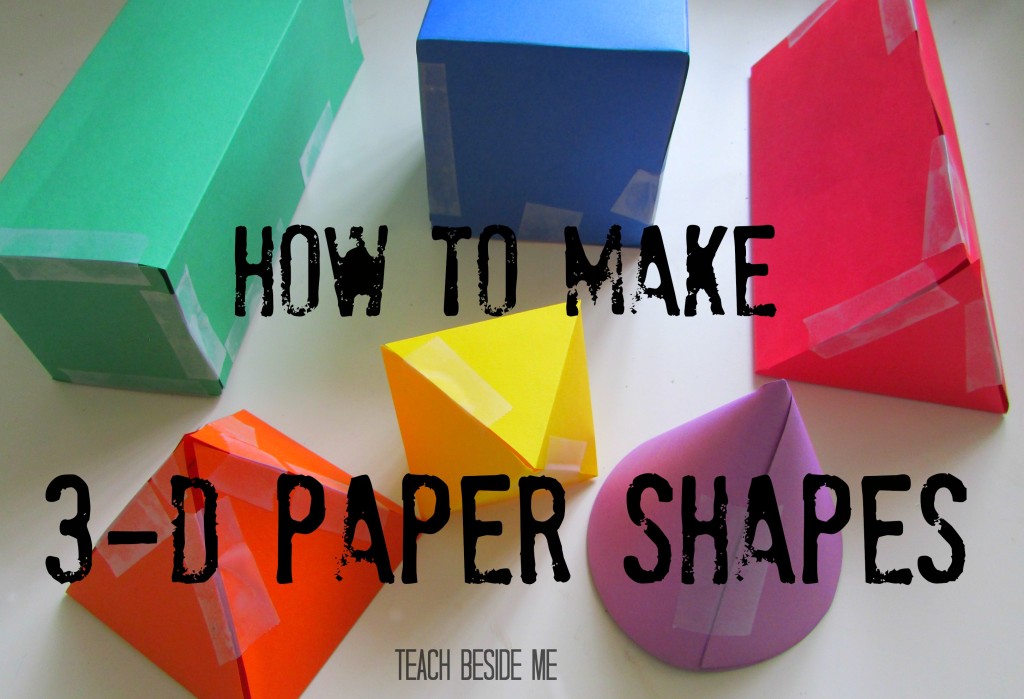
Want more 3-D Shape Ideas? Check out this post on How to Make 3-D Paper Shapes!
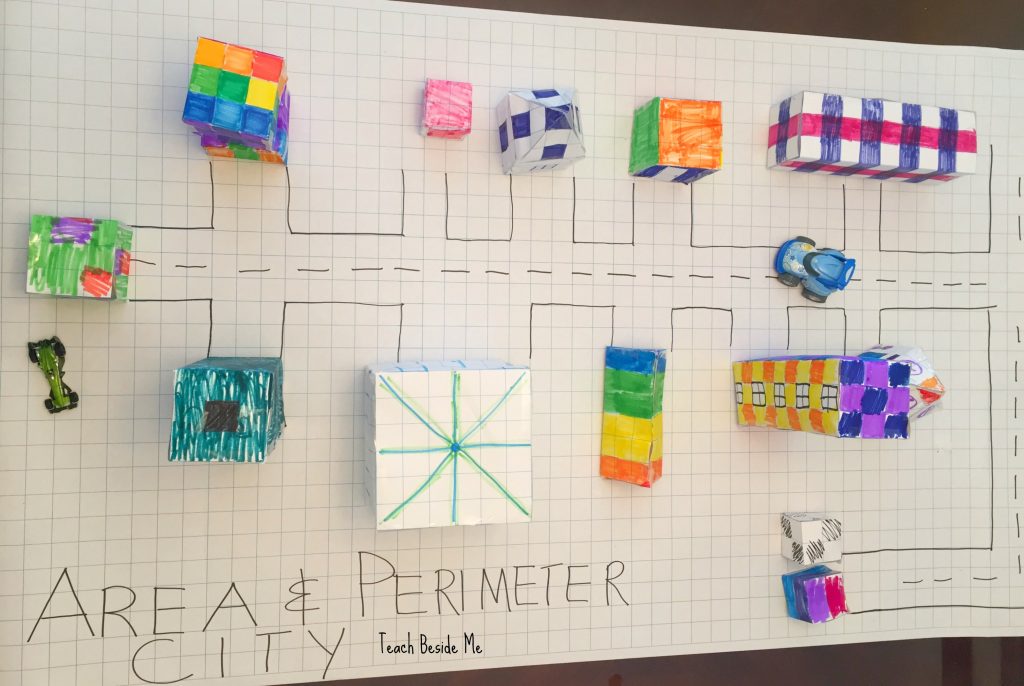
Also you may like my Area & Perimeter City post!




How awesome! I have this exact same set sitting on my shelf and my kindergartener is beside himself with anticipation for when they come out. I’m a bit behind in our shape program, though. I had told him we’d get them out when we got to the three dimensional shapes, but I may break down and do it before then.
You definitely should! No need to wait! 🙂