
Periodic Table Game for Kids: Periodic Table Battleship
This post may contain affiliate links.

Looking for a fun way to teach the Periodic Table of Elements to kids? Turn it into a game! Periodic Table Battleship is a simple chemistry game that helps kids become familiar with element names, symbols, atomic numbers, and the layout of the periodic table—all while playing a familiar strategy game.

Best of all, kids don’t need to know much about chemistry before they begin. When I first made this game, even my 8-year-old, who hadn’t studied chemistry yet, could play and enjoy it.
Instead of memorizing a long list of elements, kids interact with the periodic table over and over as they call out elements, search for coordinates, and try to sink their opponent’s ships.

If your kids enjoy learning through games, be sure to try my Periodic Table Guess Who Game, too! It’s another simple way to practice identifying and comparing elements while becoming more comfortable using the periodic table.
You can also find more hands-on ideas in my Chemistry for Kids collection and more than 200 STEM projects for kids.
Why Use Games to Teach the Periodic Table?
The periodic table contains a lot of information, and it can feel overwhelming when kids first see it. Games give students a reason to look closely at the table without requiring them to memorize everything first.
As they play Periodic Table Battleship, kids naturally begin noticing:
- Element names and chemical symbols
- Atomic numbers
- Rows (periods) and columns (groups)
- Locations of different elements
- Patterns within the periodic table
- Groups such as alkali metals, halogens, and noble gases
You can keep the game very simple for younger students or add more chemistry knowledge as kids become familiar with the table.
Download the Periodic Table Battleship Game
Supplies for Periodic Table Battleship
You will need:
- 4 laminated copies of the Periodic Table
- 2 File Folders
- 1 Giant Paper Clip
- 2 Dry Erase Markers
I laminated our periodic tables so we could mark them with dry erase markers and play again and again.
How to Set Up Periodic Table Battleship
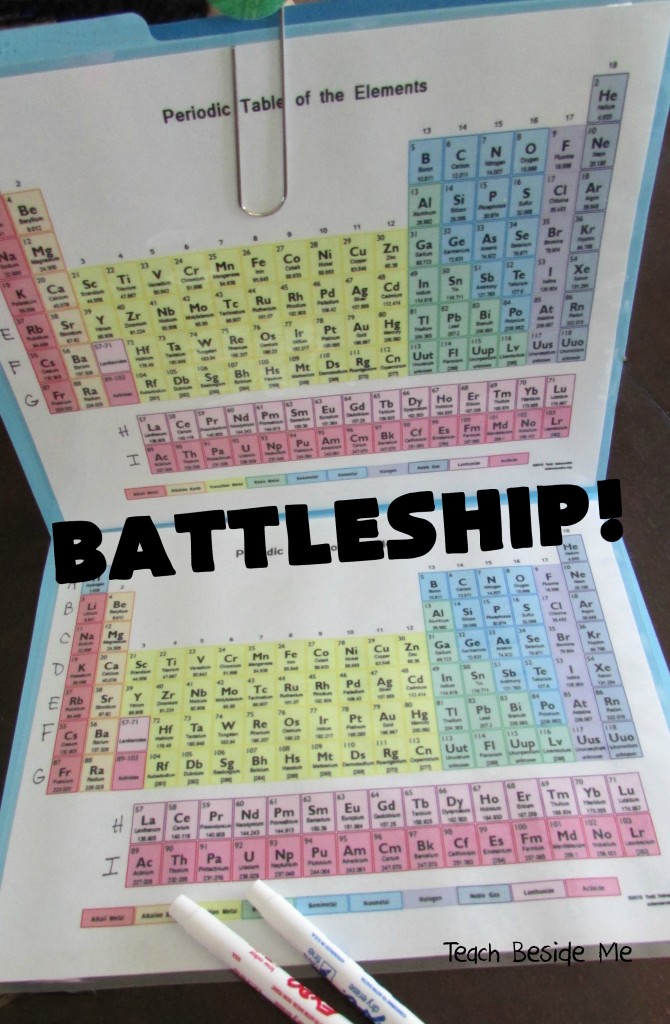
Print four copies of the periodic table—two for each player.
Each player needs one periodic table for placing ships and another for tracking guesses.
To create a simple Battleship-style divider, stand two file folders upright and clip them together at the top. Attach one periodic table to each side of the divider and place the second copy flat in front of each player.
You can glue or tape the periodic tables into the folders if you’d like to make a permanent game.
Add Coordinates for Younger Kids
For younger players, I labeled the rows along the side of the periodic table with letters. This creates simple letter-and-number coordinates and allows children to play even if they aren’t comfortable pronouncing all of the element names yet.
As they become more familiar with the periodic table, you can stop using coordinates and have them call out element names, symbols, or atomic numbers instead.
How to Play Periodic Table Battleship
Before beginning, each player secretly places ships on the lower periodic table by circling groups of neighboring elements.
Try ships that cover:
- 2 elements
- 3 elements
- 4 elements
- 5 elements
Decide together how many ships each player will use.
Players then take turns guessing locations on their opponent’s periodic table. Depending on the age and chemistry knowledge of your students, they can make guesses using coordinates, element names, chemical symbols, or atomic numbers.
Mark a miss with an X on the upper tracking table. Circle a successful hit.
A ship is sunk when every element included in that ship has been hit. Continue until one player sinks all of the other player’s ships.
Make the Periodic Table Game More Challenging
One thing I love about this game is how easily it can grow with your kids.
Beginners can simply practice locating elements. Older students can be required to place ships in different areas of the periodic table or identify elements using chemistry clues.
For example, challenge players to place a ship among the:
- Alkali metals
- Alkaline earth metals
- Transition metals
- Halogens
- Noble gases
You can also require guesses to be made using element symbols or atomic numbers instead of coordinates.
That turns a simple strategy game into repeated practice navigating and understanding the periodic table.
What Is the Periodic Table?
The modern periodic table grew from the work of Russian chemist Dmitri Mendeleev, who published an influential version of his periodic table in 1869.
Mendeleev arranged the known elements largely according to their atomic mass and chemical properties. One of the remarkable things about his table was that he left gaps where he believed undiscovered elements belonged—and successfully predicted properties of some of those missing elements.
Today, the periodic table is arranged by atomic number, which is the number of protons in an atom’s nucleus.
The elements are arranged from hydrogen, with atomic number 1, through oganesson, with atomic number 118. Their positions also reveal patterns in their chemical properties, which is one reason the periodic table is such an important tool in chemistry.
The Newest Named Elements
The four most recently named elements were officially given their names in 2016:
- Nihonium (Nh) — 113
- Moscovium (Mc) — 115
- Tennessine (Ts) — 117
- Oganesson (Og) — 118
With these additions, all seven rows of the periodic table currently have named elements.
Watch my kids playing the Periodic Table Battleship Game.
Try Periodic Table Guess Who Next!
If your kids liked Periodic Table Battleship, I’ve created another game specifically for practicing with the elements.
In Periodic Table Guess Who, players choose a mystery element and ask yes-or-no questions to eliminate possibilities until they can identify their opponent’s element.
Kids can ask questions based on an element’s location, classification, atomic number, symbol, or other characteristics. It encourages them to actually use the information contained in the periodic table, rather than simply memorize it.
These two games work especially well together: use Battleship to practice navigating the table and Guess Who to practice comparing and identifying elements.
More Chemistry Activities for Kids
Keep exploring chemistry with these activities and resources:
You can also find more creative science activities in my Science Art Book!






Probably the coolest thing I have seen done with our periodic tables so far. Great idea!
Thanks!! And thanks for making these free ones available to print. It is so helpful!
Thanks! If you ever need a special periodic table design, we take requests from readers. Always on the lookout for a new way to present the information 🙂
Love it!!! What a great idea! Since my kiddo’s are a little older ( 10 and 11) I think I will just have them call out the element by its abbreviation and or name vs calling out the coordinates. Hopefully, this will get them more familiar to them.
Yes! That is what I was thinking as well. My kids did start doing that as they played for a little while.
Me too. That way, you get to know “where” elements are relative to their neighbors, which allows you to take the next step and introduce the concept of “families” of elements (like the noble gases, etc.)
Darn, I wish this idea had popped up around 15 years ago, Guess I’ll have to wait for grandkids to employ this one…
Another option of calling out is to use the atomic number of the element, so the kiddos can get used to reading the table also. Since each element has a unique atomic number.
my kids are 10 and 11
Brilliant! Totally going to do this. Thanks!
Thank you! My kids love love battleship and now all four can all play at the same time.
Very cool. Love this. My daughter is a bit young still but I’ll probably do it anyways with her. 😛
“Ahhh, I see you’re trying to outflank me with the Noble Gas maneuver…”
Nope, but I’ll get you with the Halogen’s for sure!
I’m having trouble Pinning it.
Super neat idea! My 11yo is doing chemistry in the fall and this will be great.
Seriously BRILLIANT! My son will be in chemistry this fall. This is great jump start to it.
I am a chemistry teacher. Neat Idea…. but please don’t use letters on the side, the periodic table is numbered on the rows too. Just put those numbers (1,2,3,4, etc) if they are not there, remembering that the bottom two rows are actually embedded in the row 5 and 6 where the arrows pull them down to spread them out.. The numbers at the top should be 1A, 2A, 1B, 3B, etc. To get your students to learn the periodic table, don’t just sink ships, eliminate groups. Have “students” select one element in each group (they are labelled by color on the PT itself). Students can call by element symbol to start but they can also use location “2-1A” or atomic number or mass number. If you get a more sophisticated PT to print it will have the melting point and a lot of other properties as well.
Thanks so much for your awesome comment! I am NOT a chemistry teacher, so I appreciate your input. 🙂
Good thinking. I’m a chemistry teacher too, and my first thought was to gasp at the letters on the side. If someone really wants to use letters on the side, they could start with the letter K, then L, M, etc and go from there since the first level is the K shell. But I think using the atomic number or mass is the better idea. And after giving the number, the other person should respond by saying the name of the element.
From a chem teacher, here, we use the periods, but for my High schoolers it is a great idea to combine shell! thank you for poining that out!
For high schoolers could your ‘ships’ be molecules drawn from a hat? So if I get H2O, my opponent has to call H (once, or twice?) and O to sink it? Just a thought, great game idea!
Chemistry teacher suggestion: periodni has a color pdf with the appropriate numbering system. Intermediate students could use the names of the families so Calcium is “Alkaline Earth Metals, Period 4”
Advanced students could cut up a table and do some sort of Guess Who game.
The numbers at the top reflect current IUPAC convention. They’re the people who set the standards on this kind of thing, so I’d say leave them as is.
What a fabulous idea! Thanks for making them free to use. 🙂
What did you use for ships?
We just drew them on with our markers.
If you use transparency film and transparency markers, you wouldn’t need to print new periodic tables each time you play.
We actually laminated them, but transparency would work well, too!
Do you have a video on how to play it? Thanks. This is the coolest thing!
Oh my goodness this is such a great idea! My boys love playing battleship and love the elements. We have the Basher Books poster on our wall and they often test me on the elements and it helps them remember as well. Must try out this game – I think it will be a hit!
We love that book, too! 🙂
Why call out coordinates? Why not have them call out element names? Then they’d learn where elements appear in the periodic table.
Mostly I did coordinates to make it non-threatening for my 7-year-old to play. But they ended up calling out the element names after a few minutes of playing & liked that much better!
Thank you for sharing this! I have three grandchildren and I love to play educational games with them. I can’t wait to see what other new things pop up in the future.
Grandma Bre
This is an awesome idea. Kudos!
Instead of sinking the battleships, you Barium.
I teach high school chemistry. Would you consider using the concepts of “periods” (rows) and “groups” (columns) instead of the alphabet? It would make kids more scientifically literate and not mix them up later when they learn the real terminology for finding elements. (e.g.) Period 5, Group 15
Love that idea!
And if you LAMINATE you can use them over and over again.
Although it doesn’t follow the rules of Battleship, I’d encourage chemistry students to use Group/Period instead of letters/numbers because it teaches more chemistry vocabulary. Others have mentioned using the symbol, which also works, OR have them provide the name/symbol of the element and the other student could find the name/symbol as well to begin correlating the two.
I would prefer the kid to say, Period 1, Group 1 instead of A1 for Hydrogen. Even the little ones could get used to it easily. I am going to try it like that.
If you laminate these and use whiteboard markers they can be reused in a class situation, make about 3 sets and let the kids play as a reward for finishing their work well before the end of class. They simply wipe it clean when they are done.
Yup! That is exactly what we did!
Thanks i make one
With math like 6×7
This is BRILLIANT! I am fwding this to all my homeschool friends and my teacher friends!
Wow! I love this idea! I can’t wait to use it in my classroom. I just had to repost this idea, Karyn, because your idea is amazing! Thanks for sharing. http://castlekids46.blogspot.com/2015/09/science-game-periodictable-battleship.html
This is great inspiration! In my 8th grade classes we substitute the coordinates with “Periods” and “Groups/Families”. And for those students who want/need a little more challenge, the students are supposed to ask them a question like they would for “Go Fish” using the correct number for a proton, neutron, and electron in a neutral atom. For instance, “Do you have an element that has 19 protons, 20 neutrons, and 19 electrons?” (which is Potassium) If the opponent does, then they get to hit it. If the student inaccurately provides a subatomic number (usually it’s the neutron they will get wrong), then the opponent can say, “miss,” because they didn’t have the correct numbers. The person can try again on their next turn if they really suspect there’s something to “hit” at that spot.
This version is really useful if you want to test them on their ability to determine numbers of subatomic particles.
This is SUCH a cool idea!! I am totally going to do this with my kids this week! Thank you for sharing!
Very nice I saw this idea on pinterest this evening. But as a science teacher, I am just thinking it would be nice that instead of calling out the co-ordinates then instead to call out the names of the elements ?
What do you think ?
I think it sounds like a great idea. It would certain give the kids some practice in the names of the elements.
This works well using the electron configurations to identify the element too.
Where can I get this?
We made it. Read the instructions in the post to learn how!
We made this today and had a blast. Thank you for the fun idea!!
Karyn, would you consider making more of these yourself and selling them? I’d be happy to pay you for the cost, shipping, and your time! if you have other creative learning games you’ve created for your own kids like this, please let us know and perhaps that’s a figure business for you?! There’s a big and growing market demanding science and technology toys for kids these days…
My husband, a Chem teacher of 10 years, picked up the idea years ago from HASTI, we’ve been using it at our co-op also. The students like the thrill, we make a competition. The students get used to using the periodic table, then the championship is played with blank periodic tables, in teams. We leave only the PERIODs named (the rowes named 1-7 in a periodic talbe, what you have named A-G), and the 18 chemical GROUPS (the numbers of the colums), then at the end the class is divided in two teams. They call out the spots by saying Period 2, Group 1, Then they Say the Simbol: Li, the atomic number: 4, and we have it worked out that they have a “hit” if they have spelled the Simbol correctly and given the correct Atomic Number. We have rules for partial hits. We have also added a sand timer for each team to use to make a hit. My husband uses this championship in stead of Periodic table quizes, so the teams get the grade they scored in the game. We used ships that fit the periods (actual game pieces, made of paper) However, I think with your idea of using laminated periodic tables with markers! that would make things easier for the championship! Thank you for posting, we love ideas like this keep it comming!
Encouraged by your blog,
THe Q Family
this comment should be on the top. haha well done.
please upload the video of this , if u can
Random comment…I am Karyn, who also is a bird lover/educator. I was startled for a moment of the “Karyn” with the blue bird. Very cool. I am sharing this will all my home school Mom’s and fellow educators. Great idea! And great name!
Awesome!! Love your name. Mine is pronounced Car-In, not the traditional pronunciation. 🙂 Welcome to my site & thanks for sharing!
Brilliant is the first word that comes to mind! Doing this now! Thanks for this awesome idea.
WE are doing Chemistry this year so this will be awesome!! Thank you for sharing!!!
Brilliant!
I will pin, tweet, and post about this. What a fantastic idea!
What a great idea. I teach Natural Sciences (including chemistry) to 14 and 15 year olds in Pietermaritzburg, South Africa. I’m always looking for new ideas after 30 years of teaching the same things – even after all this time, the Periodic Table still rocks! thanks for sharing.
Hi,
It is a great way to learn chemistry. When I wasa school, my teacher gave us the periodic table in black and white. It was very difficult to me to learn it. I wish someone had taught me this way.
Thank you.
Genius! I’m going to use this with my science classes next week!
What a great idea! Yet so simple. Just wish I’d run across this earlier before my daughter finished her science (chemistry) class/exam LOL Definitely saving it for my son’s turn! Brilliant!
Very cool! This was just featured on CTV news!
http://www.ctvnews.ca/5things/find-inspiration-from-one-mom-s-periodic-table-battleship-game-1.2744802
It’s a great post. I did read with pleasure
I keep signing up for your site, but I can’t find way to download the periodic table battleship game. Am I missing something? Thanks!
When you sign up, you should get an email with a link to the subscriber freebies- including the Periodic Table Battleship. IF it doesn’t come, I am happy to send you the link through your email.
I love it! This is a great idea. A lot of fun and they don’t care that they are learning. Thank you for sharing this.
Tracy Elman
Author Homeschool 101 -Without going crazy
This would not accept my email address above. Would love a free copy.
I filled out the info to receive the Periodic Table Template, but I haven’t received anything. Please advise….My kids are super excited to make this game!
You should have gotten an email with a link to the subscriber page that has it available. Check your spam- they tend to go there.
This is a very cool idea!
Have you considered making it into an actual board game, using a print-on-demand manufacturer like Game Crafter? https://www.thegamecrafter.com/
That way you could have tokens, instead of circling the elements.
This is fun! And thanks for the printable. And yes–great soundtrack!
This looks fantastic. However if students are learning about the periodic table I would get them to use the terms ‘group’ (the numbered columns) and ‘period’ (the rows which are not numbered but can be). I would not use the lettering.
I can’t access the free periodic table for the Battleship game??
Is your subscribe button broken? Nothing happens when I click it.
You likely have pop-ups blocked preventing it from showing up. I am happy to help you subscribe manually!
This is a great idea! I love the periodic table (I am sitting here drinking hot chocolate out of a mug with the periodic table on it right now!) My 5- and 7-year-old are going to love playing periodic table battleships (and so will I). I may alter it slightly though and make it about finding hidden treasure (or something similar) for a more peaceful game. 🙂
I made this for my students with a few variations. We called it Lab Wars instead of Battleship and used laminated game pieces – a ruler to cover 6 squares, a DNA strand to cover 5, a test tube to cover 4, and a molecule to cover 3. When a piece was fully hit, students had to say something like, You broke my ruler! or, You spilled my test tube!, or You mutated my DNA strand! A player also got to take 2 turns if their opponent didn’t call out the atomic number AND element name as part of their guess. We played this early in our study of the periodic table as a way to become familiar with element names and their location on the table.