
Washington Irving’s Legend of Sleepy Hollow Activities: Literary Mystery
This post may contain affiliate links.
Washington Irving’s The Legend of Sleepy Hollow is a classic American short story filled with mystery, superstition, and one very famous Headless Horseman.
But one of the best things about the story is that Irving never really tells us what happened.
Did Ichabod Crane actually encounter the Headless Horseman? Was Brom Bones behind the whole thing? Did Ichabod’s imagination get the better of him? Or did he survive the encounter and simply decide to leave Sleepy Hollow for good?
That unanswered question makes The Legend of Sleepy Hollow perfect for a literary investigation!
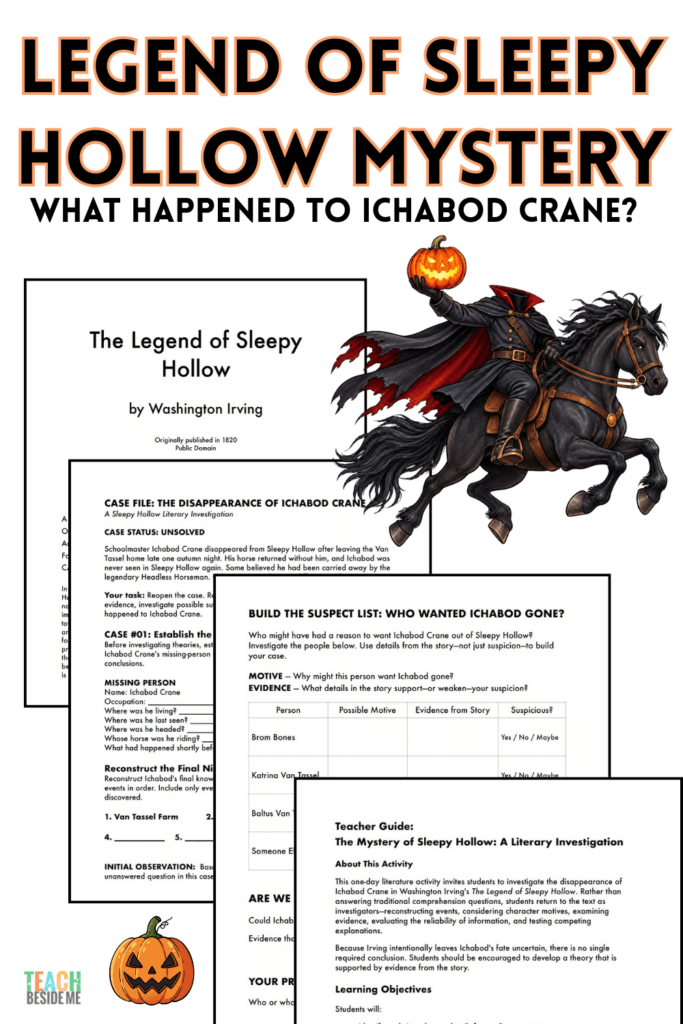
I created a Legend of Sleepy Hollow mystery activity that lets students become investigators as they examine clues, consider suspects, separate facts from rumors, and decide for themselves what they think really happened to Ichabod Crane.
Who Was Washington Irving?
Washington Irving was one of the first American writers to gain international recognition. Born in New York in 1783, he became known for short stories that blended American settings, folklore, humor, and the supernatural. In addition to The Legend of Sleepy Hollow, Irving wrote another famous short story, Rip Van Winkle.
Both stories appeared in The Sketch Book of Geoffrey Crayon, Gent., published in installments in 1819 and 1820.
The Legend of Sleepy Hollow Summary
First published in 1820, Washington Irving’s The Legend of Sleepy Hollow is one of America’s best-known early short stories.
The story is set in the Dutch settlement of Sleepy Hollow in New York’s Hudson River Valley. It follows Ichabod Crane, a lanky schoolmaster with a fascination for ghost stories and the supernatural. The tale of the Headless Horseman was already well known among the residents of Sleepy Hollow.
Ichabod becomes interested in Katrina Van Tassel, the daughter of a wealthy farmer named Baltus Van Tassel. But he has some competition. Abraham “Brom Bones” Van Brunt is also interested in Katrina—and he isn’t particularly happy about Ichabod’s attempts to court her.
One autumn evening, Ichabod attends a gathering at the Van Tassel home. After the party, he has a private conversation with Katrina and leaves looking decidedly unhappy.
On his nighttime journey home, Ichabod encounters a mysterious rider who appears to be the legendary Headless Horseman.
The Horseman pursues him through the woods toward a bridge where, according to local legend, the ghost should disappear. Instead, the rider hurls his “head” at Ichabod.
And then… Ichabod disappears.
His borrowed horse returns. Ichabod’s hat is discovered near the road, and nearby lies a shattered pumpkin. But Ichabod Crane is never seen in Sleepy Hollow again.
The Main Characters in The Legend of Sleepy Hollow
The characters themselves make the mystery surrounding Ichabod’s disappearance even more interesting.
Ichabod Crane is the schoolmaster at the center of the story. He is educated and imaginative, but he is also deeply superstitious. He loves hearing ghost stories—even though they terrify him afterward. That makes him a particularly susceptible victim for a frightening nighttime encounter.
Katrina Van Tassel is the daughter of wealthy farmer Baltus Van Tassel. Both Ichabod and Brom Bones hope to win her affection, although Irving leaves Katrina’s own intentions somewhat mysterious.
Brom Bones is Ichabod’s biggest rival. He is strong, confident, an excellent horseman, and well known for practical jokes. When his attempts to intimidate Ichabod don’t work, Brom has plenty of reason to want his rival out of the picture.
Baltus Van Tassel is Katrina’s father and the prosperous owner of the farm that attracts quite a bit of Ichabod’s attention. While it’s easy to imagine several possible motives for the characters in this story, Irving reminds us that a possible motive isn’t necessarily evidence.
And that makes things much more interesting.
Who Is the Headless Horseman?
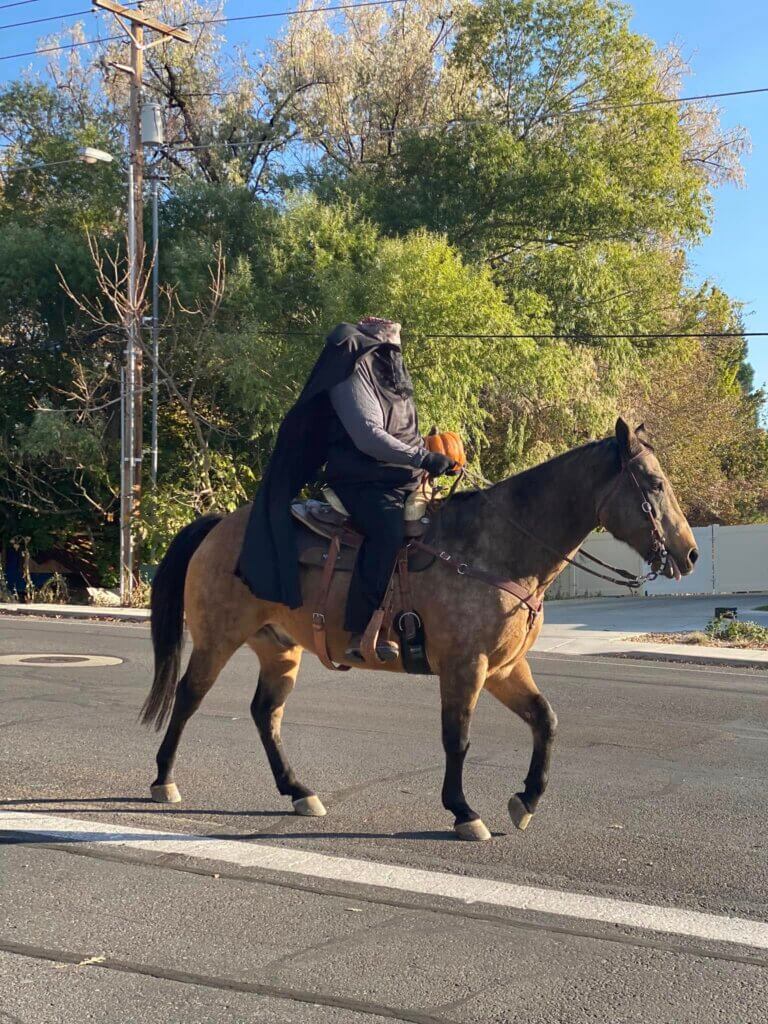
The Headless Horseman has always been a fun legend around our house because we actually have our own local version! Every year during Halloween week, someone in our city dresses as the Headless Horseman and rides through town on horseback- complete with pumpkin in hand.. It’s always fun to spot him riding through the neighborhood, and it makes Washington Irving’s famous legend feel a little more real around here!
The original Headless Horseman in Washington Irving’s story, however, is quite a bit more ominous.
According to the legend told around Sleepy Hollow, the Horseman is the ghost of a Hessian soldier whose head was carried away by a cannonball during the Revolutionary War.
His body was buried in the churchyard, but his ghost supposedly rides through the countryside at night searching for his missing head.
Ichabod has heard plenty of stories about the Horseman before his frightening ride home from the Van Tassel farm. In fact, ghost stories are part of the evening’s entertainment at the gathering.
By the time Ichabod finds himself alone on a dark road, his imagination has been very well prepared for something terrifying.
So when a mysterious rider appears beside him, Ichabod knows exactly who he thinks it is.
But is he right?
What Really Happened to Ichabod Crane?
This is where The Legend of Sleepy Hollow gets especially fun.
Irving gives us evidence for more than one explanation.
The people of Sleepy Hollow largely accept the supernatural version of events. Ichabod encountered the Headless Horseman and was spirited away by him. But there are some problems with that theory.
For one thing, there’s that shattered pumpkin found near Ichabod’s hat.
Then there’s Brom Bones. Brom is known for elaborate practical jokes. He’s a skilled horseman. He has a clear reason to want Ichabod gone. And when the story of Ichabod’s encounter is told later, Brom’s reaction to the part about the pumpkin is rather suspicious.
There’s also a later report that Ichabod was seen alive and had gone on to build a life elsewhere.
But even that doesn’t completely solve the mystery. Much of what readers learn at the end of the story comes through rumors, local beliefs, and secondhand reports.
Irving never steps in and says, “Here is exactly what happened.”
Maybe Brom disguised himself as the Headless Horseman and frightened Ichabod.
Did Ichabod’s own superstition caused him to interpret an ordinary person as something supernatural?
Ichabod could have survived the prank but was embarrassed, disappointed over Katrina, or simply ready to begin somewhere new.
Or, if you believe the residents of Sleepy Hollow, perhaps the Headless Horseman really did get him.
Irving leaves the door open just enough for readers to decide.
Why Does Washington Irving Leave the Mystery Unsolved?
I think this is one of the most interesting things to discuss after reading the story.
Irving could easily have revealed exactly what happened to Ichabod Crane. Instead, he gives us clues and lets the supernatural and rational explanations exist side by side.
And the setting makes that ambiguity even more effective.
Sleepy Hollow is a place filled with legends, ghost stories, superstition, and people who enjoy retelling strange tales. By the end of the story, Ichabod’s disappearance is already becoming another part of the folklore of the community.
Readers have to decide what they trust.
What do we actually know?
What do the townspeople merely believe?
Which details are rumors?
What can we reasonably infer from the evidence?
Those questions are what gave me the idea for this activity in the first place.
The Legend of Sleepy Hollow Literary Investigation
Instead of creating traditional comprehension questions for the story, I decided to turn the disappearance of Ichabod Crane into an unsolved case.
Students work through a six-page literary investigation as they reconstruct Ichabod’s final evening, investigate possible suspects and motives, examine clues from the story, and distinguish facts from rumors and inferences.
Then they test several possible explanations for Ichabod’s disappearance before making their own final determination.
There isn’t one required “correct” answer.
The important part is that students return to Washington Irving’s story and use textual evidence to support their conclusions.
Along the way, they’re practicing close reading, characterization, inference, source reliability, textual evidence, and literary analysis—but it feels much more like trying to solve a 200-year-old cold case.
Which, in my opinion, is considerably more fun than a worksheet full of comprehension questions.
With its eerie setting, ghostly legend, mysterious disappearance, and famous Headless Horseman, The Legend of Sleepy Hollow also makes a perfect October literature study or Halloween reading activity. It has all the spooky atmosphere of the season while giving students plenty of real literary analysis to dig into.
How to Use This Legend of Sleepy Hollow Activity
This makes a fun October literature activity, especially during the weeks leading up to Halloween. It gives you a seasonal lesson without stepping away from meaningful literature study—and the mystery format fits the story perfectly.
Students should read or listen to The Legend of Sleepy Hollow before beginning the investigation. They’ll also want access to the story during the activity so they can go back and look for evidence.
The investigation is designed to be completed in about 45–60 minutes after reading the story, making it easy to use as a one-day literature activity.
Students can investigate independently, work with a partner, or compare evidence and theories in small groups before completing their own final case reports.
It also makes for a great class discussion afterward. It’s interesting to see how students can examine the same clues and reach very different conclusions!
What’s Included in the Printable?
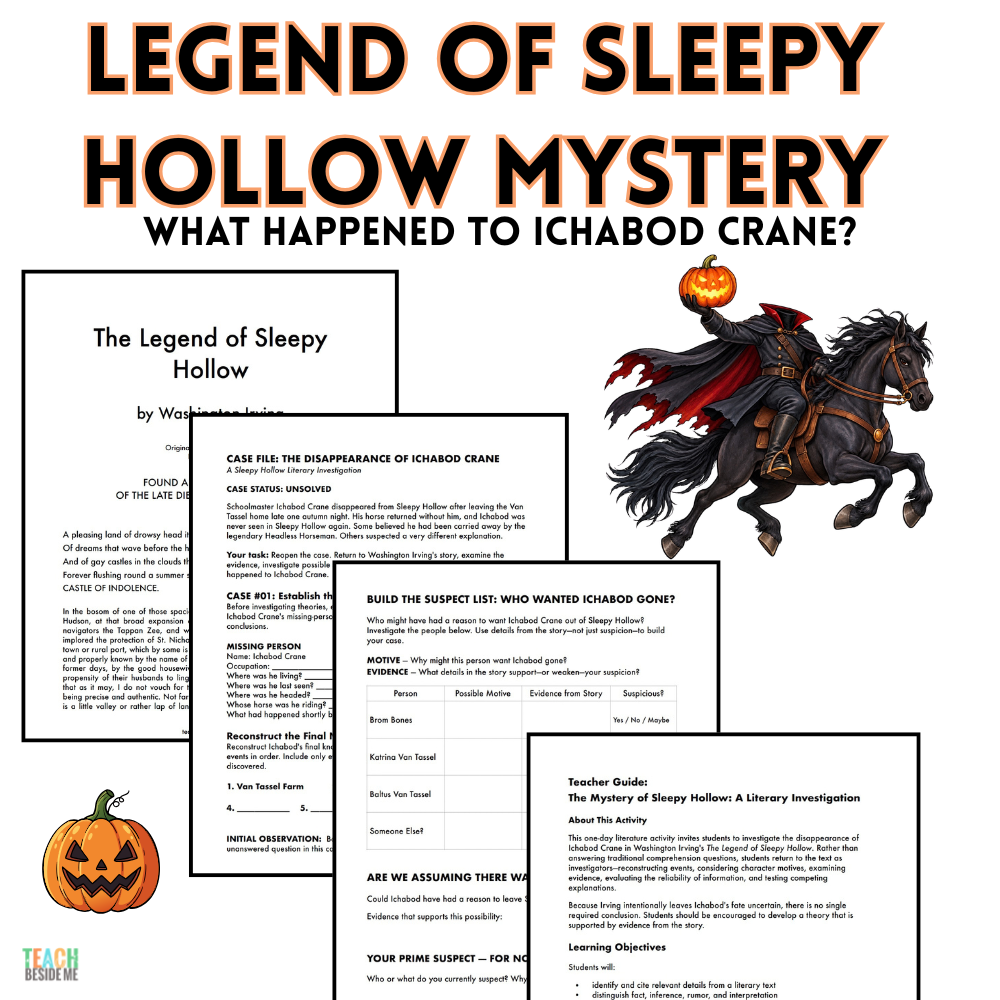
The complete Legend of Sleepy Hollow Literary Investigation includes:
- 6-page student literary investigation
- Ichabod Crane case file and timeline
- Suspect and character analysis
- Evidence investigation
- Fact, rumor, and inference activity
- Source reliability questions
- Competing theories about Ichabod’s disappearance
- Final case report
- Teacher instructions
- Teacher answer and discussion guide
- Full text of Washington Irving’s The Legend of Sleepy Hollow
I included the full public-domain text of the story right in the printable, so you don’t need to find a separate copy for your students.
GET THE LEGEND OF SLEEPY HOLLOW LITERARY INVESTIGATION IN MY SHOP:

Versions of The Legend of Sleepy Hollow
Washington Irving’s story has been retold and adapted many times over the past two centuries. If you want to extend your study of The Legend of Sleepy Hollow, it can be fun to read or watch another version and compare it with the original.
- The Illustrated Classic edition
- Disney’s Audiobook version
- Hardcover original text classic book edition
- Disney’s The Adventures of Ichabod and Mr. Toad movie version
More Classic Literature Activities
If you enjoy bringing classic literature to life in creative ways, take a look at my The Raven by Edgar Allan Poe printable activities.

You can also explore my Cups & Classics literature activities, where we pair classic books with art, writing, discussion, and hands-on learning.
Classic literature doesn’t have to mean reading a story and answering a list of questions afterward. Sometimes the most interesting thing we can do is give students a reason to go back into the text, look more closely, and start asking their own questions.
And a mysterious disappearance involving a Headless Horseman, a romantic rival, and a smashed pumpkin gives us plenty to investigate.


