Free Printable Multiplication Charts (1–10 and 1–12)
This post may contain affiliate links.
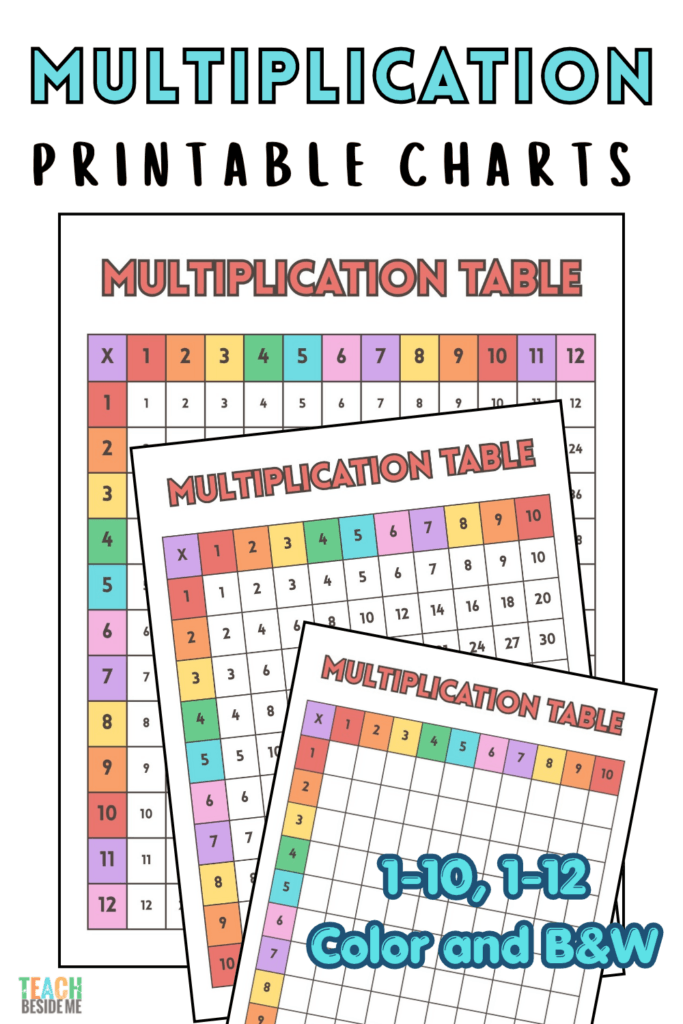
Looking for a free printable multiplication chart? These multiplication tables include colorful and black-and-white charts, plus blank practice grids for learning multiplication facts through 10 and 12.
Learning multiplication is so much easier when kids can actually see how the numbers work together! A multiplication chart is one of my favorite simple math tools because it helps children find answers, recognize patterns, and build confidence as they learn their times tables.
I’ve created a set of 8 free printable multiplication charts, including colorful and black-and-white versions, filled-in multiplication tables, and blank multiplication charts for practice.
Whether you’re introducing multiplication, practicing tricky facts, or looking for a handy math reference for your classroom, these printables are easy to use and keep on hand.
Free Printable Multiplication Charts
This printable multiplication chart set includes eight pages with two different number ranges.
Multiplication Charts 1–10
- Color multiplication chart with answers
- Blank color multiplication chart
- Black-and-white multiplication chart with answers
- Blank black-and-white multiplication chart
Multiplication Charts 1–12
- Color multiplication chart with answers
- Blank color multiplication chart
- Black-and-white multiplication chart with answers
- Blank black-and-white multiplication chart
The 1–10 charts are great for children beginning to learn their multiplication facts. The 1–12 charts include additional facts for students who are ready for more practice.
I love the colorful charts for exploring patterns, but the black-and-white versions are especially handy for classroom printing. Students can also color their own patterns on those pages!
DOWNLOAD THE MULTIPLICATION CHARTS PRINTABLE NOW!
How to Use a Multiplication Chart
A multiplication chart, sometimes called a multiplication table or times table chart, organizes multiplication facts into a grid.
The numbers across the top and down the left side are the factors. The numbers inside the grid are the products, or answers.
Here’s how to use it:
- Find the first number in your multiplication problem along the left side.
- Find the second number across the top.
- Follow the row and column until they meet.
- The number in that square is your answer!
For example, to solve 6 × 7, find 6 on the left and 7 across the top. Follow them to the square where they intersect. You’ll find 42!
As children become more familiar with the chart, encourage them to look for number patterns rather than simply looking up answers.
Multiplication Chart Patterns to Explore
One of the best things about a multiplication table is that it shows how multiplication facts are connected.
Here are some fun patterns to investigate together.
1. Find the Square Numbers
Look at the diagonal line running from the upper left to the lower right of the multiplication chart. You’ll find 1, 4, 9, 16, 25, 36, and more.
These are called square numbers because they’re the products of numbers multiplied by themselves. Try having kids circle the square numbers on their black-and-white multiplication chart.
2. Discover the Turnaround Facts
Did you notice that 3 × 7 and 7 × 3 both equal 21?
This is called the commutative property of multiplication. You can multiply two numbers in either order and get the same answer. Have children find matching products on opposite sides of the square-number diagonal.
This is a wonderful discovery for kids who feel overwhelmed by how many multiplication facts there are to memorize!
3. Explore the 5s and 10s
Look down the 5s column. Every answer ends in 5 or 0. Now look at the 10s column. Every answer ends in 0!
Have children color these columns and see what other patterns they notice.
4. Look for Patterns in the 9s
The 9s have an especially interesting pattern. Look at 9, 18, 27, 36, and 45. The tens digit increases by one while the ones digit decreases by one. And for the first ten multiples of 9, the digits of each answer add up to 9!
Can your child explain why this happens?
5. Double the Facts
Compare the 2s and 4s columns. Notice that 2 × 6 = 12, while 4 × 6 = 24. The answer doubles! Now compare the 4s and 8s. The same thing happens again.
These connections can help kids work out unfamiliar multiplication facts using facts they already know.
7 Fun Ways to Practice With a Multiplication Chart
A multiplication chart doesn’t have to be just a reference sheet. Here are some easy ways to turn it into an interactive math activity.
1. Multiplication Detective
Choose a number, such as 24, and challenge children to find every place it appears on the multiplication chart. Which multiplication facts make 24?
On a 1–12 chart, they’ll discover 2 × 12, 3 × 8, 4 × 6, and their turnaround facts.
This is also a great introduction to factors and factor pairs.
2. Roll and Multiply
Grab two dice and a blank multiplication chart. Roll both dice, multiply the numbers, and write the answer in the correct square.
For more variety, use 10-sided or 12-sided dice, or number cards.
Keep playing until you’ve filled in as many squares as possible.
3. Multiplication Color Hunt
Give each child a black-and-white multiplication chart and some colored pencils. Have them color the multiples of 2, 3, 5, or another number. Do some squares belong to more than one group? Why?
This is a fun way to explore common multiples and number patterns.
4. Mystery Multiplication Number
Cover one square on a completed multiplication chart with a small sticky note. Have children use the numbers around it and the row and column headings to figure out the missing product.
For an extra challenge, cover several squares at once!
5. Fill in One Row at a Time
Instead of asking children to complete an entire blank multiplication chart, start with one row. Practice the 2s, 5s, or 10s first, then gradually add more rows as their confidence grows.
The blank charts are also useful for quick math warm-ups and independent practice.
6. Multiplication Bingo
Have students choose nine products from their multiplication chart and write them on a blank 3 × 3 bingo grid. Call out multiplication problems such as 6 × 4 or 8 × 7. Students solve each problem and mark the answer if it appears on their bingo board.
The first to complete a row wins!
7. Find the Missing Factor
Instead of asking, “What is 4 × 6?” turn the problem around. Ask, “Four times what number equals 24?” Students can use their multiplication chart to find the missing factor.
This helps connect multiplication to division and prepares children for more advanced math.
Filled vs. Blank Multiplication Charts: Which Should You Use?
Both types are helpful, but they serve different purposes.
A filled-in multiplication chart works well as a reference while children are learning new facts. Keep one in a math notebook, on a desk, or near a homework area.
A blank multiplication chart is useful for practicing recall, reviewing facts, and checking progress.
I recommend keeping both available. Children can work on the blank version and use the completed chart to check their answers afterward.
More Hands-On Multiplication Activities
Once children understand how to use a multiplication chart, try extending the learning with multiplication games, math art, and other hands-on activities.
- Multiply and Color: Playing Card Multiplication Practice Printable
- 20 Fun Multiplication Card Games for Teaching
- Printable Multiplication Wheels for Math Fact Practice
- Number Multiples: Printable Multiplication Helpers
You can also use my free addition charts for children who are still building their addition and skip-counting skills.