
Gummy Juice Noodles: Food Chemistry Experiment for Kids
This post may contain affiliate links.
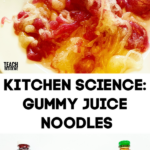
What if you could turn juice into gummy noodles?
This hands-on food chemistry experiment transforms ordinary juice into stretchy, squishy “joodles” using a fascinating scientific process called spherification.
It feels like kitchen magic — but it’s actually chemistry.

What’s Happening?
This experiment uses a reaction between:
• Sodium alginate (a gelling agent made from seaweed)
• Calcium chloride
When the juice mixture containing sodium alginate is introduced into a calcium solution, a chemical reaction forms a gel membrane. That’s what creates the gummy texture.
This technique is often used in modernist cooking to create juice spheres that look like caviar — but we turned ours into long gummy noodles instead!
Food Chemistry: How to Make Gummy Juice Noodles

Supplies You’ll Need
• 1 cup juice (100% juice works best)
• 1 teaspoon sodium alginate
• 1–2 teaspoons calcium chloride
• Blender
• Large bowl or pan
• Syringe or squeeze bottle
• Clean water for rinsing
These ingredients are typically found online.
Watch how we made the noodles:

How to Make Gummy Juice Noodles
-
Blend 1 cup of juice with 1 teaspoon sodium alginate until smooth.
-
Let the mixture rest for at least 1 hour to allow air bubbles to escape.
-
Fill a large bowl with water and stir in 1–2 teaspoons calcium chloride.
-
Using a syringe or squeeze bottle, squirt the juice mixture into the calcium solution.
-
Watch as long gummy strands form instantly.
-
Remove and rinse in clean water before tasting.
If your measurements are slightly off, you may get blobs instead of noodles — but they’re still delicious and fun.

Why This Is Such a Great STEM Activity
This experiment teaches:
• Chemical reactions
• Polymers
• Food science
• Molecular gastronomy
• Measurement accuracy
• Observation skills
And best of all — kids can eat the results.

Are They Safe to Eat?
Yes — both sodium alginate and calcium chloride are used in food science applications. Just be sure to rinse the noodles before tasting to remove excess calcium solution.

Storage
Store in the refrigerator and use within a few days for best texture.

My kids went wild over this experiment. We placed them on a plate and the kids ate them. They tasted just like gummies and my kids LOVED them! Plus, they are much better for you when you make them of 100% juice.

Experiments like this are a perfect reminder that science isn’t just something you read about — it’s something you can see, touch, and even taste. Turning juice into gummy noodles feels like magic, but it’s actually chemistry at work. When kids experience science in surprising, hands-on ways like this, they don’t just learn it — they remember it.
You May Also Like
If your kids loved these gummy juice noodles, try these other hands-on kitchen science activities:
• Cake Chemistry – Discover how ingredients react to make cake rise.
• Rock Candy Geodes – Grow edible crystals with sugar science.
• Homemade Butter in a Jar – Shake your way through a delicious chemistry lesson.
• Edible Soil Layers – Learn about Earth science with a sweet layered treat.
• Edible Layers of the Earth – Build the crust, mantle, and core with Rice Krispies.







My kids would love this experiment!
I think we had a science kit that created a similar substance, only not edible because it wasn’t with juice.
This looks like a super fun experiment! I think our son will have loads of fun doing this. I can just hear the squeals of excitement now.
so fun!!! Do you know what the chemical reaction is? Why it does it? Looking for a neat experiment for my daughter for her science fair. She needs to explain and understand so I was just wondering if you know why it happens.
This is about cross-linking polymers. For a science fair experiment, the variable you experiment with could be to compare the behavior of the sodium alginate mixture in a calcium chloride solution vs how it behaves in a sodium chloride solution. Or, what happens when you put the noodles you made using the calcium chloride solution into a sodium chloride solution. Your young scientist can research what accounts for the different behavior – and learn about ions and cross-linking polymers.
Kids will enjoy having this experiment at the school.
I saw that you ended up using two different juices
Yup! I thought it would look neat with two different colors.
We are doing this for our science fair project and we are very exited to make it!!!!!! Thank you for the idea!!!!!!!!!!!!!!!!!!!!!!!
Okay, so while you obviously haven’t made the sterotypical macaroni style noodles, “juiceroni” still seems like a fitting name for these.
Love it!!
Where did you get the Sodium Alginate and Calcium Chloride? Sadly I’m thinking this could be an awesome healthy fruit snack for me if I use 100% juice.
I got it on Amazon 🙂 It is linked in the post. They are really tasty!! It would make a good snack.
I was going to do this for a chemistry experiment and thought in would work with gelatin, it didn’t. So don’t try to substitute, use the sodium alginate!!!
Good to know! 🙂 Thanks!
HI,
So, what were your measurements for these juice noodles, despite being incorrect. We are going to try this on Friday!
Thanks!
Hey! The measurements I used are listed in there. I cup of juice, 1 teaspoon of sodium alginate. 🙂 Glad you are going
the spheres are more likely if the syringe delivers smaller drops into the calcium chloride solution. While a safety issue, a needle that fits the syringe will do this effectively or if you have access to plastic pasteur pipettes then cut off the bulb and place the shaft over the nozzle of the syringe. No, you wont get large spheres unless perhaps dip the end of the needle or pipette below the surface then slowly push the plunger – something to play around with. The alginate solution will last for about a week – perhaps refrigerate to improve this
Do you know how many batches of this you could do with the 2 oz packages that you linked? I would like to try this for a class but am unsure how much of the Sodium Alginate and Calcium Chloride I would need to purchase.
It will make a LOT. You only need a small amount for it to work. I have used it several times already and still have not run out.
We are needing to make an invention for my son’s school and I’m wondering if these would melt in hot water? For our idea, we are trying to make a liquid product into a solid (not frozen), but then it needs to melt when put in hot water like coffee or tea. Do you think these would do that?
The only thing u probably did “wrong” was ether u put in t much gell agent, or you used too big a suringe. ether way this turned out really cool!
what size syringe did you use? and what is the chemical reaction that happened? I want to teach this to kids, so need those details 🙂
Do you think this would work if it sat for only about 30 minutes instead of an hour?
Yes, it might. It just needs to thicken up.
I want to do this with my kids, how long does it take to sit?
Do you think I could make the alginate solution the night before if I kept it refrigerated?