Can You Make Paper Hold Up Books? Engineering STEM Challenge
This post may contain affiliate links.
Can you make paper hold up books? Most kids think the answer is no… until they see it happen!
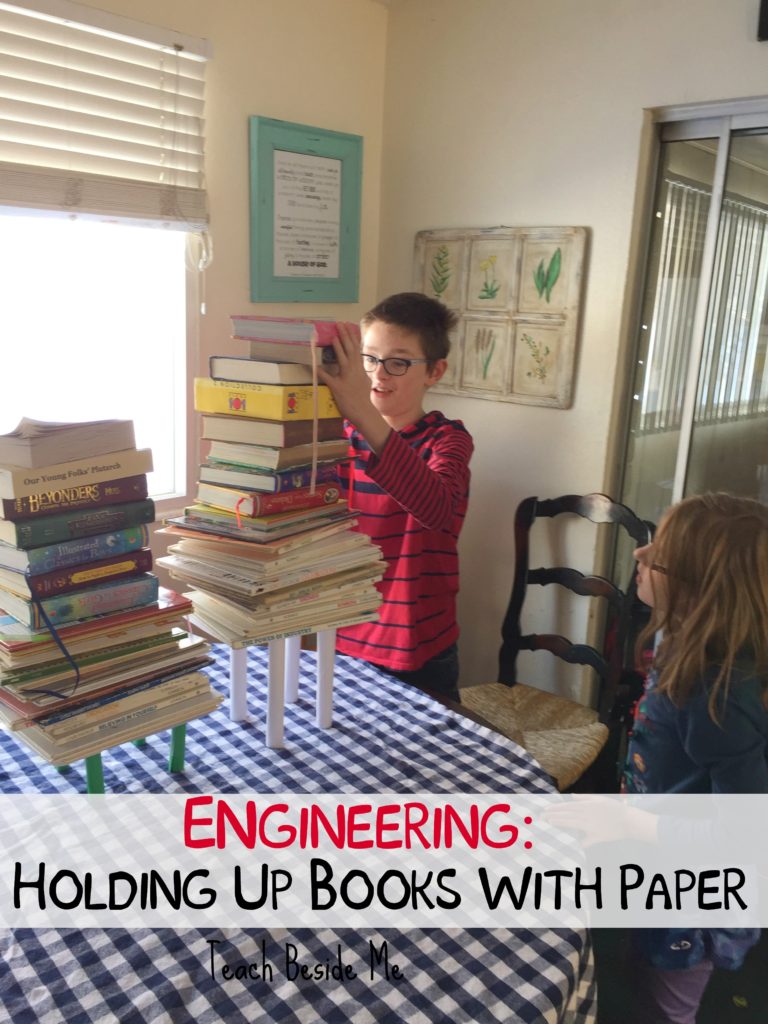
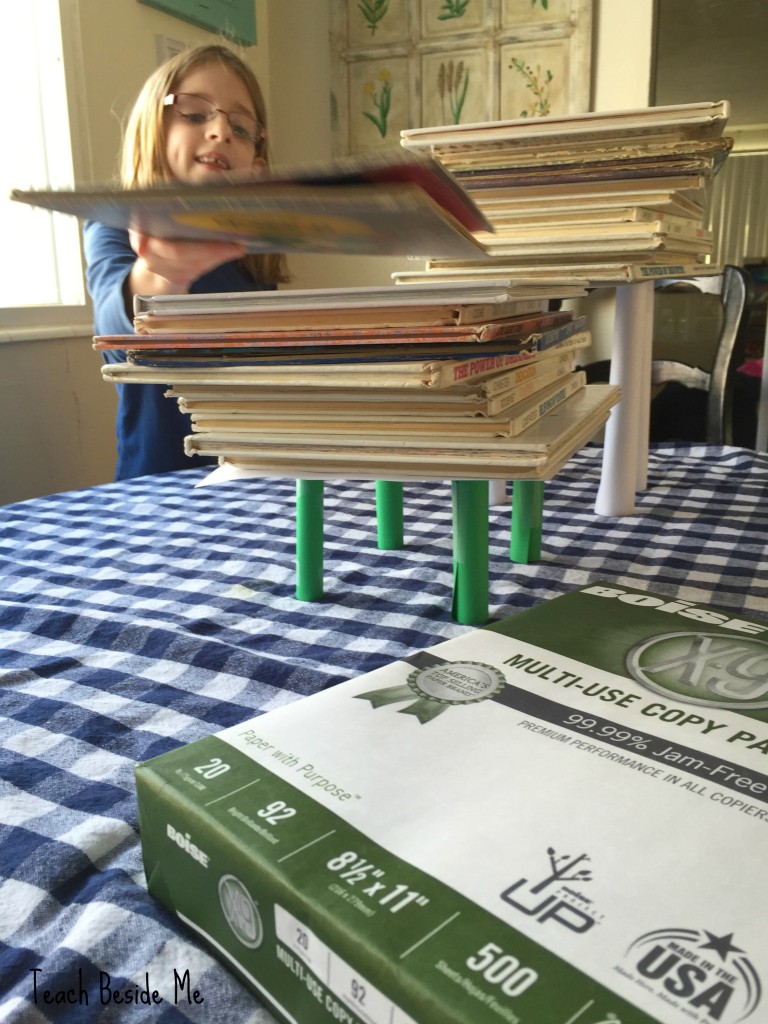
With just four sheets of printer paper and a little tape, we built a paper tower strong enough to hold 27 books. My kids were completely amazed by the results, and honestly, so was I.
This simple paper tower engineering challenge is a fantastic way to teach kids about strength, structure, design, and problem-solving using materials you probably already have at home.
The best part? It feels like magic, but it’s actually engineering!
What Kids Will Learn
This paper tower challenge teaches important STEM concepts including:
- Engineering design
- Structural strength
- Weight distribution
- Compression forces
- Problem-solving skills
- Testing and improving designs
- Making predictions and observations
Before starting, have your kids make a prediction:
Which shape do you think will hold the most books?
- Triangle
- Square
- Circle
- Another design?
Write down your hypothesis before testing!
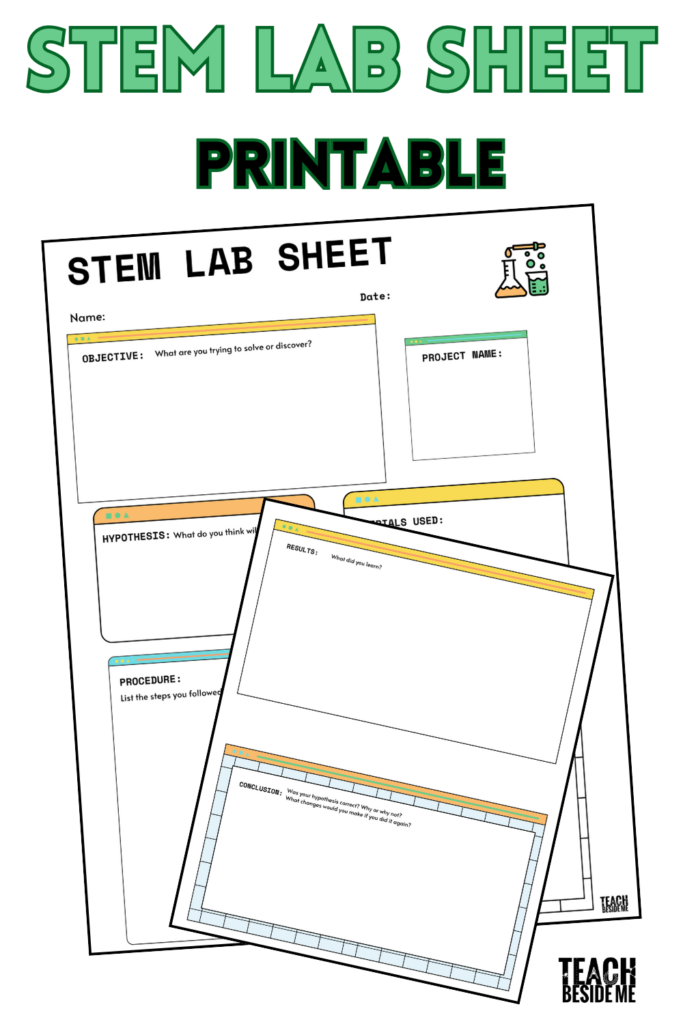
Want to turn this into a complete STEM lesson? Grab my free STEM Lab Sheet to record predictions, observations, and results.
Supplies
- Printer paper (8.5 x 11)
- Scotch tape
- Scissors
- Books for testing
- Pencil and paper for recording results
How to Make Paper Hold Up Books
Watch it in action:
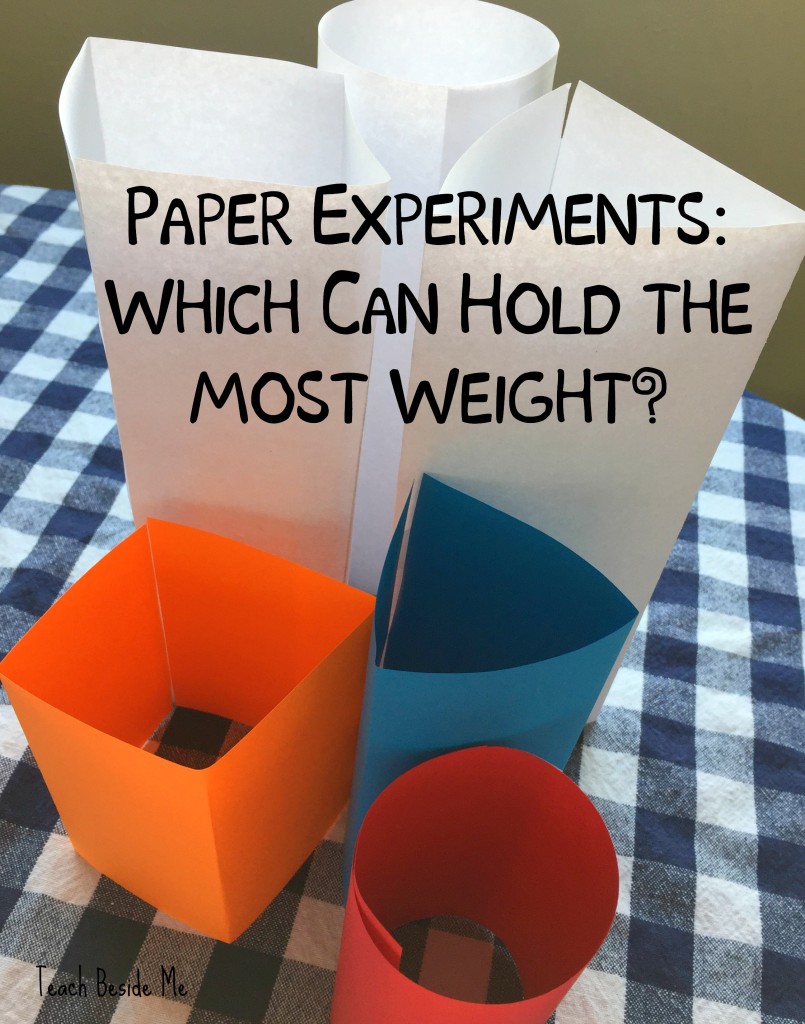
Begin by rolling or folding paper into different shapes and securing them with tape.
This activity is a great paper strength experiment because kids can test how different shapes, heights, and paper designs affect the amount of weight the paper can support.
We tested:
- Triangles
- Squares
- Loosely rolled circles
- Tightly rolled circles
We also tested two different heights to see if tower height affected strength.
Encourage kids to design their own shapes as well. Part of engineering is experimenting with new ideas!
The Paper Strength Engineering Challenge
Create four supports of the same shape and place a sheet of paper across the top.
Slowly add books one at a time and observe what happens.
Record:
- Which shape holds the most weight
- Which shape collapses first
- Whether shorter or taller supports perform better
- Any surprising results
Try to improve your design and test again.
That’s exactly what real engineers do.
Our Results
The triangles held:
- 8 books (short towers)
- 4 books (tall towers)
The squares held:
- 7 books (short towers)
- 5 books (tall towers)
The loosely rolled circles held:
- 23 books (short towers)
- 13 books (tall towers)
The tightly rolled circles were the clear winners:
- 24 books (short towers)
- 27 books (tall towers)
The tightly rolled cylinders were incredibly strong!
My kids predicted they would win, but nobody expected them to support so many books.
By the end of the experiment, we had run out of small books and started adding larger, heavier ones.
Why Does This Paper Engineering Challenge Work?
At first glance, paper seems weak.
However, when paper is folded or rolled into certain shapes, it becomes much stronger.
The cylindrical shape distributes weight evenly around the entire structure. Instead of one area carrying all the force, the load is spread across the paper support.
Engineers use this same principle when designing:
- Columns
- Bridges
- Buildings
- Water towers
- Cardboard packaging
Shape matters!
This challenge shows that a material’s strength depends not only on what it is made from, but also on how it is designed.

Extend the Learning
Try changing one variable at a time:
Test Different Paper Types
- Copy paper
- Cardstock
- Construction paper
- Tissue paper
- Newspaper
Test Different Shapes
- Hexagons
- Rectangles
- Triangles
- Cylinders
- Custom designs
Test Different Heights
Do shorter towers hold more weight than taller ones?
Test Different Adhesives
- Tape
- Glue
- Hot glue (with adult help)
Create a Paper Tower Competition
Challenge siblings, classmates, or friends to see who can build the strongest paper structure.

STEM Challenge Questions
- Why were circles stronger than squares?
- Why did shorter towers often perform better?
- How does shape affect strength?
- What would happen if you used thicker paper?
- How could you improve your design?
Use the STEM Lab Sheet to record your observations and conclusions.
More Engineering & Paper STEM Activities for Kids
If your kids enjoyed this challenge, try these other hands-on STEM activities:
6 Paper Tricks that Seem like Magic
Origami Firefly Paper Circuits
If you’re looking for an easy STEM challenge for kids or a simple engineering activity for kids, this paper tower challenge is one of my favorite STEM activities because it uses simple materials to teach big engineering concepts.
Kids are always shocked when they discover that ordinary paper can support a stack of heavy books.




would lined paper work???
I think so! Give it a try. Doesn’t hurt. 🙂
would newspapers work?
Does computer paper work to build the tower
Yup! That’s what we used.
does newspaper work?
I haven’t tried it, but I think it would.
The act of balancing books with paper is simple, but it requires no knowledge to do so. The average weight of a standard, flimsy, white piece of printer paper is less than 1 gram, right around .7 grams. It would make sense that something that light isn’t able to hold the weight of a text book. But, the act of putting the paper into a cylinder will work. The secret to the paper’s new found strength is the geometrical shape known as a cylinder. Cylinders are one of the most structurally sound, and strongest, geometrical shapes. Cylinders are able to be incredibly strong, regardless of the material they’re made out of, because they disperse stress throughout their entire shape. Any paper can work, and even tiny notecards can too. My Odyssey of the Mind group figured all this out the second we were given a problem like this. It’s simple. Triangles can also work, but they are not as strong, which is also dependent on the type of material. Through my research, the physics of paper and balance is very simple, even simple enough for a seventh grader, like me, to figure out. 🙂