Christmas Candy Cane Science Experiment (Diffusion Activity for Kids)
This post may contain affiliate links.
This Christmas Candy Cane Science Experiment is a quick and colorful STEM activity that kids can do with only a few simple supplies. It’s a holiday twist on the classic diffusion experiment (like the Skittles activity) and creates a beautiful “color spread” effect as the candy dissolves in warm water. This is an easy Christmas science idea for classrooms, homeschool lessons, or fun at home during December.
In this experiment, kids observe how sugar and food coloring dissolve and diffuse through water—perfect for teaching basic chemistry concepts in a hands-on, visual way.

What You Need
-
A white plate or shallow dish
-
Warm water

How to Do the Christmas Candy Cane Science Experiment
1. Arrange the Candy Canes
Place mini candy canes on a white plate in any design you’d like. Try:
-
Circle
-
Heart
-
Sunburst
-
Broken candy cane pieces lined up in a row
The pattern influences how the colors spread across the plate. Use the scientific method. Make predictions about how the different sizes and shapes might react.

2. Add Warm Water
Slowly pour warm water into the center of the plate. Add just enough for the water to touch the edges of the candy canes.
Warm water works best because it helps the candy dissolve quickly and clearly.
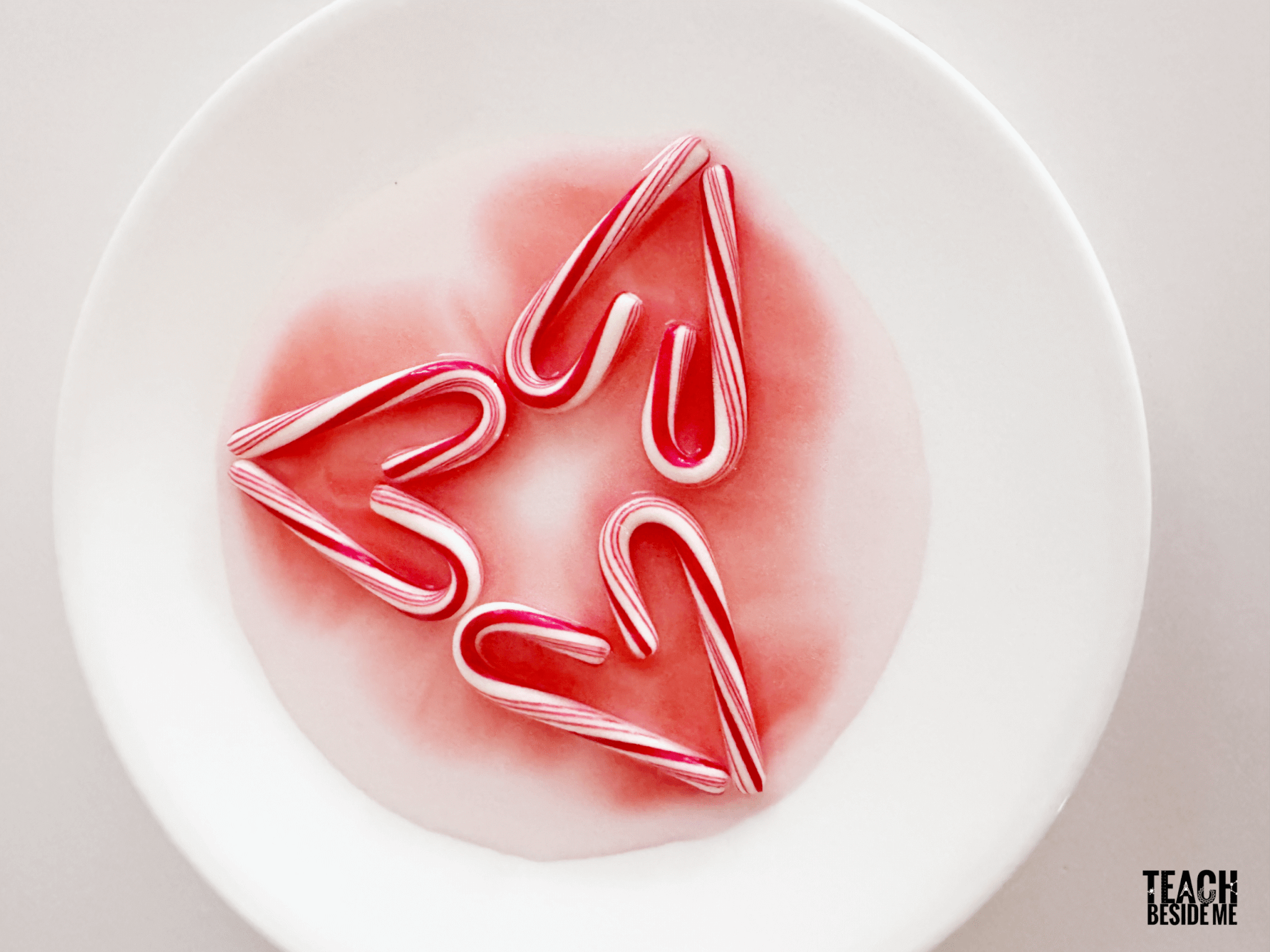
3. Watch the Color Diffusion
Within seconds, the red stripes will begin to dissolve into the water. The color slowly spreads toward the center of the plate, creating beautiful radial patterns. Kids can observe how the color travels, mixes, and changes over time. Set a timer to see how quickly it moves with different shapes.

4. Try Variations
Invite kids to explore:
-
Warm vs. cold vs hot water
- Different liquids
-
Whole candy canes vs. broken pieces
-
Alternating red and green candy canes
-
Different shapes and symmetrical patterns
-
Adding sprinkles or peppermints for comparison
Each version produces a slightly different diffusion pattern.

The Science: Why Candy Canes Create a Color Spread
Candy canes are made of sugar mixed with red food coloring. When warm water touches the candy surface:
-
The sugar dissolves into the water.
-
The food coloring separates from the candy.
-
The colored water moves outward from the candy into the clear water.
This process is called diffusion—the movement of molecules from an area of high concentration to an area of low concentration. Warm water speeds up diffusion because heat increases molecular movement.
This experiment gives kids a clear visual demonstration of dissolving, molecular motion, and diffusion.
Questions to Ask Kids
-
Which dissolves faster—whole candy canes or broken pieces?
-
Does warm water work faster than cold water?
-
How long does it take the color to reach the center of the plate?
-
Does the color stay in stripes or mix together?
-
What happens if you change the pattern?
These questions help guide scientific thinking and observation.
Tips for Success
-
Use a white plate to get the best contrast.
-
Add water slowly to avoid shifting your pattern.
-
Keep candy canes evenly spaced for predictable results.
-
Photograph the experiment at several stages for a “before and after” comparison.
Extensions: More Candy Cane Experiments
You can extend this activity with related experiments:
-
Dissolving candy canes experiment (water, vinegar, oil, salt water, soda)
-
Candy cane bending experiment (thermal softening in the oven)
-
Candy cane crystal ornaments (borax solution)
-
Comparing diffusion with different holiday candies
These are great for a December science unit or winter STEM day.
This Christmas Candy Cane Science Experiment is a simple, visual, and hands-on way to explore diffusion and dissolving. Kids love watching the colors move, and the setup is quick enough to do anytime during the holiday season. It’s an ideal addition to your Christmas science plans in your classroom or as an easy win for at-home STEM fun.
See More Christmas Learning Ideas:
Christmas STEM: Poinsettia pH Experiment
Christmas Science: How to Grow a Crystal Christmas Tree
Pascal’s Triangle Christmas Tree Math
Christmas Mad Libs Printable Worksheets
Christmas Color By Number Worksheets