Feelings and Emotions Game for Kids
This post may contain affiliate links.
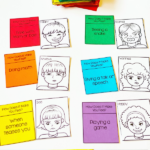
Helping kids learn to recognize, name, and talk about their emotions is an important life skill.
But sometimes asking, “How do you feel?” doesn’t get you very far!
This printable Feelings and Emotions Game for Kids gives children something concrete to talk about. Kids choose from 96 different situation cards, decide how that situation might make them feel, and match it with an emotion card.
There aren’t always right or wrong answers—and that’s part of what makes the activity so useful.
One child might feel excited about speaking in front of a group while another feels worried. Someone might love trying a new food while someone else feels unsure or even disgusted.
The goal isn’t to tell kids how they should feel. It’s to give them practice recognizing feelings and putting them into words.

Why Help Kids Talk About Feelings?
Talking about emotions didn’t come naturally to me as a child. I tended to keep difficult feelings to myself because I didn’t want to cause problems or rock the boat.
As I got older, I had to learn how important it is to recognize what I’m feeling and communicate it in a healthy way.
That’s something I want my own kids to learn earlier.
Giving children words for their emotions can make it easier for them to explain what’s happening inside. Instead of simply knowing that they feel “bad,” they can begin distinguishing between feeling sad, worried, angry, jealous, scared, bored, or disappointed.
And sometimes just having a picture or word in front of them makes that conversation easier to begin.
For another fun emotional learning activity, check out my post: Color My Feelings.

What’s Included in the Emotional Learning Game?
This printable activity includes Situation Cards and Emotion Cards that kids can match together.
Children choose a situation and then decide which emotion best represents how they might feel.
96 Situation Cards
The set includes 96 different situations that kids can think and talk about.
Some examples include:
- Being alone in the dark
- Visiting grandparents
- Climbing a tree
- Watching the news
- Swimming
- When someone is mean to you
- Tasting something new
- Listening to music
- Speaking in front of people
- When someone dies
- Cleaning your room
- Accomplishing a goal
- Meeting new people
- Flying on an airplane
- Dancing
Some situations are everyday experiences. Others give kids an opportunity to talk about more difficult or complicated feelings.
There is also a full page of 16 blank situation cards so you can add experiences that are relevant to your child, family, classroom, or group.

Emotion Cards for Kids
The set also includes cards representing a variety of emotions and feelings:
- Happy
- Scared
- Sad
- Surprised
- Silly
- Worried
- Angry
- Disgusted
- Grumpy
- Bored
- Anxious
- Jealous
- Sneaky
- Wondering
- Shocked
- Indifferent
The Happy emotion is represented with 12 different faces so children can choose one they connect with.
You’ll also find 16 blank face cards. Kids can draw an expression to represent another emotion or create a face showing exactly how a particular situation makes them feel.
The emotion cards are black and white, so kids can color them if they’d like.

How to Play the Feelings and Emotions Game
Place the emotion cards face up where kids can see them.
Shuffle the situation cards and place them face down.
Choose one situation card at a time, read it together, and ask:
How would this make you feel?
The child chooses an emotion card that represents their response.
But don’t stop at matching the cards!
Ask questions such as:
- Why would you feel that way?
- Could someone else feel differently about this?
- Have you ever been in a situation like this?
- Can you think of another emotion you might feel at the same time?
That last question can be especially interesting because we don’t always experience emotions one at a time.
A child might be both happy and nervous about meeting new people, for example.

There Isn’t Always One Right Answer
This is one of the most important parts of the activity.
The situation cards aren’t intended to have predetermined emotional matches.
Consider: Climbing a tree.
One child might choose happy. Another might choose scared. Someone else might feel worried at first and happy after reaching the top.
Those different answers create an opportunity to talk about how people can experience the same situation differently.
Rather than correcting a child’s choice, ask them to tell you more about it.

Emotions and Feelings Writing Prompt
The printable also includes a writing activity called Sometimes I Feel…
Kids choose an emotion—or draw their own—and then respond to:
Things that make me feel this way…
Put the page in a dry-erase pocket to use it repeatedly with different emotions.
You could also print several copies and create a simple feelings book. Kids can complete a page for different emotions and write or draw about situations that make them experience each one.
For children who aren’t ready to write independently, let them draw their response or dictate it to an adult.
We put it into a dry erase pocket to make it re-usable.

More Ways to Use the Emotion Cards
You don’t have to use these only as a matching game.
Try using them as:
- Morning meeting prompts
- Conversation starters
- Writing prompts
- Homeschool health activities
- Classroom discussion cards
- Family conversation cards
- Calm-down corner resources
- Storytelling prompts
You can also choose an emotion and challenge kids to think of several different situations that could cause someone to feel that way.
Or reverse the game: choose a situation and see how many different feelings kids can reasonably connect to it.
Get the Feelings and Emotions Game
The printable Emotional Learning Game for Kids includes 96 situation cards, emotion cards, blank situation cards, blank emotion faces, and a writing activity to help kids explore and talk about feelings.


More Activities for Kids:
The Gratitude Game: Pick-Up Sticks
Color My Feelings ~ My Many Colored Days
Funny Would You Rather Questions for Kids
Did You Know? Conversation Starters for Kids