Goldilocks and the Three Bears STEM Challenge
This post may contain affiliate links.
Looking for a fun and easy Goldilocks and the Three Bears STEM activity for kids? This hands-on fairy tale STEM challenge invites children to design and build chairs strong enough for Baby Bear, Mama Bear, and Papa Bear using simple building materials.
Fairy tale STEM challenges are one of my favorite ways to combine books, creativity, engineering, and problem-solving. Kids love bringing stories to life while learning important STEM concepts through hands-on play.
This Goldilocks and the Three Bears STEM challenge is perfect for:
- Preschool
- Kindergarten
- Elementary classrooms
- Homeschool lessons
- STEM clubs
- Fairy tale units
- Literacy centers
It is simple to set up, highly engaging, and encourages kids to think like engineers while having fun.
What Is a Fairy Tale STEM Challenge?
A fairy tale STEM challenge combines classic children’s stories with science, technology, engineering, and math activities.
After reading a favorite fairy tale, children complete an engineering design challenge inspired by the story.
These activities help kids practice:
- creativity
- critical thinking
- problem-solving
- teamwork
- planning
- building
- testing ideas
Fairy tale STEM activities are wonderful because they connect literacy and engineering in a meaningful and memorable way.
See my WHOLE Fairy Tale STEM Bundle HERE!
Read Goldilocks and the Three Bears
Start by reading your favorite version of Goldilocks and the Three Bears.
We especially love:
- classic fairy tale versions
- retellings
- silly fractured fairy tales
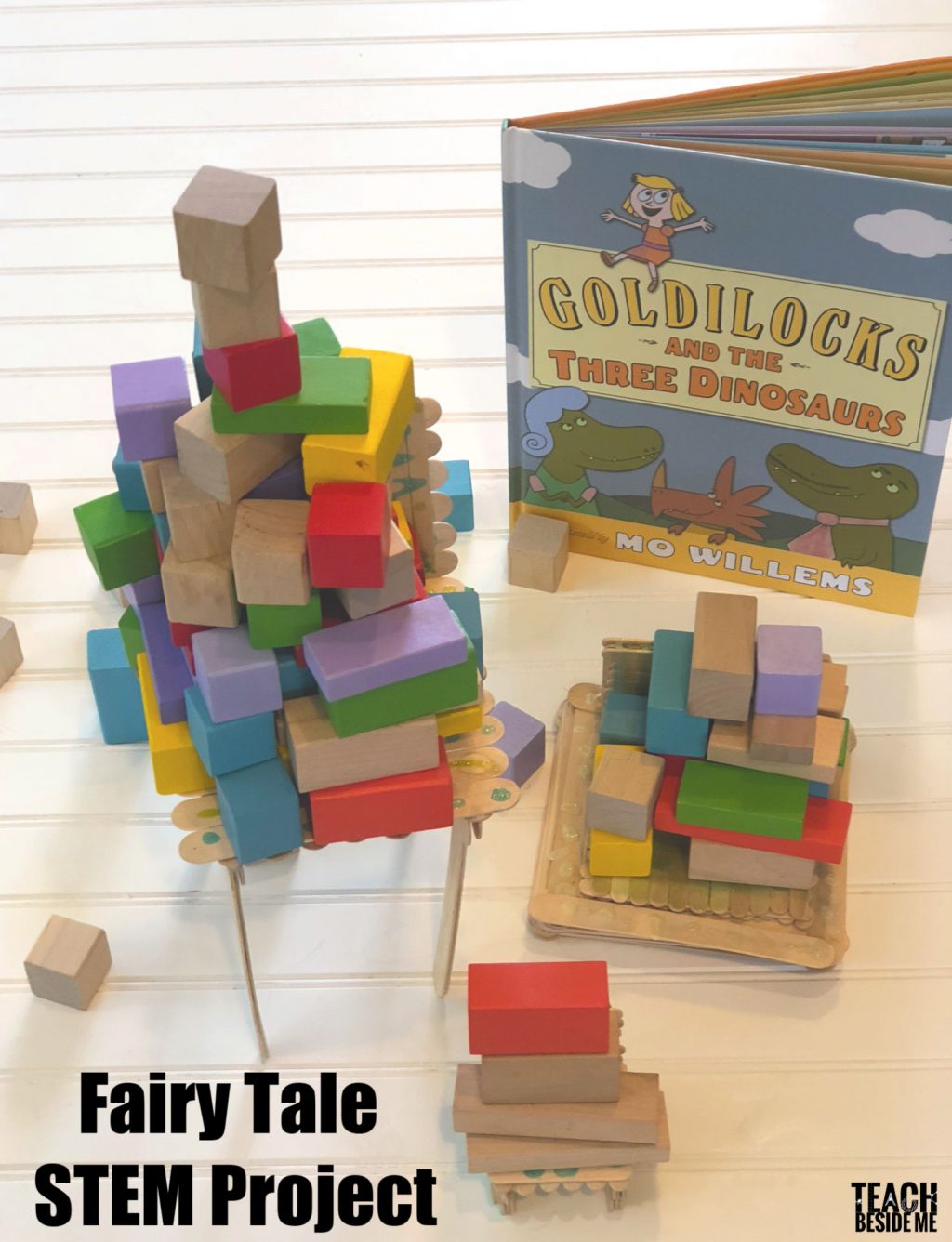
One of our favorite variations is Goldilocks and the Three Dinosaurs by Mo Willems. It always makes my kids laugh and adds a fun twist to the traditional story.
As you read, encourage kids to think about the bears’ chairs:
- Why did Baby Bear’s chair break?
- What could make a chair stronger?
- Which chair would hold the most weight?
- What shapes make structures stable?
These discussion questions naturally lead into the engineering challenge.

Goldilocks and the Three Bears Engineering Challenge
The Challenge:
Can you design and build a chair strong enough for Baby Bear, Mama Bear, or Papa Bear?
Kids will use simple materials to create miniature chairs and then test how much weight each one can hold.
This challenge encourages children to think about:
- balance
- stability
- structure
- size
- weight
- design
It is an excellent introduction to the engineering design process for young children.
Supplies Needed
For this Goldilocks STEM challenge, we used:
- Popsicle sticks
- School glue
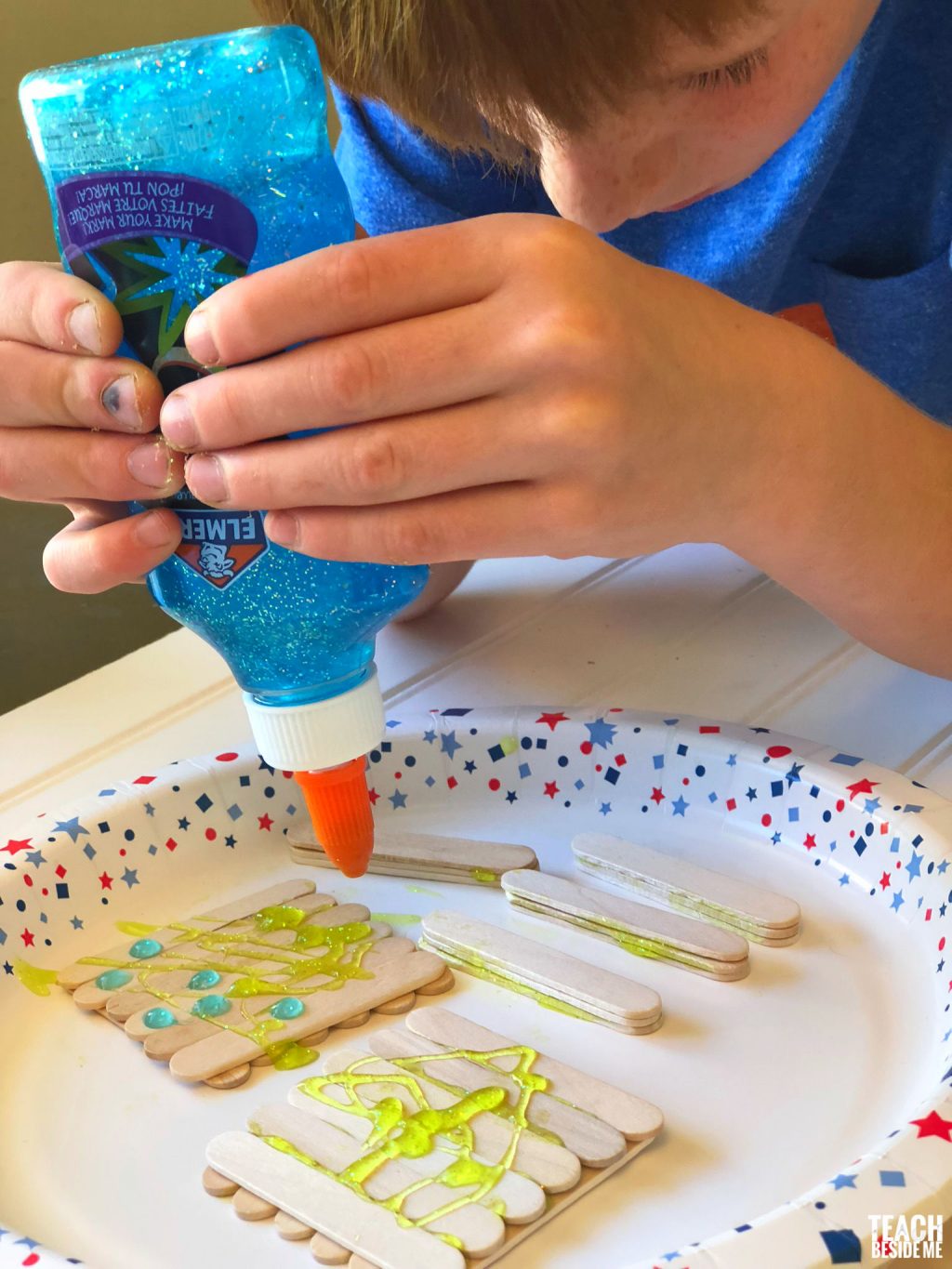
- Glitter glue
- Pipe cleaners (optional)
We used several different sizes of craft sticks, which made the designs even more interesting.
The glitter glue was especially fun because it added both color and strength to the structures.
You could also experiment with:
- cardboard
- clothespins
- straws
- wooden blocks
- masking tape
This makes a wonderful low-prep STEM resource for classrooms and homeschool lessons.
For this fun Fairy Tale STEM project, we used glue and popsicle sticks only. We had three different sizes of sticks. I gave my kids the option to use pipe cleaners, too, but they chose not to once they started building.
Designing the Bear Chairs
Each child designed their own chair independently.
One of my favorite parts of STEM activities is watching kids come up with completely different solutions to the same problem.
As they built, we accidentally ended up creating:
- a Papa Bear chair
- a Mama Bear chair
- a Baby Bear chair
It worked perfectly with the story!
Some children focused on:
- height
- width
- decoration
- balance
- strength
Others experimented with different ways to connect the craft sticks together.
This open-ended building process encourages creativity and problem-solving in such a natural way.

Testing the Strength of the Chairs
Once the glue dried, it was time for the best part:
testing the chairs!
We decided to test each chair by seeing how many blocks it could hold before collapsing.
The larger chairs could hold more blocks simply because of their size, but some smaller designs were actually stronger and more stable.
Kids loved comparing:
- which designs worked best
- which chairs tipped over
- what made a structure stronger
- how shape affected stability
This testing process is one of the most valuable parts of STEM learning because children can immediately see the results of their design choices.
The Engineering Design Process for Kids
This Goldilocks and the Three Bears STEM challenge is a wonderful way to introduce the engineering design process to young children.
Ask
What kind of chair would be strongest for the bears?
Imagine
Brainstorm different chair designs and ideas.
Plan
Decide how to build the chair using the available materials.
Create
Build the chair and test how well it works.
Improve
Redesign weak areas and make the chair stronger.
This process teaches kids that failure is part of learning and improving designs.
STEM Skills Kids Practice
This fairy tale STEM activity helps children practice many important skills.
Kids develop:
- engineering skills
- fine motor skills
- critical thinking
- creativity
- problem-solving
- spatial reasoning
- planning
- perseverance
- observation skills
Children also begin learning basic structural engineering concepts such as:
- balance
- support
- stability
- weight distribution
- strong shapes
Hands-on STEM activities help children become active learners instead of simply observing.
Why Fairy Tale STEM Activities Work So Well
Fairy tales create an exciting starting point for engineering challenges because children already feel connected to the characters and story.
This emotional connection helps kids become more invested in the challenge.
Instead of simply saying:
“Build a chair.”
the story creates a meaningful problem to solve:
“How can we build a chair strong enough for the bears?”
Story-based STEM activities are especially effective for younger children because they combine:
- imagination
- storytelling
- creativity
- hands-on learning
This makes STEM feel approachable and fun.
Classroom and Homeschool Ideas
This Goldilocks and the Three Bears STEM challenge works beautifully in:
- classrooms
- homeschool lessons
- STEM clubs
- library programs
- fairy tale units
- kindergarten STEM centers
- first grade engineering lessons
You can easily adapt the activity for different grade levels by:
- limiting materials for younger children
- adding design requirements for older children
- timing the challenge
- measuring chair height and width
- testing different weights
This also works well as part of fairy tale STEM lesson plans or literacy extensions.
Questions to Ask During the STEM Challenge
Encourage deeper thinking with questions like:
- Which chair is strongest?
- Why did one chair collapse?
- What shapes make structures stronger?
- How could you improve your design?
- Would triangles make the chair sturdier?
- What materials worked best?
- Which chair would Goldilocks choose?
These discussions help children think critically about engineering and design challenges.
Fairy Tale STEM Bundle
This Goldilocks and the Three Bears STEM activity is part of my Fairy Tale STEM Bundle, filled with hands-on engineering projects inspired by favorite fairy tales.
The bundle includes:
- engineering challenges
- printable resources
- design activities
- literacy connections
- classroom-friendly STEM projects


More Fairy Tale STEM Activities
If your kids enjoyed this Goldilocks STEM challenge, be sure to try these other fairy tale engineering projects:
- Three Billy Goats Gruff STEM Challenge
- Cinderella STEM: Build Cinderella’s Carriage
- Jack and the Beanstalk Counting Math Game for Kids
You may also enjoy my large collection of Book Activities for Kids filled with hands-on literacy ideas, crafts, and STEM projects connected to favorite stories.
Hands-on learning is one of the best ways to help children build creativity, confidence, and problem-solving skills while making learning memorable and fun.




What are the pipe cleaners used for?