Guess How Many in the Jar Estimation + Free Printables
This post may contain affiliate links.
Looking for a fun, easy way to practice estimation with kids? The classic Guess How Many in the Jar is one of those simple math activities that children never seem to get tired of!
Fill a clear jar with candy, buttons, LEGO pieces, or other small objects, and challenge kids to estimate how many are inside. Everyone makes a guess, and then comes the fun part: counting the objects to see who came closest!
This activity is also known as an Estimation Station, and it’s a wonderful way to help children develop number sense, practice counting strategies, and think more carefully about quantities.
I’ve created free printable guessing slips and a tracking sheet to make this activity easy to use at home, in the classroom, or at a party.
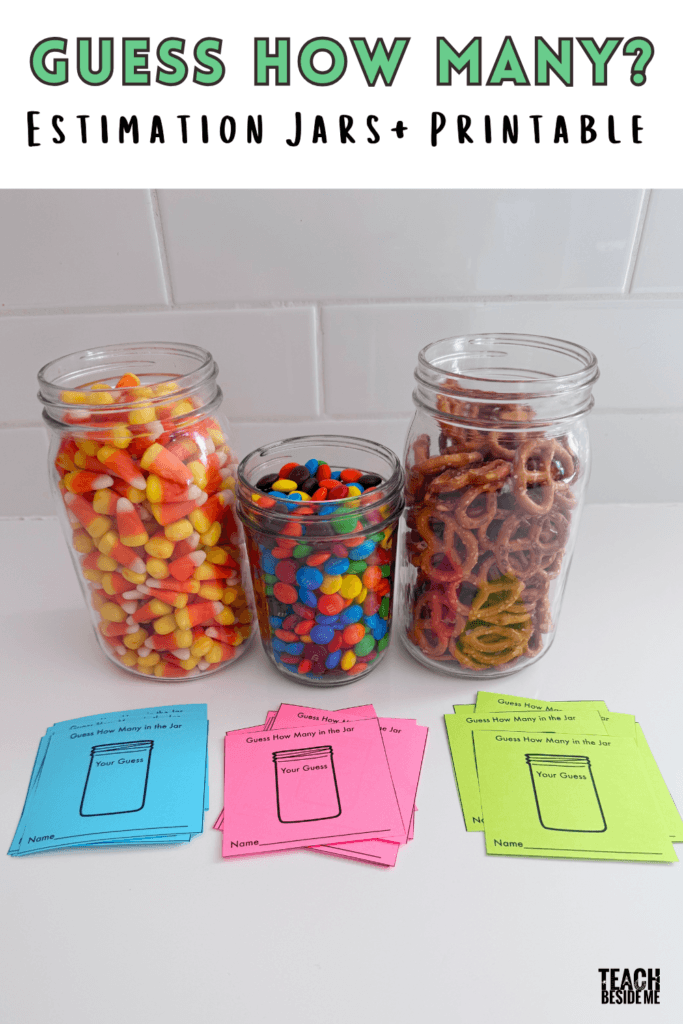
What Is a Guess How Many in the Jar Activity?
A guessing jar game is a simple estimation activity where children predict how many objects are inside a container without counting them first.
All you need is a clear jar, a collection of small objects, and a way to record everyone’s guesses.
The goal isn’t necessarily to guess the exact number. It’s to make a reasonable estimate based on what you can observe.
You can use this activity as:
-
A classroom estimation station
-
A homeschool math activity
-
A math center or morning work challenge
-
A party guessing game
-
A seasonal classroom activity
-
A family math challenge
It’s easy to adapt for different ages, too. Younger children can practice estimating smaller quantities, while older students can use multiplication, measurement, and other strategies to make more accurate predictions.
How to Set Up a Guessing Jar
Setting up your own estimation jar takes just a few minutes.
Supplies Needed
-
A clear jar or container
-
Small objects to fill the jar- see ideas below!
-
Paper and pencils
-
My free Guess How Many in the Jar printable (Download below!)
-
A counting tray or workspace for revealing the answer
Instructions
1. Fill your jar.
Choose small objects for filling the jars. Count the objects as you add them, and keep the total a secret.
For younger children, start with 20–50 objects. For older children, try 100 or more.
2. Display the jar.
Place it somewhere children can see it clearly. Encourage them to look at the jar from different angles, but don’t let them open it or count every object individually.
3. Make an estimate.
Give each child a guessing slip to record their name and estimated number. Encourage children to think about how many objects might fit in one layer or how many groups of ten they can imagine inside the jar.
4. Collect the guesses.
Use the printable tracking sheet to record each participant’s name and estimate. You can collect guesses throughout the day or leave the jar out for a week as an ongoing classroom challenge.
5. Reveal the answer!
When everyone has submitted a guess, empty the jar and count the objects together. Try counting in groups of 5, 10, or 20 to make the counting process another learning opportunity. Compare the actual number with everyone’s estimates. Who came closest?
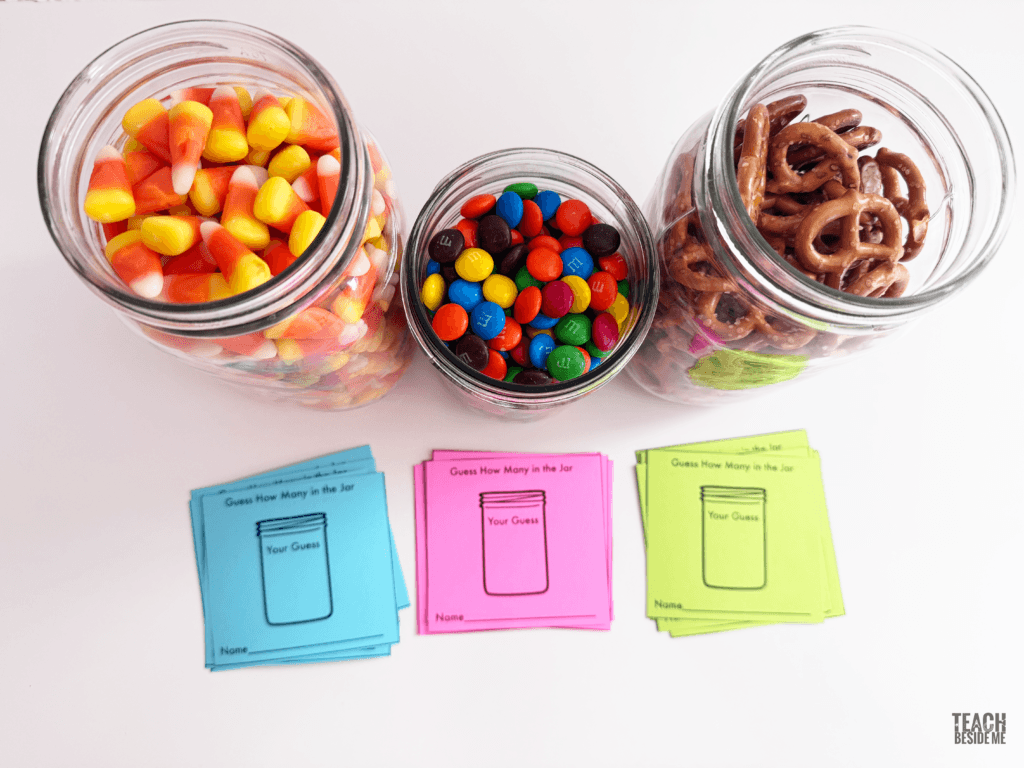
How to Teach Kids to Estimate How Many Are in a Jar
This is where a simple guessing game becomes a valuable math lesson! Estimation is more than choosing a random number. It’s about using what you know to make a reasonable prediction. Here are a few strategies to teach children before they make their guesses.
1. Estimate One Layer at a Time
Ask children to look at the bottom of the jar. About how many objects fit across one layer? How many layers do they think are stacked inside?
For example, if they estimate that each layer contains 12 objects and the jar has approximately 8 layers, they might calculate: 12 × 8 = 96 objects
This won’t give an exact answer, especially when objects are irregularly shaped, but it provides a useful starting point.
2. Use Groups of 10
Show children what 10 of the objects look like before filling the jar. Then ask them to imagine how many groups of 10 might fit inside. Would the jar hold 5 groups? 10 groups? 20 groups?
This strategy helps children develop number sense and visualize larger quantities.
3. Think About the Size of the Objects
Not all objects fill a jar the same way! A jar filled with tiny beads will contain far more objects than the same jar filled with large pom-poms. Ask children to consider the size and shape of the objects, along with the empty spaces between them.
4. Make a Reasonable Guess
Encourage children to explain their thinking.
You might ask:
-
Do you think there are more or fewer than 100?
-
What helped you choose your number?
-
How many objects do you think fit across the bottom?
-
Would your estimate change if the jar were twice as tall?
-
Is your estimate close to someone else’s? Why might that be?
The discussion is just as valuable as the final answer!
What Can You Put in an Estimation Jar?
One of my favorite things about this activity is how easily you can change it. You can use almost anything you already have around the house or classroom.
Here are some ideas.
Everyday Guessing Jar Fillers
-
Pennies
-
Dried beans
-
Small wooden blocks
-
Puzzle pieces
-
Small candies
Choose items that are easy to count after the guessing is finished. For younger children, larger objects and smaller quantities make the activity more manageable. Keep small objects away from children who might put them in their mouths.
Seasonal Guess How Many in the Jar Ideas
You can use the same guessing jar all year long by changing the objects inside!
Fall Guessing Jar Ideas
-
Candy corn
-
Acorns
-
Mini pumpkin erasers
-
Dried corn kernels
-
Autumn-colored pom-poms
-
Candy pumpkins
A candy corn guessing jar is especially fun for Halloween parties or fall classroom math centers.
Winter and Christmas Guessing Jars
-
Jingle bells
-
Mini marshmallows
-
Peppermint candies
-
Snowflake confetti
-
Red and green pom-poms
-
Small holiday erasers
Spring and Easter Guessing Jars
-
Jellybeans
-
Mini plastic eggs
-
Flower-shaped beads
-
Pastel pom-poms
-
Small spring erasers
-
Colorful buttons
Summer Guessing Jar Ideas
-
Small seashells
-
Glass pebbles
-
Colorful beads
-
Mini beach-themed erasers
-
Small craft shells
-
Brightly colored pom-poms
You could even create a new estimation challenge every month!
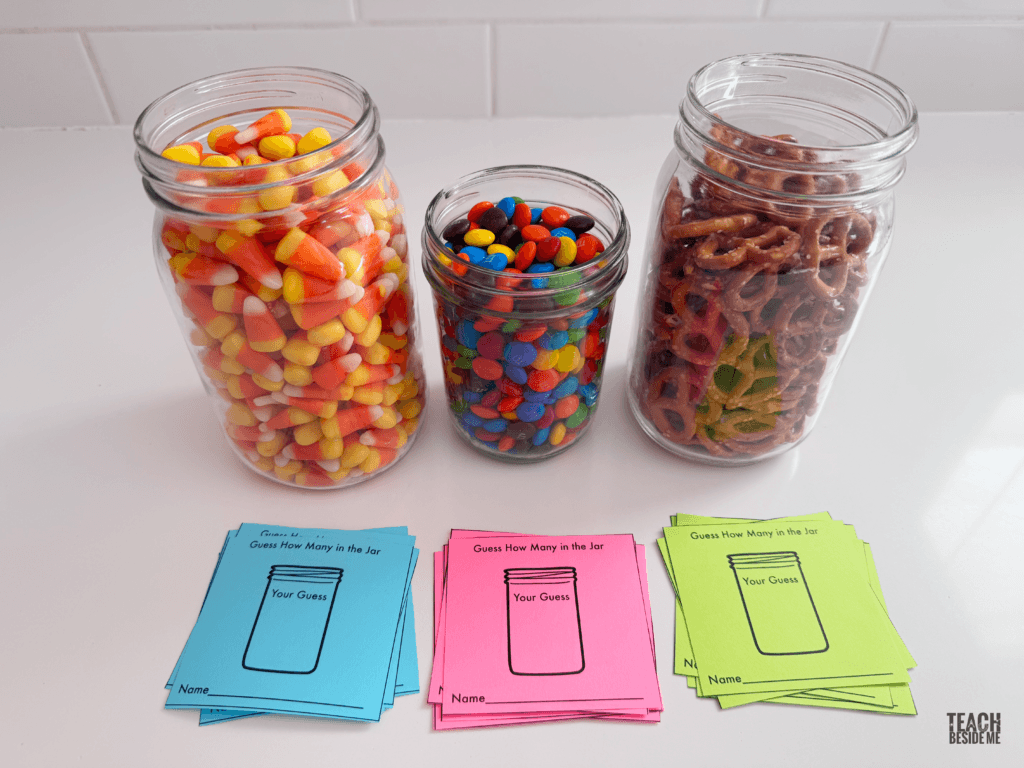
Free Guess How Many in the Jar Printables
To make this activity even easier, I’ve created a free Guess How Many in the Jar printable pack.
The printables include:
-
Guessing slips: Four per page, with space for each child’s name and estimate. Just print, cut apart, and distribute.
-
Tracking sheet: A recording page where teachers or parents can keep track of participants and their guesses.
These black-and-white printables are easy to use in classrooms, homeschool settings, parties, and math centers. Print as many guessing slips as you need, fill your jar, and you’re ready to play!
Download the Free Guess How Many in the Jar Printables
Math Activities to Extend the Learning
Once everyone has made their guesses and you’ve counted the objects, don’t put the jar away just yet! There are several ways to turn this activity into an even richer math lesson.
Graph the Guesses
Have students create a bar graph or line plot showing everyone’s estimates.
Which range of numbers was most popular? Were the guesses clustered together or spread far apart?
Find the Difference
Ask students to calculate how far their guesses were from the actual number. For example, if the jar contained 85 objects and a child guessed 100: 100 − 85 = 15
Their estimate was 15 objects too high.
You can also compare guesses that were above and below the actual number.
Calculate the Mean, Median, and Mode
For older students, use the class estimates to practice finding the mean, median, and mode. How does the average estimate compare with the actual number?
Practice Skip Counting
When it’s time to reveal the answer, sort the objects into groups of 2, 5, or 10. This gives younger children practice with skip counting and helps everyone verify the final total.
Compare Two Jars
Fill two jars of different sizes with the same type of object. Which jar contains more? How much more? Or try two jars of the same size filled with different objects.
Children can compare how the size and shape of the objects affect the total quantity.
Keep an Estimation Journal
If you use a weekly estimation station, encourage children to record their guesses and explain the strategies they used. Over time, they can look back and see whether their estimates are becoming more accurate.
Tips for a Successful Classroom Estimation Station
If you’re planning to make this a regular classroom activity, here are a few tips to keep it running smoothly.
- Change the objects regularly. A new jar each week or month keeps children interested and gives them more opportunities to practice.
- Use different quantities. Start with smaller amounts, then gradually increase the challenge as students improve.
- Keep guesses private. Collect the guessing slips before revealing anyone’s estimates so children make their own predictions.
- Encourage explanations. Ask students how they arrived at their numbers instead of focusing only on who guessed correctly.
- Let students help count. Sorting and counting the objects is part of the learning experience.
- Celebrate thoughtful estimating. Recognize students who use good strategies, even when their guesses aren’t the closest.
You could even assign a different student each week to help prepare the next estimation jar.
Why Estimation Activities Are Important for Kids
Estimation is an important part of developing strong number sense.
Children use estimation in everyday situations, from figuring out how many supplies they need for a project to deciding whether they have enough money for a purchase.
A guessing jar helps children practice several important math skills:
-
Number sense: Understanding and comparing quantities
-
Place value: Thinking about numbers in groups of tens and hundreds
-
Multiplication: Using groups and layers to estimate larger amounts
-
Problem-solving: Choosing strategies and evaluating whether answers are reasonable
-
Data analysis: Recording, graphing, and comparing estimates
-
Math communication: Explaining how they arrived at an answer
Best of all, children get to practice these skills through a simple, hands-on activity that feels like a game.
Try Some Related Math Activities:
- Gummy Bear Math~ Patterns, Graphing & Addition Activities
- Trail Mix Graphing Activity for Kids: Math You Can Eat!
- Apple Fractions Printable Math Pack