
Homemade Wind Vane Science Experiment: Learn Wind Direction
This post may contain affiliate links.
Tracking wind direction is a classic hands-on way to explore weather science—and building your own homemade wind vane makes it even more fun! In this project, kids will create a simple DIY weather vane using everyday supplies and learn the science behind how it works.
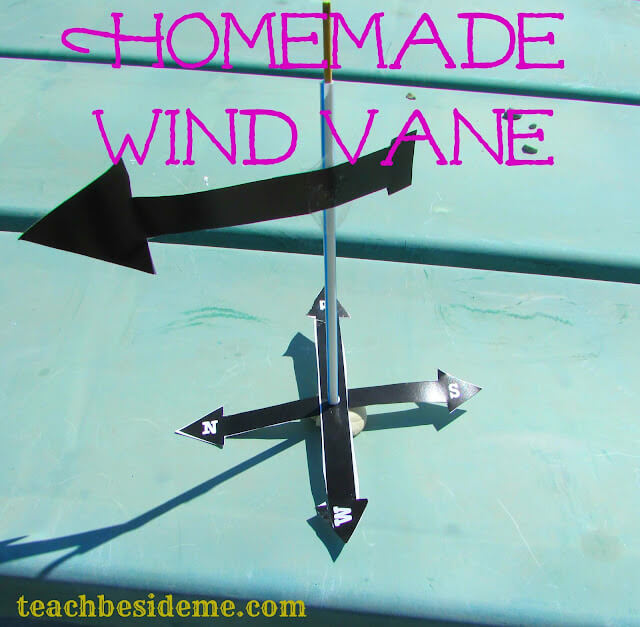
What Is a Wind Vane?
A wind vane, also known as a weather vane, is a tool used to show the direction the wind is blowing. It’s one of the oldest known weather instruments—used for thousands of years on rooftops, barns, and weather stations around the world.
Traditionally, a weather vane has:
- An arrow or shape that spins with the wind
- A base marked with N, S, E, and W (the cardinal directions)
Wind vanes are often decorative (like the classic rooster shape on farmhouses), but they also provide important information about upcoming weather changes.
Supplies for a Homemade Wind Vane
- Download the printable wind vane template
- Cardstock or heavy paper
- Straw
- Wooden skewer or dowel
- Small lump of modeling clay or playdough
- Scissors
- Tape or glue
- Compass (to find North when outside if needed)
How to Make Your Wind Vane
- Print the Template: Cut out two double-headed arrows labeled North–South and East–West, plus one single arrow (for the top).
- Prepare the Base: Press a ball of clay into the bottom of a cup or onto a sturdy paper plate. Stick the wooden skewer upright into the center.
- Attach the Cardinal Arrows: Slide the N-S and E-W arrows onto the skewer to form a cross. Use tape or a small hole to hold them in place.
- Make the Spinner: Tape the single arrow to a straw. Then slide the straw onto the top of the skewer so it can spin freely.
- Take It Outside: Use a compass to orient the base arrows so they point correctly. Then observe which way the top arrow points—it shows the direction the wind is coming from!
The Science Behind Wind Direction
The direction the wind comes from can help predict weather changes:
- Wind from the north often brings cooler air
- Wind from the south may bring warmer air
Wind direction is caused by differences in air pressure and the rotation of the Earth. Meteorologists use wind direction data to help forecast weather patterns, especially around low-pressure systems, where wind spirals inward.
Science Extensions & Discussion Ideas
- Record wind direction multiple times per day for a week. Graph your results.
- Compare wind direction with local weather forecasts.
- Talk about how wind impacts temperature and storms.
- Research other weather tools like anemometers (for wind speed) and barometers (for pressure).
Weather Book Pairings:
- Feel the Wind by Arthur Dorros — simple nonfiction for younger kids
- The Kids’ Book of Weather Forecasting by Mark Breen — hands-on activities and explanations
- National Geographic Kids Everything Weather by Kathy Furgang — colorful, engaging science




Those are some fun posts to share 🙂