Kandinsky Artist Study for Kids: Concentric Circles Art Project
This post may contain affiliate links.
One of my favorite parts of homeschooling has always been studying famous artists and recreating artwork inspired by their styles. It’s such a wonderful way to introduce children to art history while encouraging them to explore their own creativity!
For this Kandinsky artist study, we learned about the Russian abstract artist Wassily Kandinsky and created our own colorful concentric circles art using oil pastels and watercolors.
This is one of my favorite art projects for kids because it’s simple enough for young children but offers plenty of opportunities for older students to explore color theory, abstract art, geometry, and even music!

Who Was Wassily Kandinsky?
Wassily Kandinsky (1866–1944) was a Russian-born painter and art teacher who became one of the pioneers of abstract art.
He was born in Moscow, Russia, and grew up surrounded by music and art. Although he loved painting, he didn’t begin his professional art career right away.
In fact, Kandinsky studied law and economics and worked in academics before deciding to pursue art seriously. In 1896, when he was about 30 years old, he moved to Munich, Germany, to study painting.
Isn’t that interesting? One of the most influential abstract artists in history didn’t begin his formal artistic training until adulthood!
Kandinsky eventually became known for creating paintings that emphasized colors, lines, and shapes rather than recognizable objects.
Instead of painting a realistic landscape or portrait, he wanted to explore how art could communicate feelings and ideas through color and form.
He helped establish an influential artistic group called Der Blaue Reiter (The Blue Rider) in 1911. Later, he taught at the famous Bauhaus school in Germany, where artists and designers explored the relationships between art, geometry, and design.
Kandinsky spent his final years living and working in France, where he died in 1944. Today, he is remembered as one of the most important pioneers of abstract art.
Interesting Facts About Kandinsky for Kids
- Kandinsky was born in Russia in 1866.
- He originally studied law and economics before becoming an artist.
- He loved music and believed painting could communicate emotions in ways similar to music.
- He was especially interested in the relationships between colors and geometric shapes.
- He helped establish the Blue Rider art group.
- He later taught at the Bauhaus school in Germany.
- His artwork became increasingly abstract throughout his career.

What Is Abstract Art?
Abstract art is artwork that doesn’t necessarily represent things exactly as they appear in real life. Instead of painting a realistic tree, house, or person, an abstract artist might use shapes, colors, lines, and textures to express an idea or feeling.
Kandinsky believed that colors and shapes could communicate emotions without needing to show recognizable objects. This makes abstract art especially fun to explore with children!
There isn’t just one correct way to create an abstract painting. Kids can experiment with colors, patterns, and arrangements while developing their own artistic ideas.
Kandinsky, Music, and Color
One of the most fascinating things about Kandinsky was his connection to music.
He loved music and believed that painting and music had much in common. Just as a musician uses notes, rhythm, and harmony to create a composition, Kandinsky used colors, lines, and shapes to create visual compositions. He even gave some of his artworks musical titles, including Compositions and Improvisations.
Kandinsky wrote about the emotional effects of colors in his book Concerning the Spiritual in Art. He believed that different colors could create different feelings in the viewer.
For example, a bright yellow might feel energetic or cheerful, while a deep blue might suggest calmness or contemplation. Of course, colors don’t have exactly the same meaning for everyone! That’s part of what makes art so interesting.
Try this with your kids: Play a piece of music and ask them which colors or shapes come to mind.
Would fast, lively music inspire bright colors and jagged lines? Would slow, peaceful music inspire soft colors and flowing shapes?
There’s no single right answer. The goal is to explore how music and visual art can both express feelings.
One of Kandinsky’s most recognizable works of art is called the Squares with Concentric Circles. It was painted in 1914. I am sure you have probably seen it around! I have always loved this painting. It’s so bright and cheery and is such a fun one for kids to successfully recreate, so that’s what we did!
Kandinsky’s Squares with Concentric Circles

One of Kandinsky’s most recognizable works is Color Study: Squares with Concentric Circles, created in 1913.
This colorful artwork is made up of twelve roughly square sections arranged in three rows of four. Inside each section are circles of different colors and sizes. But look closely! The circles aren’t perfectly round, and many are uneven or slightly off-center. That’s part of what makes the artwork so interesting.
Kandinsky wasn’t trying to create twelve identical designs. He was exploring how different colors interact with one another.
What Makes This Artwork Special?
The original artwork was a color study, rather than a large, finished oil painting. Kandinsky created it using watercolor, gouache, and chalk on paper. Each square gave him an opportunity to experiment with a different combination of colors. Notice how the colors change the appearance of each circle.
Some combinations create strong contrast, while others seem softer or more harmonious. A color might appear bright in one square but look very different when surrounded by another color. This is a wonderful example of how artists experiment with color relationships.
The original artwork is part of the collection of the Lenbachhaus museum in Munich, Germany.
Questions to Ask Kids About Kandinsky’s Art
Before beginning your own project, take a few minutes to study the original artwork together.
Ask your children:
- How many squares can you count?
- What shapes do you see inside each square?
- Are all the circles perfectly round?
- Which colors stand out the most?
- Which square is your favorite? Why?
- How do the different color combinations make you feel?
- What would happen if you changed the background color of one square?
These simple questions encourage children to observe artwork closely and think about the choices artists make.

How to Make Kandinsky-Inspired Concentric Circles Art
After studying Kandinsky’s artwork, we decided to create our own version using oil pastels and watercolors.
I found inspiration for this project in our Usborne Art Treasury book, which has wonderful ideas for introducing children to famous artists.
We used a mixed-media technique called oil pastel resist. The oil pastels create colorful lines that resist the watercolor paint, producing a beautiful effect.
This project is simple enough for younger children but can be adapted for older students who want to experiment more carefully with color combinations.
Supplies
- Watercolor paper
- Oil pastels
- Watercolor paints
- Paintbrushes
- Water cup
- Paper towels
- Optional: ruler and pencil
Watercolor paper works especially well because it’s thicker than regular printer paper and holds up better when wet.
Step 1: Divide Your Paper Into Squares
Begin with a large sheet of watercolor paper. We folded our paper in half lengthwise and then into thirds to create six sections. You can also use a ruler to draw a grid.
Kandinsky’s original color study contains twelve sections, but we used six larger spaces to make the project easier for my kids. Either option works beautifully!

Step 2: Draw Concentric Circles With Oil Pastels
Inside each section, draw several circles, one inside another. These are called concentric circles because they share approximately the same center.
Use different colors for each ring, and experiment with different combinations. The circles don’t need to be perfectly round. In fact, Kandinsky’s circles were often irregular! Encourage kids to fill each section with their own creative color combinations.

Step 3: Paint Over the Circles With Watercolors
Once you’ve drawn all the circles, it’s time to add watercolor paint! Paint over each square with a different color or combination of colors. The oil pastels will resist the watercolor paint because the oily, waxy materials don’t mix easily with water. This creates a beautiful effect as the watercolor fills the paper around the pastel lines.
Kids love watching the colors appear around their drawings! Try using contrasting colors to make the circles stand out. For example, blue watercolor around orange or yellow pastel can create a bold, colorful design.

Step 4: Let Your Kandinsky Art Dry
When all the sections are painted, set the artwork aside to dry completely. Once dry, display your colorful Kandinsky-inspired artwork!
I love how every child’s artwork turns out differently. Even when everyone follows the same instructions, their choices of colors and shapes create something completely unique.
That’s one of the things I enjoy most about teaching art!

What Kids Learn From This Kandinsky Art Project
This activity combines art history, creativity, math, and science in one hands-on lesson.
- Art History: Learn about Wassily Kandinsky and the development of abstract art.
- Color Theory: Explore how colors look different when placed next to one another.
- Geometry: Identify circles, squares, and repeating shapes.
- Science: Observe how oil pastels resist water-based paint.
- Creative Expression: Experiment with different colors, shapes, and arrangements to communicate feelings.
- Music Appreciation: Explore how music and visual art can express similar moods and emotions.
It’s a wonderful STEAM activity that encourages children to think creatively while making connections between different subjects.
More Kandinsky Art Activities to Try
Want to extend your artist study? Here are a few more creative activities inspired by Kandinsky’s ideas.
Paint to Music
Play several different pieces of instrumental music.
Have children create abstract paintings while listening, using colors and lines that match how the music makes them feel.
Compare the artwork created during different musical selections.
Explore Color Contrasts
Have children draw several concentric circles using different color combinations.
Try warm colors in one square and cool colors in another.
Then experiment with complementary colors, such as blue and orange or red and green.
Which combinations stand out the most?
Create a Collaborative Kandinsky Mural
Give each child one square of paper and ask them to create a colorful concentric circle design.
Combine everyone’s squares into one large artwork inspired by Kandinsky’s original color study.
This is especially fun for classrooms, homeschool co-ops, and group art lessons.
Make Kandinsky Circles With Colored Paper
Instead of painting, cut circles from colorful construction paper.
Layer the circles from largest to smallest to create concentric circle designs.
This is a great alternative for younger children who are still developing their painting skills.
Explore More Famous Art With Printable Coloring Pages
If your kids enjoyed learning about Kandinsky, you might also love exploring other famous artists through coloring!
I created a collection of Famous Art Coloring Pages: 15 Masterpieces for Kids to help children become familiar with important works of art.
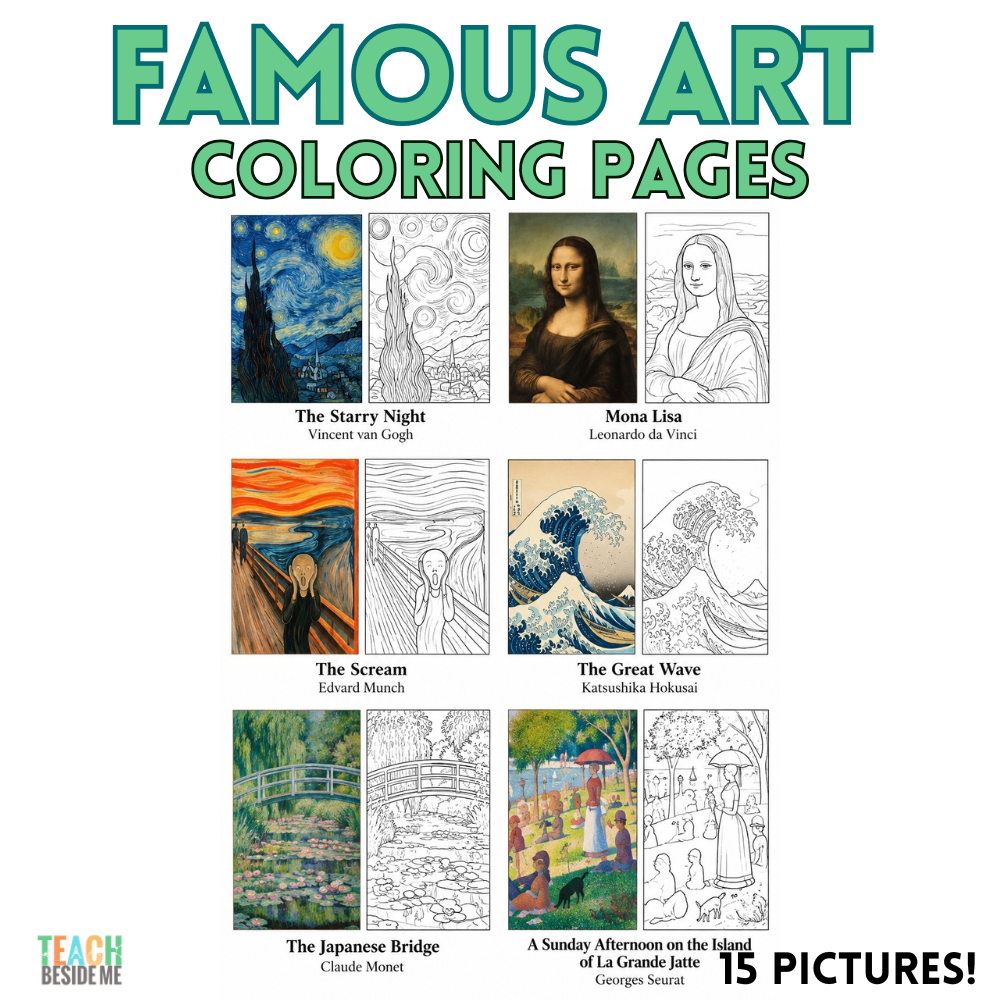
These printable coloring pages are a fun way to introduce art history and encourage children to study famous paintings more closely.
You can use them during artist studies, homeschool art lessons, classroom art history activities, or simply for creative coloring time.
More Famous Artist and Math Art Projects
If you enjoyed this Kandinsky artist study, explore some of my other creative art activities!
- Math Art and Drawing Games for Kids – Discover more ways to combine mathematical thinking with creative drawing and art projects.
- Famous Art Coloring Pages – Explore fifteen famous masterpieces through printable coloring activities.
- The Scream Art Project for Kids – Learn about Edvard Munch and create an expressive artwork.
- Chihuly Art Project for Kids – Explore colorful sculptural art inspired by Dale Chihuly.
I hope this Kandinsky art project inspires your kids to explore color, shape, and creative expression!





Hi!
I am doing a study on Kandinsky with a pre-k class. I would love to explore his piece, Circle in a Circle, with this group as they are going to made their own piece on a canvas. Do you have any recommendations of children’s books to read along with artist?