
Space Food: How to Make Astronaut Ice Cream
This post may contain affiliate links.
If you want to try a fun space science activity for kids, try making astronaut ice cream! This easy kitchen science project teaches kids about space food, freeze-drying, and the science of meringue, all while creating a sweet treat that mimics the famous freeze-dried ice cream astronauts eat.
Real astronaut ice cream is made by freeze-drying regular ice cream, which removes most of the water while keeping the flavor. The result is a crunchy, lightweight dessert that doesn’t melt — perfect for space travel!
Today we’re making a homemade version using meringue, which has a similar light, crispy texture.

My Childhood Fascination with Space
I grew up in southern Florida, and whenever a space shuttle launched from Cape Canaveral, our elementary school would take us outside to watch it streak across the sky. Those moments made a huge impression on me.
Like many kids, I dreamed of becoming an astronaut someday.
One of the most memorable events of my childhood was the Challenger explosion. It was heartbreaking, but seeing that there had been a woman astronaut aboard the shuttle only strengthened my determination and fascination with space.
Although I didn’t become an astronaut, I’ve always loved learning about space exploration.
During many field trips to the Kennedy Space Center, I was fascinated by the displays showing how astronauts live, work, and eat in space. The freeze-dried foods especially caught my attention — and astronaut ice cream quickly became my favorite!
Now I love sharing that curiosity with my own kids.
What Is Astronaut Ice Cream?
Astronaut ice cream is freeze-dried ice cream originally developed for NASA missions.
Freeze-drying removes about 90–95% of the water from food while preserving its flavor and nutrients. This process creates a lightweight food with an extremely long shelf life.
Because it doesn’t melt, astronaut ice cream can be eaten without refrigeration — making it ideal for space travel.
Today, astronaut ice cream is commonly sold at:
-
science museums
-
space centers
-
gift shop
Kids love trying it because the texture is crunchy and airy instead of creamy.
Did Astronauts Actually Eat Astronaut Ice Cream?
Here’s a surprising fact:
Astronaut ice cream only flew on one space mission — Apollo 7 in 1968.
Astronauts didn’t enjoy it very much because:
-
it was dry and crumbly
-
the crumbs floated in zero gravity
-
it was messy inside the spacecraft
Because of this, NASA quickly moved to other types of space food. Even though astronauts don’t eat it in space anymore, it remains a fun novelty food connected to space exploration.
Why Do Astronauts Freeze-Dry Their Food?
Freeze-drying is one of the best food preservation methods for space travel.
Benefits of freeze-dried space food
-
removes 90%+ of water weight
-
dramatically reduces food weight
-
keeps most nutrients intact
-
provides very long shelf life
-
food can be rehydrated with water
These qualities make freeze-dried food ideal for space missions where every ounce of weight matters.
Many foods can be freeze-dried, including:
-
fruits
-
vegetables
-
meats
-
meals
-
desserts
Can You Freeze-Dry Ice Cream at Home?
To make real astronaut ice cream, you would need a home freeze dryer.
Companies like Harvest Right sell home freeze-drying machines that allow people to freeze-dry foods such as:
-
fruit
-
vegetables
-
meals
-
ice cream
However, freeze dryers are expensive and not common in most kitchens. That’s why this recipe uses meringue, which naturally dries into a crispy, airy texture similar to freeze-dried ice cream.
What Is Freeze-Drying?
Freeze-drying is a process that removes water from frozen food through sublimation, where ice turns directly into vapor without becoming liquid.
The process works in three steps:
-
The food is frozen solid.
-
A vacuum removes pressure around the food.
-
Ice inside the food evaporates directly into vapor, leaving the food dry.
This process keeps the food lightweight, shelf-stable, and nutritious, which makes it ideal for long space missions.
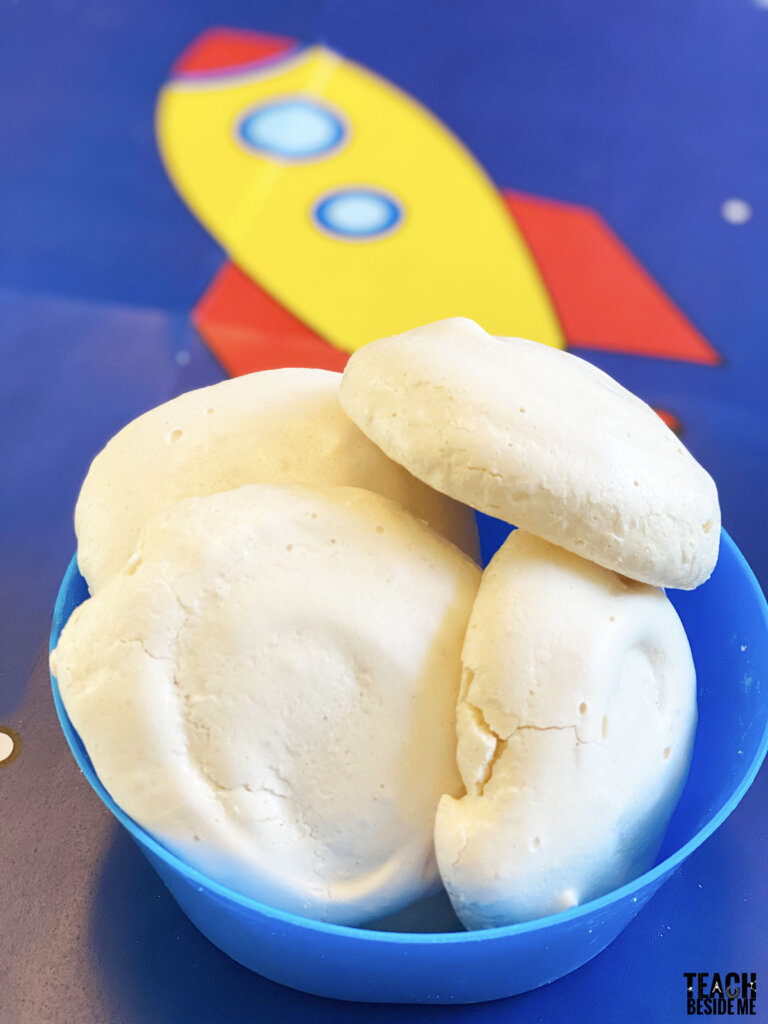
How to Make Astronaut Ice Cream (Meringue Version)
This homemade version is easy and makes a great space science activity for kids.
Ingredients
- 6 large egg whites (room temperature)
- ½ teaspoon cream of tartar
- 1½ cups sugar
- 1 tablespoon vanilla extract- (or 1 teaspoon peppermint extract)
- gel food coloring (optional)
- mini chocolate chips (for mint chocolate chip flavor)

Instructions
-
Separate the egg whites and place them in a large bowl.
-
Beat with an electric mixer until slightly foamy.
-
Add the cream of tartar and continue mixing until soft peaks form.
-
Slowly add the sugar one spoonful at a time, continuing to mix.
-
Add vanilla extract and optional food coloring.
-
Continue mixing until stiff peaks form.
-
If making multiple flavors, divide the mixture and add flavorings.
-
Scoop onto a parchment-lined baking sheet.
-
Bake at 200°F for about 2 hours until dry and crispy.
-
Let cool completely.
The result is a light, crunchy treat that mimics astronaut ice cream!

We made two flavors with ours so I split it in half and made half vanilla and half min chocolate chip. Yum!

The Science of Meringue
This activity is also a great food science lesson. When egg whites are whipped, their proteins unfold and trap air bubbles, forming foam.
As the mixture continues to whip:
-
proteins reorganize around the air bubbles
-
the foam becomes more stable
-
the structure thickens
Why sugar matters
Sugar stabilizes the foam and helps the meringue hold its shape. During baking, moisture evaporates and leaves behind a crisp, airy structure.
Why cream of tartar is added
Cream of tartar is acidic and helps:
-
stabilize the egg white foam
-
increase volume
-
keep the structure from collapsing

Space Science Extension for Kids
Turn this activity into a full space science lesson by discussing:
-
how astronauts eat in space
-
why food needs to be lightweight
-
how freeze-drying preserves food
-
what life is like aboard the International Space Station
You can even compare the texture of your homemade version with store-bought astronaut ice cream.

Fun Space Food Facts for Kids
• Astronauts eat about 3 meals and several snacks each day in space.
• Some space foods are rehydrated with water inside special pouches.
• Tortillas are often used instead of bread because crumbs float in zero gravity.
• The International Space Station has more than 200 menu options.
• Astronauts say spicy foods taste better in space because microgravity affects smell.
Have you ever tried astronaut ice cream? What did you think? Try making this meringue astronaut ice cream with your kids to teach them about space food and the way astronauts have to eat in space!
Check out my Science Art Book for more inspiring & fun projects!


how many does the recipe make?
Yes please let me know how many this recipe makes. I have a classroom if 20 students and not sure how many times I should dlb this recipe.
There were two female astronauts on the Challenger shuttle.