
Math Checkers: Fun Addition, Subtraction, Multiplication & Division Games
This post may contain affiliate links.
Turn a classic game of checkers into a fun, hands-on math activity! Math Checkers combines the strategy of traditional checkers with math fact practice, making it a great way for kids to work on addition, subtraction, multiplication, and division.
Players solve math problems as they move around the board, earning points while practicing their math facts and planning their next moves.
I originally created the multiplication version when my daughter was struggling to memorize her multiplication facts. I wanted a way to make practicing more enjoyable, and since checkers was already a familiar game, it seemed like the perfect combination!
Since then, I’ve expanded the game to include addition, subtraction, and division checkers, too.
You can download the original multiplication version for free below, or grab the complete Math Checkers Bundle to practice all four operations.

Why Play Math Checkers?
Learning math facts takes practice and repetition. But that doesn’t mean the practice has to be boring!
One of my favorite ways to reinforce math skills is through games. When kids are focused on making their next move or trying to capture an opponent’s piece, they get repeated opportunities to use math in a meaningful way.
Math Checkers combines several skills:
- Math fact fluency: Practice solving multiplication problems repeatedly.
- Mental math: Work toward recalling answers without counting or using a calculator.
- Strategic thinking: Plan moves, anticipate your opponent’s choices, and decide when to capture pieces.
- Problem-solving: Consider the value of different moves and their potential point totals.
- Addition: Keep a running score by adding the answers to the problems solved.
I especially like that kids aren’t simply answering a list of multiplication problems. They’re using their answers as part of a game!
What You Need to Play Math Checkers
This is an easy math game to prepare, and you only need a few supplies.
- A printable Math Checkers game board
- 12 checkers or game pieces for each player, in two different colors
- Pencil and paper for keeping score
- Optional: Laminator or page protector and dry erase marker
The printable includes game pieces, but you can also use regular checkers, plastic counting chips, or other small counters.
If you don’t want to print a game board, you can even make your own using an existing checkers board. Write math problems on removable labels and place them on the playable squares.
That makes it easy to customize the game for whichever math facts your children need to practice.
How to Play Multiplication Checkers
Math Checkers follows the basic rules of traditional checkers, with one important addition: players solve a math problem each time they land on a new square.
Step 1: Set Up the Board
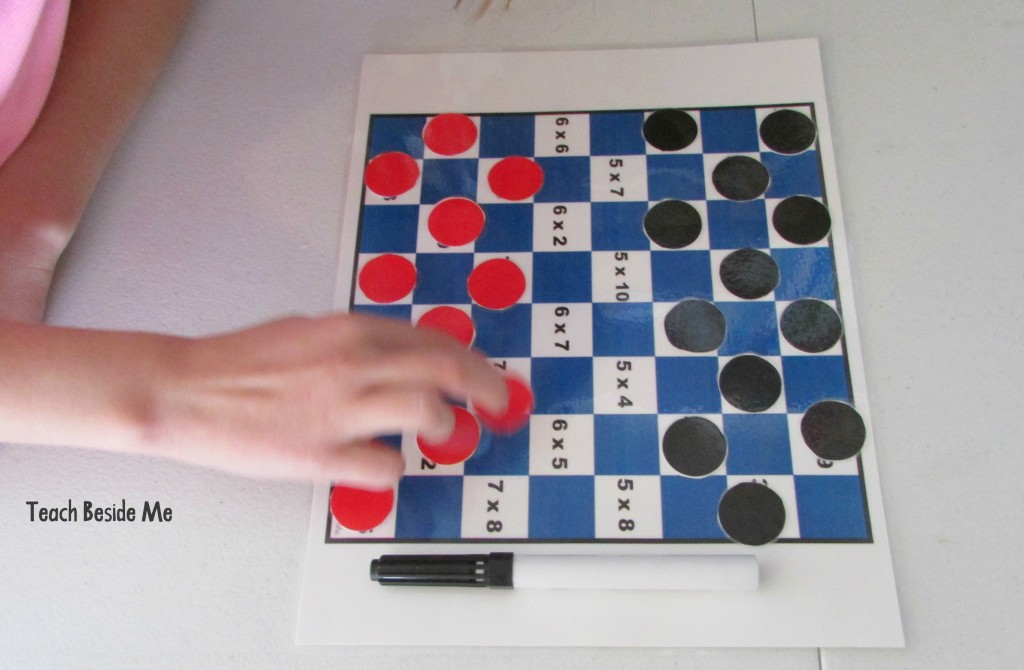
Place the game board between two players. Each player begins with 12 game pieces arranged on the playable squares in the three rows closest to them.
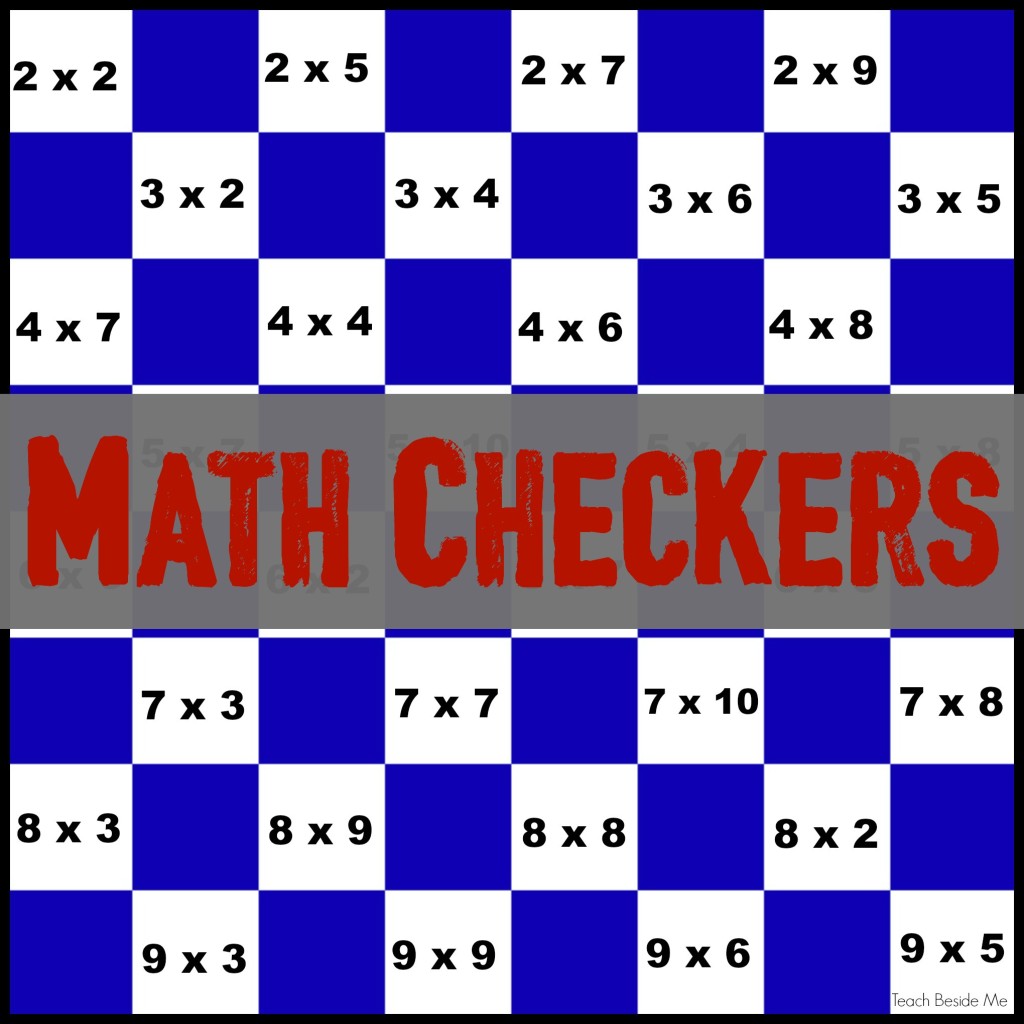
On my printable board, the playable squares are the light-colored squares containing multiplication problems.
Each player should have a different color of game pieces.
Step 2: Take Turns Moving
Players take turns moving one checker diagonally forward onto an empty square.
When a player lands on a square, they solve the multiplication problem printed there.
For example, if a player lands on a square that says 6 × 7, they solve the problem:
6 × 7 = 42
They then add 42 points to their running score.
This gives children a reason to practice their multiplication facts throughout the game.
Step 3: Jump and Capture Opponent’s Pieces
Just like regular checkers, players can capture an opponent’s piece by jumping diagonally over it into an empty square immediately beyond it. The captured piece is removed from the board.
When making a jump, the player solves the multiplication problem on the square where their checker lands and adds the answer to their score.
If another legal jump is available with the same checker, the player continues jumping and earns points for each landing square.
You can follow the usual rule requiring captures when available or agree on a simpler version before starting.
Step 4: Crown Your Kings
When a checker reaches the opposite end of the board, it becomes a king! Place another checker on top of it to mark its new status. Kings can move diagonally forward or backward, giving players more opportunities to move around the board and capture pieces.
Players continue solving math problems and earning points as they move.
Step 5: Add Up the Points
In this version of checkers, players keep track of the answers to the math problems they solve. At the end of the game, add up the points each player earned. The player with the most math points wins!
You can also play using traditional checkers rules, where the goal is to capture all your opponent’s pieces or leave them without a legal move. The math problems simply become part of each turn.
I like having both options because you can focus on strategy, math practice, or a combination of the two.
Free Printable Multiplication Checkers Game
Want to try Math Checkers with your kids?
Download my free Multiplication Checkers printable and start playing!
Print the board and game pieces, gather a partner, and you’re ready to practice multiplication facts through play. For a more durable game, laminate the board or place it inside a reusable page protector.
Make Math Checkers Easier or More Challenging
One of the great things about Math Checkers is how easily you can adjust the game to fit different skill levels.
For Kids Still Learning Their Multiplication Facts
If your child is still working toward memorizing multiplication facts, allow them to use a multiplication chart for support.
You can also play without keeping score at first, focusing instead on solving each problem correctly. As children become more confident, encourage them to solve the facts mentally.
For Kids Who Need More of a Challenge
Try adding a few extra rules:
Mental math only: Players must solve the problem without using a multiplication chart or calculator.
Explain your strategy: After a move, ask the player to explain why they chose that square.
Estimate your score: Before adding up the points, have players estimate their final totals.
Create your own board: Use a blank checkers board and choose more challenging multiplication problems, such as two-digit multiplication.
You can also experiment with different scoring rules. For example, players might earn bonus points for a successful capture or for reaching the opposite side of the board.
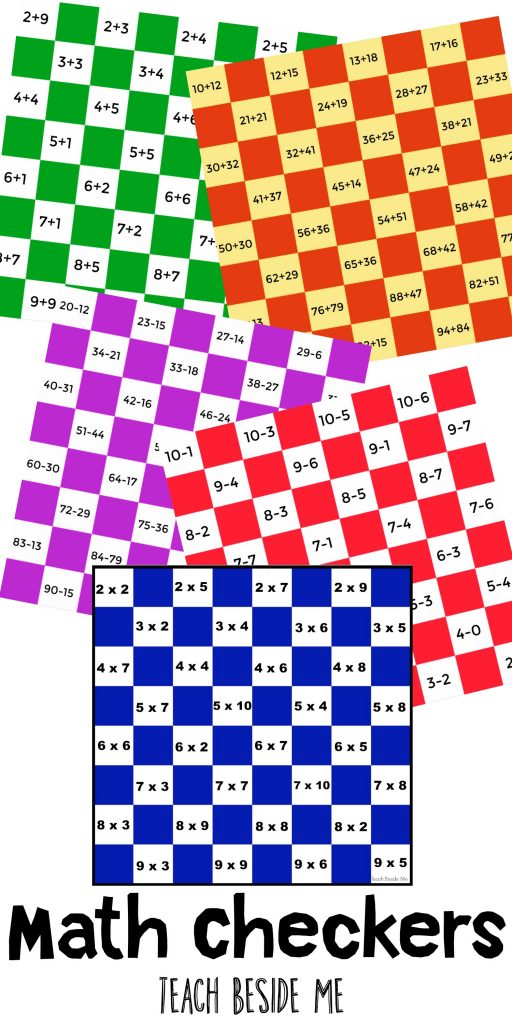
Math Checkers for Addition, Subtraction, and Division
Multiplication was the first Math Checkers board I created, but the game works just as well with other math operations!
I’ve since created additional versions so children can practice different math skills using the same familiar game.
My Math Checkers Bundle includes versions for:
- Addition: Practice adding numbers and building addition fact fluency.
- Subtraction: Reinforce subtraction skills through repeated problem-solving.
- Multiplication: Practice multiplication facts while developing strategy.
- Division: Build confidence with division facts and related multiplication skills.
This makes the game useful for a wider range of ages and abilities.
You can choose the board that matches your child’s current math goals or rotate between the different versions throughout the week.
Get the Complete Math Checkers Bundle Here!

More Fun Math Games for Kids
If your children enjoy Math Checkers, you might also like some of our other hands-on math games!
- The Great Graphing Race — A fun way to practice graphing and data collection.
- Math Pick-Up Sticks — Turn a familiar game into math practice.
- Peek-a-Boo Math Game — A playful approach to practicing math skills.
- Pentomino Blocks Math Game — Explore shapes, spatial reasoning, and problem-solving.
- Roll-a-Beetle Game — A fun roll-and-draw game.
- Math Grid Game — Another way to make math practice more engaging.
Math Checkers is a simple way to turn ordinary math fact practice into something kids actually look forward to.
Sometimes all it takes is a familiar game with a new twist to make learning more enjoyable!
Have fun playing!




This sounds like great fun! May have to play this with my 8th grader , even though he’s in Algebra!
We always need practice in the basics….even us older ones! 🙂
Ha! SO true!
Cool games!!
What a great idea! I love it. Thanks! Rachel @ sisterswithasystem
Thanks.
looks like fun!
This is an awesome idea, thank you.
Great Ideas and Printables!
Thanks!
I don’t see a place where i can subscribe to get the free multiplication printable!
This is great. I would, however, love to have the multiplication facts in random order so that neither side had all the lower numbers or all the higher numbers. Since mine are third graders, some of them are still struggling with the higher numbers, so that would make it a more even playing field.
Look forward to using your fantastic resources