Building Electric Circuits: STEM Challenges for Kids
This post may contain affiliate links.

Learning about electricity becomes so much more exciting when kids get to build their own circuits! These building electric circuits STEM challenges give students hands-on experience with batteries, wires, lights, and other simple materials as they explore how electricity works.
I’ve created a printable set of 8 Electric Circuits STEM Challenge Cards to help kids investigate electrical circuits through building, experimenting, and problem-solving.
From making a simple light bulb glow to testing which materials conduct electricity, these activities are perfect for homeschool science lessons, classroom STEM centers, science clubs, and hands-on technology lessons.

Get the Building Electric Circuits STEM Challenge Cards here!
What Is an Electric Circuit?
An electric circuit is a path that allows electric current to flow. To build a basic circuit, you need an energy source, such as a battery, a conductive path, such as wires or copper tape, and something that uses the electrical energy, such as a light bulb or LED.
When the circuit forms a complete, closed path, electricity can flow. If the path is broken or disconnected, the circuit is open, and the light or other component will not work.
Building circuits gives kids a chance to see these science concepts in action rather than simply reading about them.
As students experiment, they can learn about:
-
Open and closed circuits: Why a complete path is necessary for current to flow.
-
Conductors and insulators: Which materials allow electric current to pass through them.
-
Series circuits: How components can be connected along a single path.
-
Parallel circuits: How electricity can travel through multiple branches.
-
Electrical energy: How batteries supply energy to a circuit.
-
Troubleshooting: How to identify and fix problems when a circuit doesn’t work.
These are wonderful opportunities for kids to practice observation, critical thinking, and the engineering design process.
Building Electric Circuits STEM Challenges
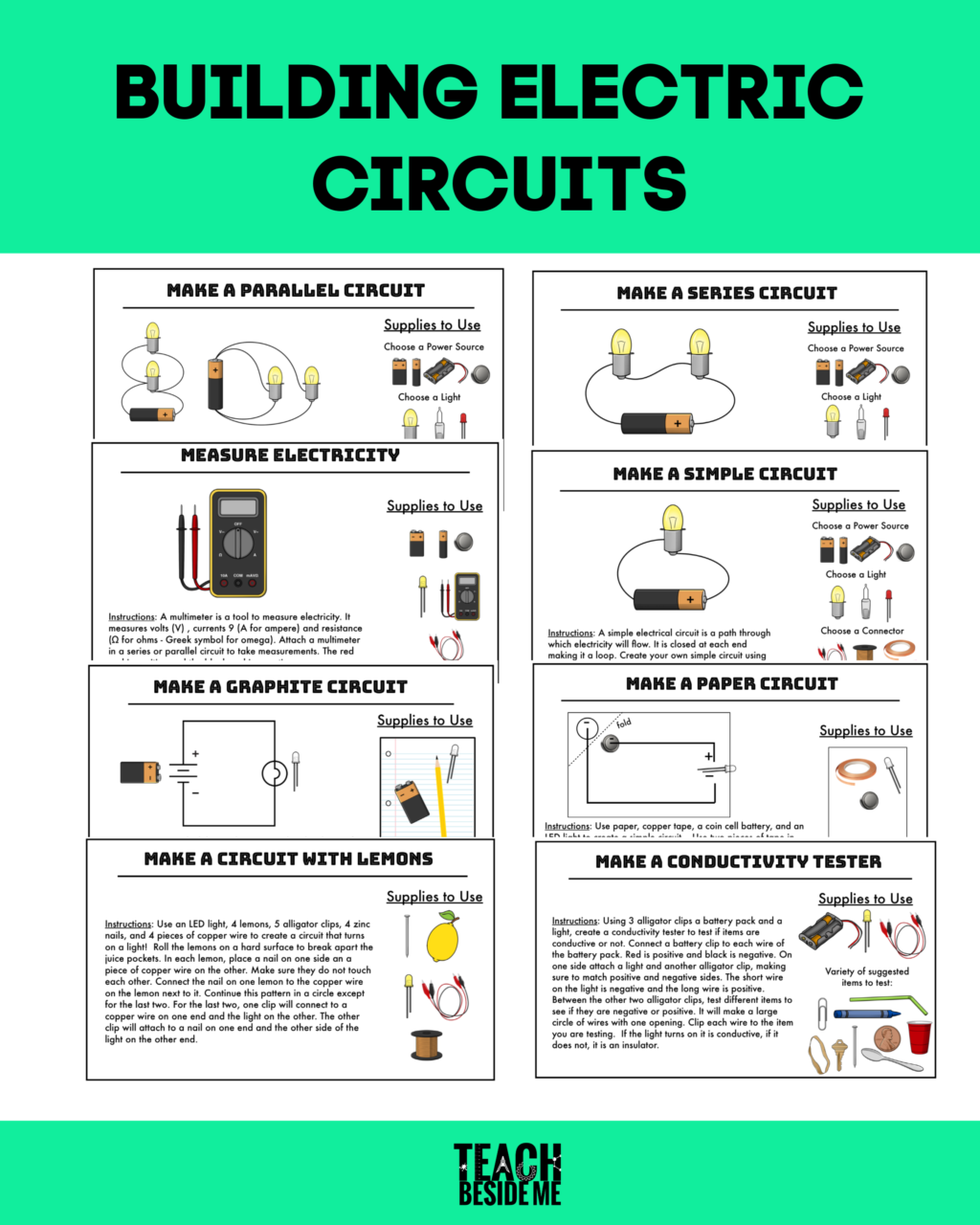
My printable Building Electric Circuits STEM Challenge Cards include eight different activities that help students explore electricity in creative ways.
Each card includes a diagram, a supply list, and instructions for building the circuit. Some challenges are intentionally open-ended, allowing students to choose materials, experiment with different designs, and discover what works.
Each card has a diagram showing how to build the circuit. It also includes a supply list, and instructions. They are a little open-ended for some of them, allowing kids to choose their supplies when building the circuits. Once you give kids a basic knowledge of how circuits work, they will be able to build and create them in a variety of ways. That’s the fun of these.

1. Make a Circuit with Lemons
Can you use lemons to produce electricity?
In this challenge, kids investigate how a lemon battery works by using different metals and the lemon’s juice to create a simple electrochemical cell.
This is a great introduction to how chemical energy can be converted into electrical energy.
Related activity: Lemon Battery Experiment
2. Make a Conductivity Tester
Not all materials allow electricity to flow equally well!
Students build a simple conductivity tester and use it to investigate everyday objects and materials. They can make predictions, test their ideas, and sort materials into conductors and insulators.
Try testing items such as coins, aluminum foil, plastic, rubber, and paper.
3. Make a Graphite Circuit
Did you know that the graphite in a pencil can conduct electricity?
This challenge encourages kids to investigate graphite as part of an electrical circuit. It’s a surprising way to explore conductivity using an ordinary classroom material.
Students can experiment with pencil marks and observe how their circuit responds to changes in the conductive path.
4. Make a Paper Circuit
Paper circuits combine science, engineering, and creativity!
Using copper tape, a battery, and an LED light, kids can create a circuit on paper. They can incorporate their circuits into cards, artwork, and other creative projects.
This is one of my favorite ways to connect STEM learning with art.
5. Make a Simple Circuit
Start with the basics!
Students build a simple electrical circuit using a battery, conductive wires, and a small light or other suitable component.
The goal is to create a complete path that allows electricity to flow.
Once the circuit works, challenge students to disconnect one wire and explain what happens.
6. Measure Electricity
How can we measure what’s happening in an electrical circuit?
This challenge introduces students to using a multimeter to investigate electrical measurements.
With guidance, students can begin exploring voltage and learn how scientists and engineers use measuring tools to understand circuits.
7. Make a Series Circuit
In a series circuit, electrical components are connected along a single path.
Students can experiment with connecting multiple lights or other components in series and observe what happens when one part of the circuit is disconnected.
This activity helps demonstrate how all the components in a series circuit depend on the same complete path.
8. Make a Parallel Circuit
A parallel circuit has more than one path for electrical current.
Students build a circuit with separate branches and compare it with the series circuit they created previously.
Can one light continue working when another branch is disconnected? This is a fun question to investigate!

Supplies for Electric Circuit STEM Activities
You won’t need every supply for every challenge. Many of these materials can be reused for multiple projects, making them a worthwhile addition to a classroom or homeschool STEM supply collection.
Here are the materials used across the activities:
- Double Sided Copper Tape
- Multimeter
- LED Pin Lights
- 3V Coin Cell Batteries
- 9V Batteries
- AA Batteries
- Alligator Clips
- Copper Wire
- Other Small Light Bulbs (Christmas lights would work)
- Small Battery Pack
- Zinc Nails
- Lemons
- Pencil & Paper
A note about safety: These challenges should use only low-voltage batteries, never household outlets or mains electricity. Adults should supervise battery use, especially coin cell batteries, which are dangerous if swallowed. Avoid short-circuiting batteries, and choose components rated for the battery voltage being used. A 9V battery should not be connected directly to a typical LED without an appropriate current-limiting resistor.

How to Use the Electric Circuits STEM Challenge Cards
There are several ways to incorporate these printable circuit activities into your lessons.
STEM centers: Set up a station with the challenge card and its supplies. Students can work individually or in small groups to build their circuits.
Science lessons: Introduce a concept such as conductors or parallel circuits, then let students investigate it through the corresponding challenge.
Engineering challenges: Give students a card, let them study the diagram, and encourage them to build the circuit with minimal assistance. Allow time for testing, redesigning, and troubleshooting.
STEM clubs or enrichment: Use one challenge each week to create an eight-activity electricity unit.
I recommend beginning with the simple circuit activity before introducing more complex challenges. Once students understand how to make a complete circuit, they’ll be better prepared to experiment with different materials and configurations.
Questions to Ask During Circuit STEM Challenges
The learning doesn’t have to stop once the light turns on!
Encourage kids to think about the science behind their creations with questions such as:
-
What makes electricity flow through your circuit?
-
What happens when you disconnect one wire?
-
Why do some materials conduct electricity while others don’t?
-
What changes when you add another light?
-
How is your series circuit different from your parallel circuit?
-
What did you try when your circuit didn’t work?
-
How could you improve your design?
You can also have students draw their completed circuits, label the components, and record what they observed.
These simple reflections turn a building activity into a more complete STEM learning experience.
Get the Printable Electric Circuits STEM Challenge Cards
Ready to start building?
My Building Electric Circuits STEM Challenge Cards include eight printable activities with diagrams, materials lists, and instructions to help kids explore electricity through hands-on experimentation.
They’re a convenient way to organize an electricity unit, STEM center, or series of engineering challenges.
Purchase the Building Electric Circuits STEM Challenge Cards in my shop!


More Electricity and Circuit Activities for Kids
If your kids enjoy building circuits, there are so many other creative ways to explore electricity!
Try these hands-on projects from Teach Beside Me:
Creative Paper and Soft Circuit Projects
-
Halloween Paper Circuits — Combine electricity with a fun seasonal STEM activity.
-
Menorah Paper Circuit — Explore electricity through a Hanukkah-themed project.
-
Sewn Circuit Firefly — Learn how to incorporate a circuit into a sewing project.
-
Soft Circuit Christmas Ornament — Make a holiday decoration with an electrical circuit.
-
Firefly Paper Circuit — Create a glowing paper firefly.
Homemade Battery Experiments
These activities are great companions to the challenge cards because they give students additional ways to investigate electricity and electrical energy.
You can also explore more creative circuit activities for kids from Left Brain Craft Brain.
Whether you’re introducing electricity for the first time or looking for new STEM challenges, building electric circuits is a fantastic way to help kids learn through experimentation and discovery!