
How to Make a Candle Seesaw (Easy Physics Experiment for Kids)
This post may contain affiliate links.

Have you ever seen a candle balance and rock back and forth all by itself? This fascinating candle seesaw experiment is a simple STEM activity that demonstrates center of mass, gravity, kinetic energy, and conservation of energy. It’s an eye-catching science demonstration that’s sure to amaze kids and spark curiosity about how motion and balance work.
This experiment is best demonstrated with adult supervision since it uses an open flame.
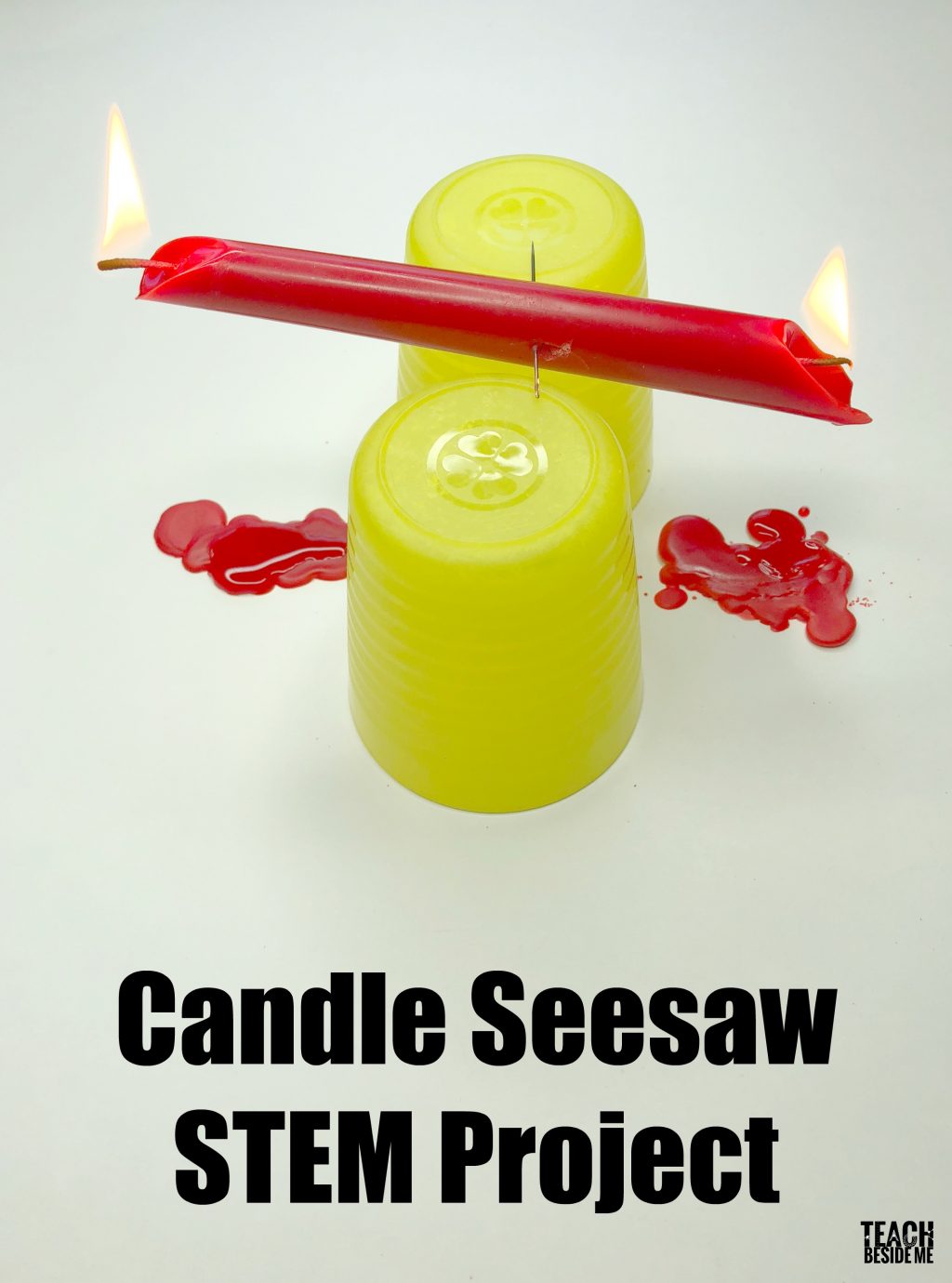
How to Make a Candle Seesaw
Supplies
- Long taper candle
- Carving knife
- Long sewing needle or thin nail
- Matches or lighter
- Two cups (or two glasses)
- Tray or aluminum foil to catch dripping wax
- Safety glasses (recommended)

Instructions
1. Expose the hidden wick.
Most taper candles only have a visible wick on one end. Carefully carve away a small amount of wax from the opposite end until you expose the wick hidden inside the candle.
2. Find the candle’s balance point.
Balance the candle across two fingers until you find the point where it rests evenly. Because taper candles are wider at one end, the balance point usually won’t be exactly in the center. Mark this spot.
3. Insert the pivot.
Warm the tip of your needle or nail with a match and carefully push it through the candle at the balance point. Leave equal lengths sticking out on each side.
4. Set up the seesaw.
Rest the needle across two cups so the candle can rock freely.
5. Light the heavier end.
The candle will naturally tip toward the heavier side. Light that wick first and allow it to burn until the candle begins to balance. Then light the second wick.
6. Watch the motion begin!
As wax melts and drips from one end, the candle gradually becomes lighter on that side, causing it to rise. Soon the opposite end becomes heavier, and the candle rocks back the other way.
Place a tray or foil underneath to catch the dripping wax.

Why Does the Candle Rock Back and Forth?
This experiment demonstrates several important science concepts.
Gravity
Gravity constantly pulls downward on both ends of the candle.
Center of Mass
The candle pivots around its balance point. As melted wax drips away, the candle’s center of mass shifts from one side to the other.
Potential & Kinetic Energy
When one end rises, it gains gravitational potential energy. As it falls again, that energy changes into kinetic energy, the energy of motion.
Conservation of Energy
The continual melting of wax changes the candle’s mass, allowing the center of mass to shift repeatedly. This causes the candle to rock back and forth until enough wax has burned away that the motion eventually stops.
Questions to Ask Kids
- Why does one end fall first?
- What happens as the wax drips?
- Why doesn’t the candle stop after one movement?
- What would happen if one end were much heavier?
- Why does the rocking eventually stop?
STEM Extensions
Try changing one variable at a time.
- Use candles of different lengths.
- Compare thick and thin taper candles.
- Time how long the candle rocks before stopping.
- Count the number of complete swings.
- Draw a graph of the candle’s movement over time.
Safety Tips
- Adult supervision is required.
- Keep the experiment away from anything flammable.
- Place the candle over a tray or foil to catch hot wax.
- Never leave a burning candle unattended.
- Allow the candle to cool completely before handling.


