How to Make Play Dough Circuits (Easy Light-Up STEM Activity for Kids)
This post may contain affiliate links.

Did you know you can make play dough that actually lights up? This playdough circuit experiment is one of the easiest ways to teach kids how electricity works using simple materials at home.
Play dough circuits are a fun and simple STEM activity. Kids can build real electrical circuits using play dough, a battery, and LED lights. It’s a hands-on way to learn about electricity, conductivity, and circuits—without needing wires or complicated supplies.

What are play dough circuits?
Play dough circuits are simple electrical circuits made using conductive dough, a battery pack, and LED lights. The dough acts like a wire, allowing electricity to flow and light up the bulb.
This is a very easy way to introduce electric circuits to young kids.
This experiment is the best because it:
✔ Lights up instantly
✔ Uses simple household ingredients
✔ Is perfect for preschool through elementary
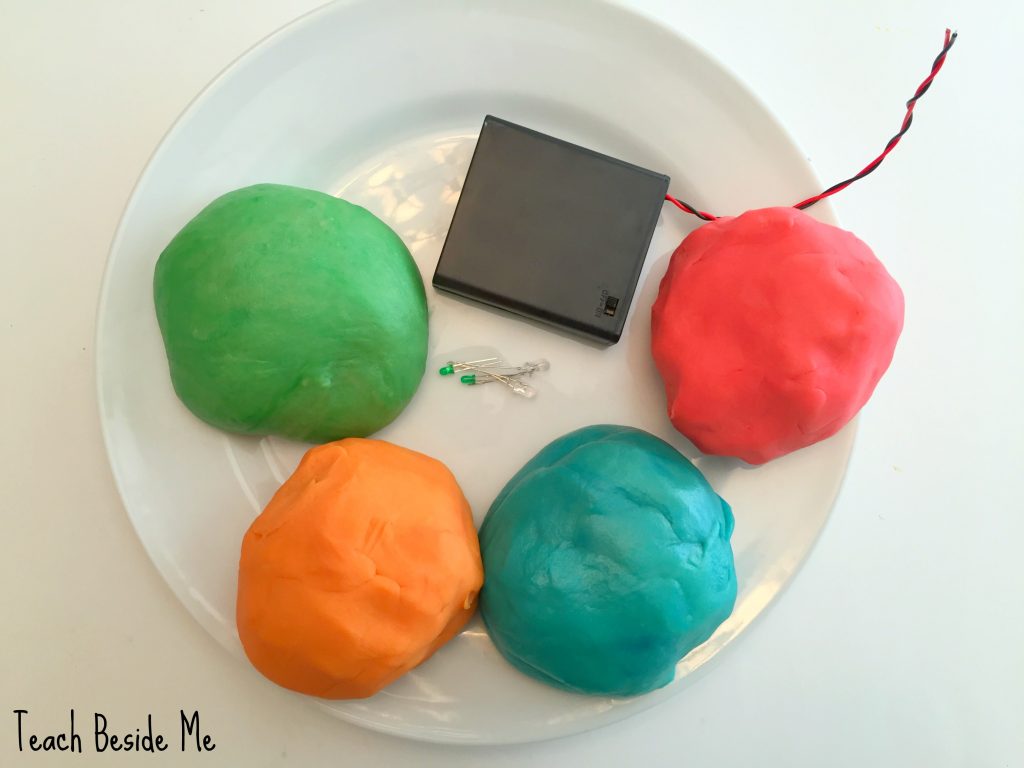
You can use regular store-bought play dough or make your own at home. You need two different types of play dough. You need a conductive dough (the regular old salty recipe) and you need an insulating dough, too. This is made with sugar instead of salt.
Both conductive and insulating dough can be stored in a ziplock bag or other air tight container and kept for a few weeks. I suggest making the two doughs a different color so you can easily tell them apart.
Supplies for Play Dough Circuits:
- Conductive Play Dough (recipe below)
- Insulating Play Dough (recipe below)
- Battery Pack + AA batteries
- LED Pin Lights (LED stands for Light Emitting Diodes)
- You could also try buzzers instead of lights!
Conductive Homemade Play Dough Recipe: (salt dough)
Any old salty play dough recipe will do here! Or you can use your store bought dough.
1 cup Water
1 1/2 cups Flour
1/4 cup Salt
3 Tbsp. Cream of Tartar (or 9 Tbsp Lemon Juice gives the same results)
1 Tbsp. Vegetable Oil
Food Coloring, if desired
Mix in a medium size pot and cook over medium heat, stirring the mixture consistently. It will thicken into a dough as it cooks. Let it cool. If it is still too gooey, knead in a bit more flour.
Insulating Play Dough Recipe (sugar dough)
1 1/2 to 2 cups Flour
1/2 cup Sugar
3 Tbsp. Vegetable Oil
1/2 cup Water (use distilled for better results)
Food Coloring, if desired
This dough does not need to cook. Mix well in a mixing bowl. Start with less flour, then add more if the dough is too sticky. Mine was really sticky so I added quite a bit more flour to get it to the right consistency.
Now that you have both kinds of dough ready, it’s time to experiment.

How to Make Play Dough Circuits (Step-by-Step)
- Roll two pieces of conductive dough into separate shapes
- Place insulating dough between them to keep them from touching
- Insert the battery pack wires into each piece of conductive dough
- Place the LED light with each leg in a different piece of dough
- Make sure the positive and negative sides match
- Watch it light up!
Here is how it works: Electricity flows in loops called circuits. This project can be set up as a parallel circuit. Electricity flows along the path of least resistance. The conductive dough will allow electricity to flow while the insulating dough will not.
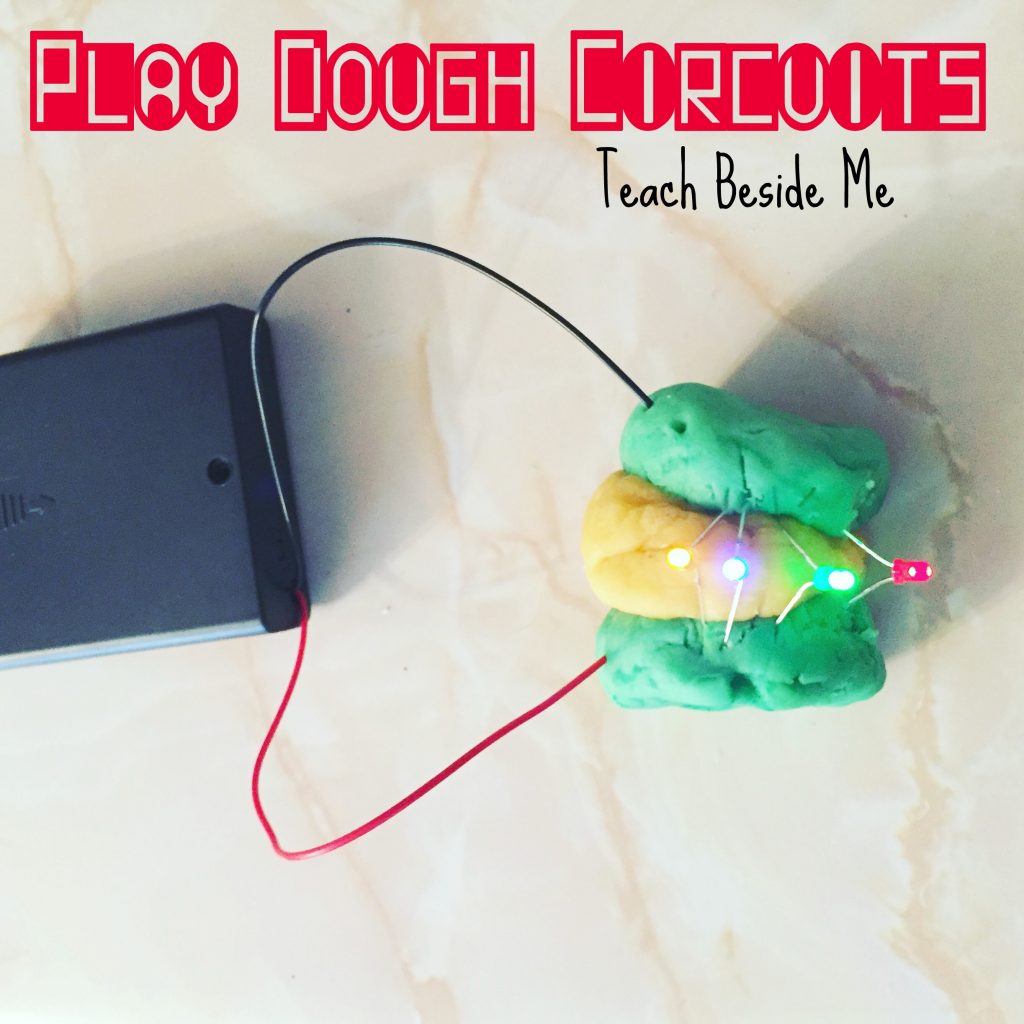
Your battery pack and pin light bulb each have positive and negative sides. The longer pin or leg is positive and the red wire is positive (just like on a jumper cable!) You need to match those up to create the circuit.
Layer two pieces of conductive play dough together with the insulating dough between them. Then put the wires into each of the pieces of dough and spread out the pins on the LED light and insert them. Each leg of the LED should only touch the conductive dough, and the positive and negative sides must match or it will not work.
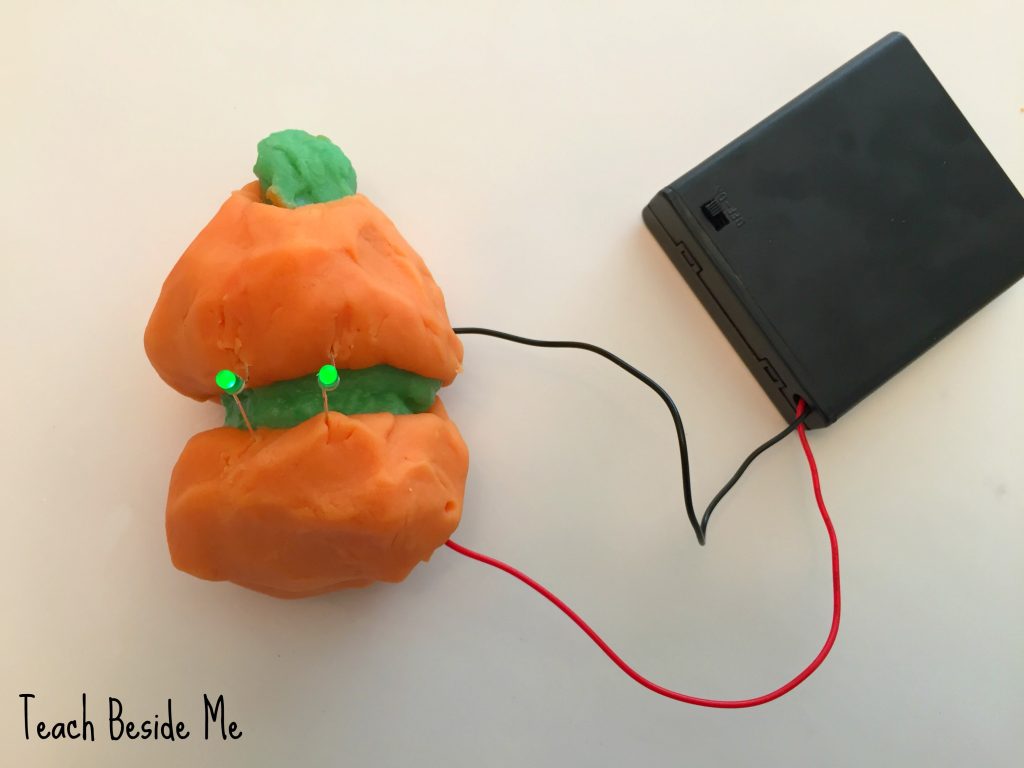
Once you figure it out, try experimenting with different designs! We made a pumpkin and a flower with ours! You can add in multiple lights, but the power dims a little with each one that is added.
Why Does Conductive Play Dough Work?
In the conductive play dough, salt and cream of tartar are included. These ingredients contain ions that allow electrical charges to flow through them.
In the insulating dough, the salt and cream of tartar are not included and distilled water is recommended. Sugar does not conduct electricity the way salt does. The water from our tap has minerals (including salt) in it. Using distilled water removes those conductive minerals.
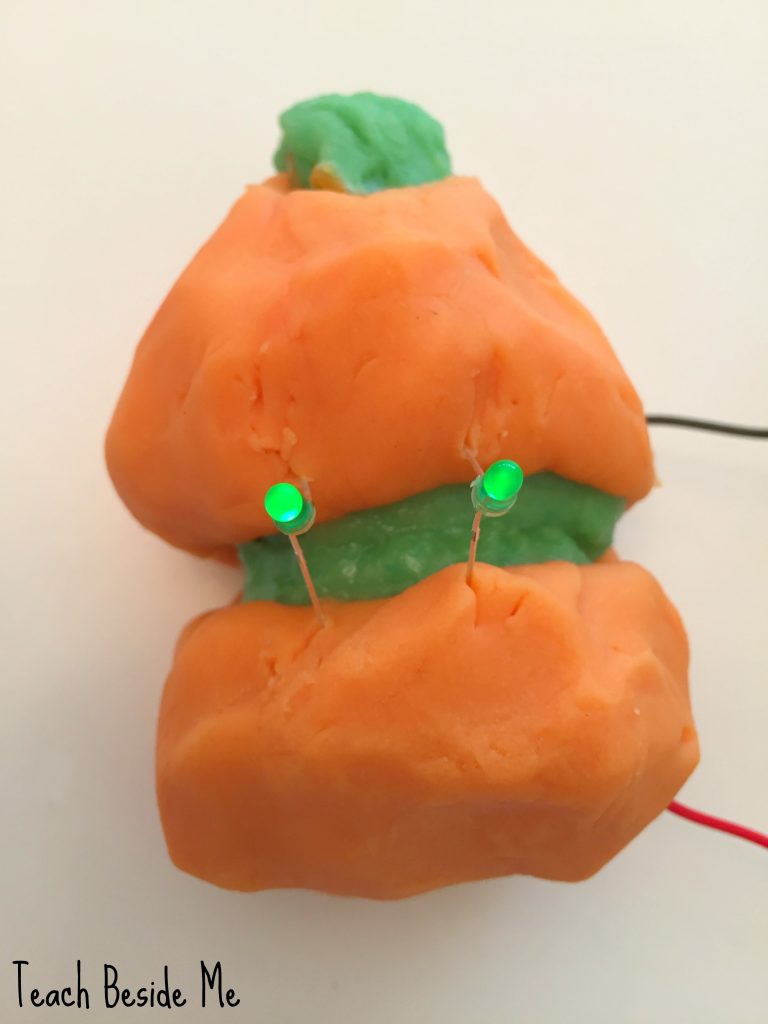
Try These Fun Play Dough Circuit Ideas
- Light-up pumpkin (great for fall)
- Flower with glowing center
- Add multiple LEDs for a brighter design
- Try a buzzer for sound
Why isn’t my play dough circuit working?
If your light won’t turn on, check these common issues:
- The LED legs may be backwards
- The battery pack may be flipped
- The two conductive dough pieces may be touching
- The dough may be too dry or crumbly
Safety Tips
- Always supervise children when using batteries
- Do not let kids put the dough in their mouths
- Disconnect batteries when not in use
FAQ’s
Can play dough conduct electricity?
Yes! Play dough can conduct electricity when it contains salt. The salt dissolves into ions that allow electrical current to flow.
Why does play dough work as a conductor?
Salt and water in the dough create free-moving ions. These ions carry electrical charge, allowing electricity to move through the dough.
What makes insulating dough different?
Insulating dough uses sugar instead of salt, which does not create ions. This prevents electricity from flowing through it.