Famous Art Coloring Pages: 15 Masterpieces for Kids
This post may contain affiliate links.
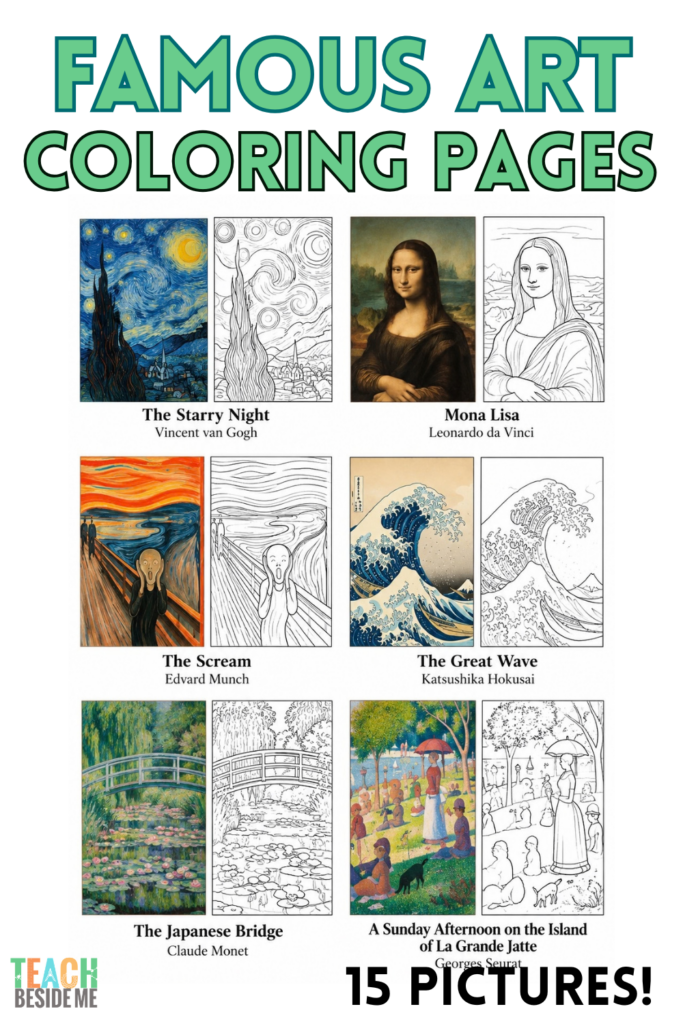
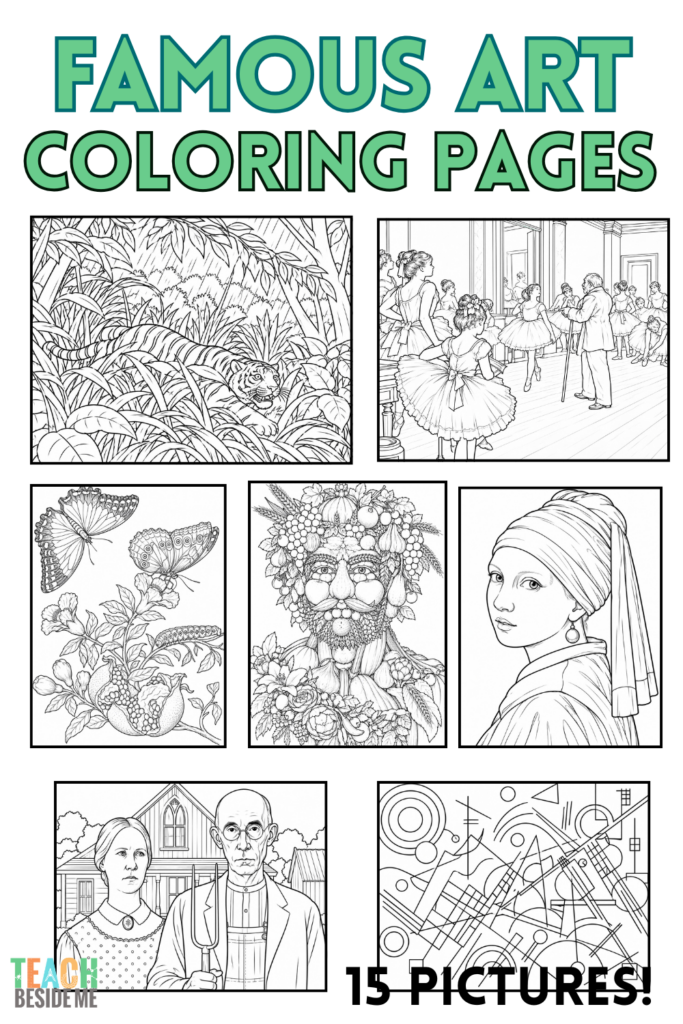
Introducing children to famous works of art doesn’t have to mean sitting through a long art history lesson! One of my favorite ways to help kids explore art is to give them the opportunity to really look at it, notice the details, and then create something themselves. I created this set of Famous Art Coloring Pages to introduce kids to 15 well-known masterpieces and the artists who created them.
The printable collection includes works from Leonardo da Vinci, Claude Monet, Vincent van Gogh, Mary Cassatt, Hokusai, Wassily Kandinsky, and many more.
Each masterpiece also includes a short art appreciation description so kids can learn about the artist, where they were from, the art movement or style, and some interesting things to notice in the artwork.
Use them for an artist study, homeschool art lesson, classroom art activity, or as the starting point for your own masterpiece-inspired art projects.
Famous Art for Kids: Look, Learn, Color & Create
When we study famous artists with kids, I don’t think the goal should be memorizing a long list of names and dates. I want kids to actually notice the art.
That’s why I like a simple approach:
LOOK: Start by looking at the original masterpiece. What do you notice first? Look at the colors, lines, shapes, people, objects, patterns, and details.
LEARN: Read a little about the artist and artwork. Where and when did the artist live? What kind of art did they create? Is there an interesting story behind this particular work?
COLOR: Use the printable masterpiece coloring page to look even more closely at the composition. Kids can try to recreate the original colors—or make completely different artistic choices.
CREATE: Take it a step further by using the page as a template or inspiration for your own art project.
That last part is especially fun for me. A printable outline doesn’t have to be used only with crayons!
15 Famous Masterpieces to Explore
The printable pack includes 15 famous works of art from different countries, centuries, and artistic styles.

Mona Lisa — Leonardo da Vinci
Leonardo da Vinci was an Italian Renaissance artist, inventor, scientist, and thinker. His famous Mona Lisa is known for her mysterious expression, the hazy landscape behind her, and Leonardo’s beautifully soft blending technique called sfumato.
As kids color the Mona Lisa, have them notice her expression and the unusual landscape in the background.
Girl with a Pearl Earring — Johannes Vermeer
Dutch artist Johannes Vermeer was known for his beautiful use of light and for painting quiet scenes of everyday life. Girl with a Pearl Earring stands dramatically against a dark background, with light catching her face and famous earring.
This is a wonderful artwork for talking about light, shadow, and contrast.
The Great Wave off Kanagawa — Katsushika Hokusai
Japanese artist Katsushika Hokusai created The Great Wave off Kanagawa as a woodblock print in the early 1830s. The enormous curling wave towers above small boats while Mount Fuji appears in the distance.
Look for the repeating curved shapes throughout the wave and talk about how Hokusai created a strong sense of movement.
The Japanese Footbridge — Claude Monet
French artist Claude Monet was one of the founders of Impressionism. His garden at Giverny became the subject of many of his paintings, including his beautiful Japanese-style bridge surrounded by water lilies and plants.
Monet’s work is a great opportunity for kids to explore color, light, nature, and visible brushstrokes.
The Dance Class — Edgar Degas
French artist Edgar Degas frequently drew and painted ballet dancers. Rather than showing only polished performances, he was fascinated by the ordinary moments of dancers practicing, waiting, stretching, and resting.
In The Dance Class, look at the many different things happening around the studio. It almost feels like we’ve stepped quietly into a real ballet lesson.
A Sunday on La Grande Jatte — Georges Seurat
French artist Georges Seurat developed a method of painting with many tiny touches of color that became known as Pointillism.
His enormous A Sunday on La Grande Jatte — 1884 shows people spending a leisurely day beside the Seine River. From a distance, all those little marks of color visually blend together.
Try looking at the original artwork both close up and from farther away!
The Starry Night — Vincent van Gogh
Dutch artist Vincent van Gogh used bold color, expressive lines, and energetic brushstrokes in his paintings.
The Starry Night is one of the world’s most recognizable paintings. Its swirling sky, glowing stars, dark cypress tree, and quiet village make this an especially fun masterpiece for kids to recreate.
The Scream — Edvard Munch
Norwegian artist Edvard Munch used color, line, and exaggerated forms to express powerful emotions.
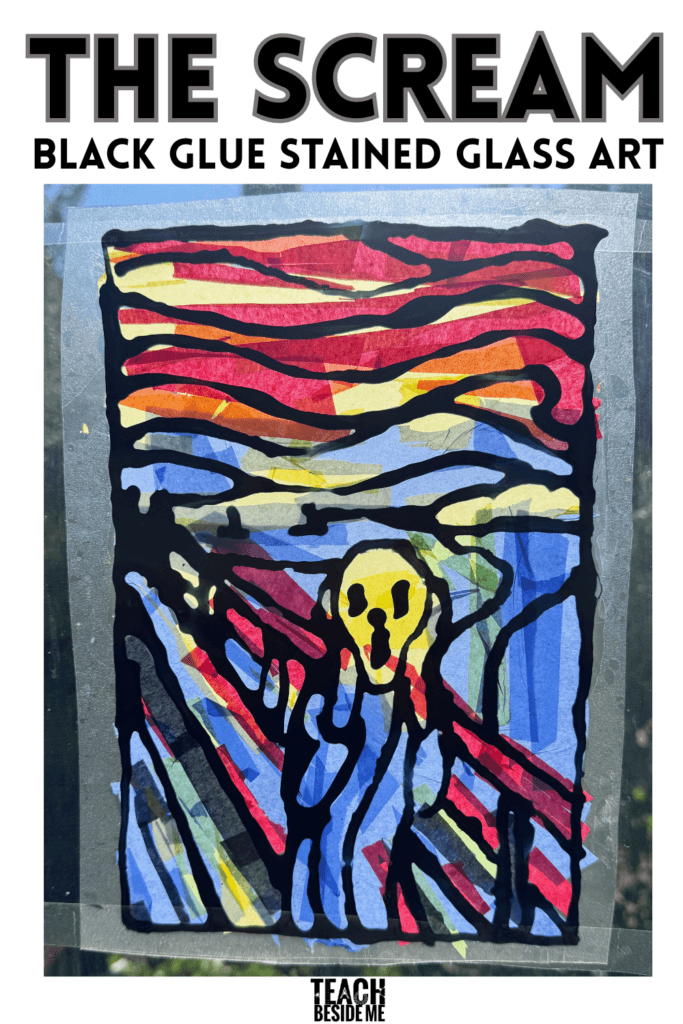
In The Scream, nearly everything seems to swirl around the central figure. Notice how the straight lines of the bridge contrast with the curving sky, landscape, and figure.
We turned this one piece to turn into a hands-on art project.
Try The Scream Art Project
Want to take one of these famous artworks a step further? Try my The Scream Art Project for Kids, inspired by Edvard Munch’s famous painting. Kids use black glue, colorful tissue paper, and clear contact paper to create a stained-glass-style version while exploring line, movement, color, texture, and emotion.
In that post, I’ve also included a free printable with a simplified project template and a detailed The Scream coloring page!
Tiger in a Tropical Storm (Surprised!) — Henri Rousseau
French artist Henri Rousseau became famous for imaginative jungle paintings despite never having traveled to a tropical jungle.
In Tiger in a Tropical Storm (Surprised!), layers of enormous leaves nearly conceal a tiger as wind and rain sweep through the scene. Kids can look for the many overlapping plant shapes and the diagonal lines that create the feeling of a storm.
Composition VIII — Wassily Kandinsky
Wassily Kandinsky was born in Russia and became one of the pioneers of abstract art. He was fascinated by music and believed that shapes and colors could create feelings much like sounds do.
Composition VIII is filled with circles, triangles, lines, curves, and geometric forms. Instead of asking kids what the picture is “of,” ask them how the shapes seem to move, balance, or interact.
The Red Room (Harmony in Red) — Henri Matisse
French artist Henri Matisse was known for his bold use of color and pattern.
In The Red Room, brilliant red fills both the wall and table while blue vines seem to travel across them. The flattened perspective makes it difficult to tell exactly where one surface ends and another begins.
This is a fun masterpiece for experimenting with completely different color schemes and patterns.
American Gothic — Grant Wood
American artist Grant Wood was born in Iowa and became known for painting the people and landscapes of the Midwest.
His famous American Gothic was inspired by an Iowa house with a distinctive Gothic-style window. The two figures were modeled by Wood’s sister and his dentist and were intended to represent a farmer and his daughter.
See how many repeating lines and shapes you can find in the clothing, pitchfork, faces, and house.
Children Playing on the Beach — Mary Cassatt
Mary Cassatt was an American artist who spent much of her career in France and became closely connected with the Impressionists.
She was especially known for portraying women and children in everyday moments. In Children Playing on the Beach, the children aren’t posing for us—they’re completely absorbed in playing in the sand.
It’s a lovely example of how artists can make an ordinary moment worth looking at closely.
Pomegranate and Menelaus Blue Morpho Butterfly — Maria Sibylla Merian
German-born artist and naturalist Maria Sibylla Merian combined art and science in her remarkably detailed studies of insects and plants. In 1699, she traveled to Suriname in South America with her daughter to observe and document tropical species firsthand. Her work helped show insect metamorphosis and the relationships between insects and the plants they depended upon.
Her Pomegranate and Menelaus Blue Morpho Butterfly, created in 1702–1703, shows pomegranate blossoms and fruit alongside brilliant blue morpho butterflies and a banded sphinx moth caterpillar. It is a version of plate 9 from her famous Metamorphosis Insectorum Surinamensium.
Have kids look closely at the different stages of plant and insect life in the image. It’s a wonderful example of how careful scientific observation can also become beautiful art.
Vertumnus — Giuseppe Arcimboldo
Italian artist Giuseppe Arcimboldo created some of the most unusual portraits in art history. He arranged fruits, vegetables, flowers, books, and other objects so that together they formed human faces.
His painting Vertumnus portrays Holy Roman Emperor Rudolf II using fruits, vegetables, flowers, and grains.
Before coloring it, see how many individual foods your kids can identify. Then step back and watch all those separate objects turn into a face!
Printable Famous Art Coloring Pages
The complete printable collection includes 15 famous art coloring pages, along with a corresponding art appreciation page for each masterpiece.
The coloring pages intentionally have no titles or labels printed on the artwork itself. I wanted them to be useful for much more than traditional coloring.
Try using them with:
- crayons, markers, or colored pencils
- watercolor paints
- oil pastels
- tissue-paper collage
- torn-paper mosaics
- watercolor resist
- tracing activities
- stained-glass-style art
- mixed-media projects
Kids can recreate the colors and style of the original masterpiece, or use the outlines as a starting point for something completely new.
Art Appreciation Questions for Kids
You don’t need an art history degree to talk about famous art with children. Simply looking closely and asking questionscan lead to some wonderful discussions.
Try questions such as:
What do you notice first?
Where does your eye go next?
What colors do you see?
What kinds of lines and shapes did the artist use?
Does the artwork seem still or full of movement?
How does it make you feel?
What do you think is happening?
What detail do you find most interesting?
What would you change if you were the artist?
And don’t worry about finding one “correct” answer. Part of learning to appreciate art is learning to look, wonder, notice, and form your own ideas.
More Famous Artist Projects for Kids
Chihuly Art Project for Kids with Melted Plates
100 Art Projects for Kids ~ Inspired by Famous Artists
Paul Cézanne Artist Study: Exploring the Father of Modern Art
Mondrian Style Fibonacci Art: Hands on Science Art for Kids
Explore Famous Art With Kids
Kids don’t need to memorize every art movement, artist, or date to begin appreciating great art.
Give them opportunities to look closely, ask questions, experiment with materials, and create something themselves.
These famous art coloring pages provide an easy starting point for exploring 15 very different artists and masterpieces—from Renaissance portraiture and Japanese woodblock printing to Impressionism, Expressionism, Pointillism, abstract art, and scientific illustration.