Best Books for Third Graders: Chapter Books, Read-Alouds & Series
This post may contain affiliate links.
Looking for the best books for third graders?
Third grade is such an exciting year for reading! Kids are beginning to move beyond learning how to read and are using their reading skills to discover new worlds, interesting characters, fascinating facts, and stories they don’t want to put down.
But 3rd grade readers can also vary a lot.
Some third graders are just beginning to feel comfortable with chapter books. Others are ready for longer novels, while some still prefer highly illustrated books or graphic novels. All of those can be perfectly good reading choices.
The best books for 3rd graders aren’t necessarily the longest or most challenging books they can manage. They’re books that help kids become confident, curious readers who actually enjoy reading.
I’ve gathered some of my favorite books for 8- and 9-year-olds, along with recommendations from teachers, homeschool-friendly read-alouds, book series, nonfiction, and choices for reluctant readers.
Whether you’re building a third-grade homeschool reading list, stocking a classroom library, or simply trying to find a book your child will love, you’ll find plenty of ideas here.

What Should a Third Grader Be Reading?
By third grade, many children are transitioning into longer chapter books with more developed plots and characters.
Rather than focusing too heavily on a particular reading level, look for books that your child can read with reasonable fluency and understand well enough to tell you what’s happening.
Third graders benefit from reading a mixture of:
- Chapter books they can read independently
- Books that are slightly easier and simply fun
- More challenging books read together or aloud
- Nonfiction about subjects they’re interested in
- Poetry
- Graphic novels and highly illustrated books
- Classic children’s literature
Reading aloud is still incredibly valuable at this age, too. Just because your child can read independently doesn’t mean you need to stop sharing books together!
Best Chapter Books for Third Graders
Third grade is a wonderful age to introduce children to book series. Once kids connect with a character or author, having another familiar book waiting can make choosing what to read next much easier.
The Wild Robot(opens in new tab) by Peter Brown
The Wild Robot follows Roz, a robot who finds herself alone on a remote island and must learn how to survive among the animals who live there.
It’s adventurous and funny but also opens the door to conversations about nature, technology, family, kindness, and what it means to belong.
This is an especially good choice for kids who are beginning to tackle longer novels because the chapters are short and accessible.
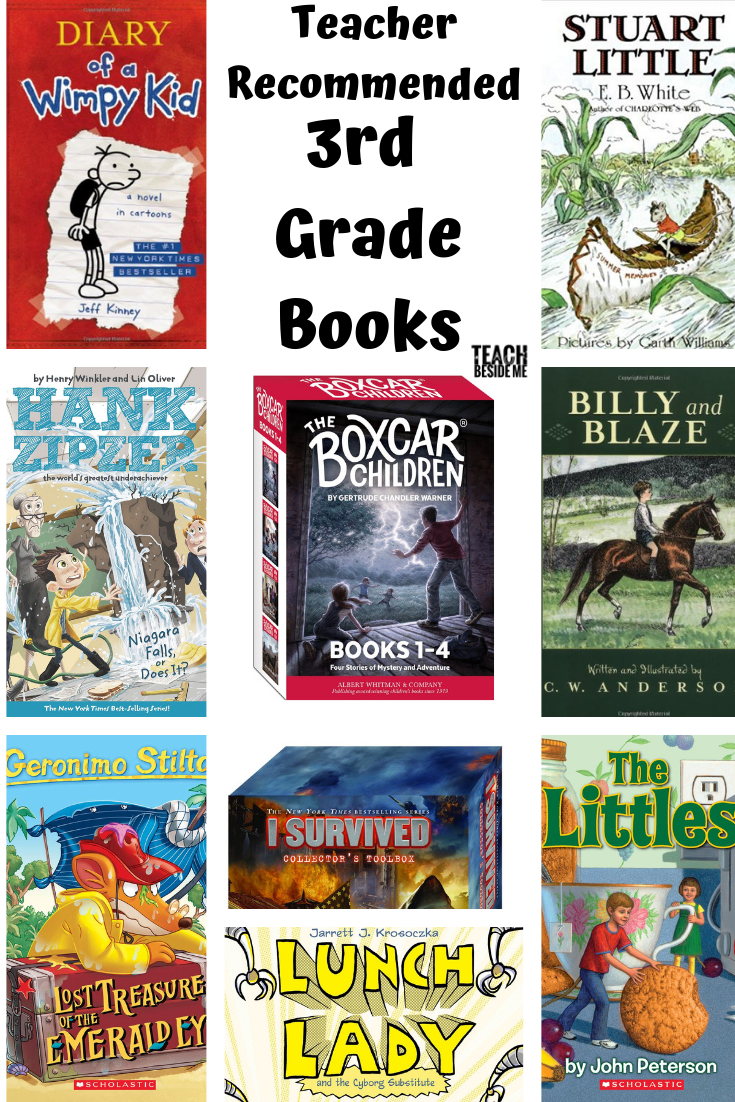
The Boxcar Children(opens in new tab) by Gertrude Chandler Warner
This has been a favorite series in our family.
Four orphaned siblings create a home together in an abandoned boxcar and solve mysteries throughout the series. The original books are approachable chapter books with plenty of adventure and strong sibling relationships.
The Littles(opens in new tab) by John Peterson
The Littles series was one of my son’s favorites!
The Littles are tiny people with tails who secretly live inside the walls of a human family’s home. The books have short chapters, humor, and plenty of adventure, making them a great bridge into chapter books.
Geronimo Stilton(opens in new tab) by Geronimo Stilton
Geronimo Stilton is a mouse, newspaper editor, and somewhat reluctant adventurer who somehow continually finds himself traveling the world and solving mysteries.
Colorful fonts, illustrations, and playful page layouts make these especially inviting for children intimidated by pages filled entirely with text.
Zoey and Sassafras(opens in new tab) by Asia Citro
This series combines fantasy with STEM as Zoey uses science to help magical creatures.
Kids encounter the scientific method, observations, experiments, and problem solving while following an entertaining story. It’s a particularly fun choice for homeschoolers who enjoy combining literature and science.
Dragon Masters(opens in new tab) by Tracey West
For children who love dragons and fantasy but aren’t quite ready for longer fantasy novels, Dragon Masters is an accessible early chapter-book series filled with adventure and illustrations.
Mercy Watson(opens in new tab) by Kate DiCamillo
Mercy is a toast-loving pig who continually finds herself in ridiculous situations.
These books have short chapters, wonderful illustrations, and lots of humor. They’re technically on the easier end for many third graders—which is exactly why they can be such good confidence-building books.
The Mouse and the Motorcycle(opens in new tab) by Beverly Cleary
When a young mouse named Ralph discovers a toy motorcycle, adventure follows.
Beverly Cleary understood children so well, and this is a wonderful classic for independent reading or as a family read-aloud.
Sideways Stories from Wayside School(opens in new tab) by Louis Sachar
A school accidentally built 30 stories high—with one classroom on each floor—is the setting for these hilarious and completely absurd stories.
They’re especially good for kids who like short, funny stories and aren’t immediately drawn to traditional novels.
The Lighthouse Family(opens in new tab) by Cynthia Rylant
These gentle stories about a family formed by animals living together at a lighthouse are beautifully written and illustrated.
They’re especially nice for children who enjoy quieter, character-driven stories.
Historical Fiction for Third Graders
I Survived Series(opens in new tab) by Lauren Tarshis
Teachers consistently recommend the I Survived books, and it’s easy to understand why.
Each story follows a young person experiencing a major historical event or natural disaster, including the sinking of the Titanic, the destruction of Pompeii, Hurricane Katrina, Pearl Harbor, and others.
These can be especially useful in homeschool because it’s easy to pair a book with whatever period of history you’re studying.
I’d just keep in mind that some events covered in the series are frightening or tragic, so individual books may be a better fit for some children than others.
Childhood of Famous Americans(opens in new tab)
My kids have really enjoyed this biography series over the years.
Rather than focusing only on famous Americans as adults, these books introduce readers to their childhoods. They’re a fun way to incorporate biography into history studies while still giving kids something that feels like a story.
Betsy-Tacy(opens in new tab) by Maud Hart Lovelace
Beginning in 1897, the Betsy-Tacy books follow best friends Betsy and Tacy as they grow up in Minnesota.
They’re wonderful books about friendship and everyday childhood and also give readers a glimpse into life around the turn of the twentieth century.
Classic Books for Third Graders
Third grade is also a wonderful time to introduce some classic children’s literature.
Stuart Little(opens in new tab) by E.B. White
Stuart may be tiny, but his adventures certainly aren’t!
This imaginative classic follows a mouse-like boy born into a human family as he navigates life and eventually sets off on an adventure of his own.
My Father’s Dragon(opens in new tab) by Ruth Stiles Gannett
A young boy travels to Wild Island to rescue a baby dragon, bringing along a wonderfully strange collection of supplies to help him solve problems along the way.
Short chapters and illustrations make this classic especially approachable for young readers.
Billy and Blaze(opens in new tab) by C.W. Anderson
These classic horse stories follow Billy and his pony Blaze through adventures together.
They’re wonderful for horse-loving readers and children who enjoy gentler stories.
Charlotte’s Web(opens in new tab) by E.B. White
The friendship between Wilbur the pig and Charlotte the spider has made this one of the most beloved children’s novels of all time.
It’s beautiful, funny, and heartbreaking in places, which makes it especially good as a read-aloud when you can talk about the story together.
Great Third Grade Read-Aloud Books
One of the mistakes we sometimes make as kids become stronger readers is assuming that read-aloud time has served its purpose.
It hasn’t!
Children can understand stories read aloud to them that are considerably more complex than books they can comfortably read independently. Reading aloud exposes kids to richer vocabulary, more complicated plots, and different styles of writing.
Some wonderful third-grade read-aloud choices include:
Because of Winn-Dixie(opens in new tab) by Kate DiCamillo
The Miraculous Journey of Edward Tulane(opens in new tab) by Kate DiCamillo
The One and Only Ivan(opens in new tab) by Katherine Applegate
The Tale of Despereaux(opens in new tab) by Kate DiCamillo
The BFG(opens in new tab) by Roald Dahl
These are also great choices for homeschool families looking for books everyone can enjoy together.
Books for Reluctant Third Grade Readers
If you have a child who says they hate reading, my first goal wouldn’t be to find a harder book.
I’d find a book they want to read.
Funny books, graphic novels, highly illustrated chapter books, and fast-moving series can help reluctant readers discover that books aren’t just school assignments.
Try:
Diary of a Wimpy Kid(opens in new tab) by Jeff Kinney
The Bad Guys (opens in new tab)by Aaron Blabey
Dog Man(opens in new tab) by Dav Pilkey
Lunch Lady(opens in new tab) by Jarrett J. Krosoczka
And yes, graphic novels count as reading!
Kids are still following plots, making inferences, learning vocabulary, interpreting characters, and developing reading stamina.
A graphic novel can also be the book that finally convinces a reluctant reader that reading can be fun.
Nonfiction Books for Third Graders
Don’t overlook nonfiction when you’re trying to encourage a third grader to read.
Some kids who show little interest in novels will happily spend an hour reading about sharks, space, weather, dinosaurs, inventions, sports, animals, or historical disasters.
Try nonfiction series such as:
Who Was? / What Was? books
National Geographic Kids books
DK Eyewitness books
Magic School Bus books
Biographies written for young readers
Books connected to your current science or history studies
Letting children pursue their interests through nonfiction is still building vocabulary, comprehension, background knowledge, and reading stamina.
How to Choose Books for Your Third Grader
Don’t worry too much about creating the perfect third-grade reading list.
Instead, aim for variety.
Give your child access to books that are easy, books that stretch them a little, books you read together, silly books, beautiful books, informational books, and books they choose entirely for themselves.
If a book is frustrating enough that your child has to stop constantly to decode words, it may be better as a read-aloud for now.
And if they’re happily devouring a book that seems “too easy”?
I’d generally let them enjoy it.
Strong readers don’t spend every minute reading at the very edge of their ability. Adults certainly don’t!
Frequently Asked Questions About Third Grade Reading
What age are most third graders?
Most third graders are around 8 to 9 years old, although ages naturally vary depending on birthdays, school enrollment, and homeschool placement.
Should third graders be reading chapter books?
Many third graders are ready for chapter books, but there isn’t one type of book every third grader needs to be reading.
Illustrated chapter books, graphic novels, nonfiction, poetry, picture books, and read-aloud novels all have value.
What reading level should a third grader be at?
Reading-level systems vary, so I wouldn’t choose books based solely on a number or letter.
Pay more attention to whether your child can read the book with reasonable fluency, understand what is happening, and enjoy the story.
Are picture books too young for third graders?
Absolutely not!
There are sophisticated, beautifully written picture books appropriate for elementary-age children and beyond. Picture books are especially useful for history, science, geography, art, poetry, and introducing complex ideas.
How can I get my third grader to read more?
Give them lots of choice.
Try funny books, series, graphic novels, nonfiction about their interests, audiobooks paired with print books, and family read-alouds.
And don’t underestimate the power of finding one series they love. Once a child discovers a world or group of characters they want to return to, suddenly you don’t have to convince them to pick up the next book.
Build a Third Grade Reading Life
Third grade doesn’t need to be about checking off a list of books kids “should” read.
It’s a wonderful year for helping children discover what kind of readers they are.
Introduce them to classics. Let them laugh over silly books. Read beautiful novels aloud together. Keep nonfiction everywhere. Let them reread favorites. And when they fall in love with a series, make sure the next book is waiting.
The goal isn’t simply to create a third grader who can read.
It’s to help create a child who chooses to read.