Fun Paper Board Games to Play With a Pen or Pencil
This post may contain affiliate links.
Paper and pencil games are great for so many different situations. Today I have some fun paper board games that you can play with your kids, students, youth groups, or whenever you need a quick activity. These games are a great way to help you keep kids off of video games, phones & other screens. See Also: Six Paper Tricks That Seem Like Magic!

Pencil and paper games, or paper board games are versatile and can be enjoyed by all kinds of people: children, adults, larger groups, and individuals. No matter the skill level, there will be a game that fits!
They are easy to set up, are portable, inclusive and a great form of entertainment for so many different settings. Use these fun paper games as party games, on a road trip, as a quick game for a brain break in a classroom or homeschool, for family game nights, at church to keep kids quiet, or in the waiting room at the doctor’s office.
Ready for the best games played with just a pen or pencil and paper? Grab a few pieces of paper, some pencils, pens, or colored pencils and let’s get playing!
60 of The Best Pencil and Paper Games:
Word Games:
Alias: One player writes a word or phrase, and others take turns giving clues to help teammates guess it.
Word Association: Players take turns writing words that are associated with the previous word, building a chain of connected words.
Hidden Words: Try to create as many smaller words as possible from one long word.
Chain Reaction: Write a word, and the next player writes a word that starts with the last letter of the previous word. Continue the chain as long as possible.
Capital Cities: Write down the names of countries, and players have to write the corresponding capital cities next to them.
Alphabet Game: Choose a category (like animals, foods or countries) and take turns writing words that fit the category, starting with each letter of the alphabet in order.
Word Snake: Write a word, and the next player writes a word starting with the last letter of the previous word, forming a snake-like chain.
20 Questions: One player thinks of an object, and the others have up to 20 yes-or-no questions to guess what it is. You don’t even need paper & pencil for this one! Just your own minds.
Categories: This is a very simple activity. Choose a category (like animals or countries) and take turns listing items in that category. The person who thinks of the most wins. Try a different variation by listing them in alphabetical order.
Anagrams: Write a word, and others try to form as many different words as possible using its letters.
Hangman: Hangman is a great classic game to pass time in a classroom setting. One player thinks of a word, and the other tries to guess it by suggesting letters. As they guess wrong, they draw body parts until the whole person is drawn. This can be played with multiple players. Play it with categories or themes for more variety.
Variations on the hangman game include drawing a snowman or an apple tree with 10 apples. This is nice if you want to soften the game and not to play with a person hanging. Skeletons in the Closet variation- Players draw a skeleton, one bone at a time, by guessing letters of the hidden word. Each wrong guess adds a bone to the skeleton.
Word Search: You can create your own word searches with many different online sites, or find some pre-made ones to use.This activity has a grid of letters with hidden words for players to discover and circle. These are great to make themed for different lessons when kids are learning terms or vocabulary.
Word Ladder: Start with one word, and end with another. Change one letter at a time to form new words, and reach the target ending word.
Mad Libs: Write a story with blanks for nouns, verbs, adjectives, etc., and have another player fill in the blanks without knowing the context. I have lots of printable Mad Libs!

Dictionary Game: Look up a word in the dictionary, write down the definition, and have others guess the word.
Word Pyramid: Start with a long word and remove one letter at a time to form new words until you can’t make any more.
Folding Stories: Each player writes a sentence of a story, folds the paper to hide it, and passes it to the next person who continues the story without seeing what was written before.
Consequences: This is similar to Folding Stories above. Fold a paper over 8 times. Each player writes a part of a story using prompts (like a name, place, action) without knowing what the others have written, then read the funny story together.
Cross Out: Write a list of words, and the goal is to cross out words that share common letters until only one word remains.
Word Squares: Create a 5×5 square grid and fill it randomly with a few letters. Use the free spaces to fill it with words in all directions.
Crossword Puzzles: Create and solve your own crossword puzzles, using a grid of squares where players write words that intersect based on given clues. There are tons of free printable ones online.
M.A.S.H: Did you play this in middle school? Predict your future by choosing categories (like spouse, job, home) and writing three choices under each category. Eliminate options through a counting game to see what your future will hold!
Missing Vowels: Write words with the vowels removed, and others have to guess the words.
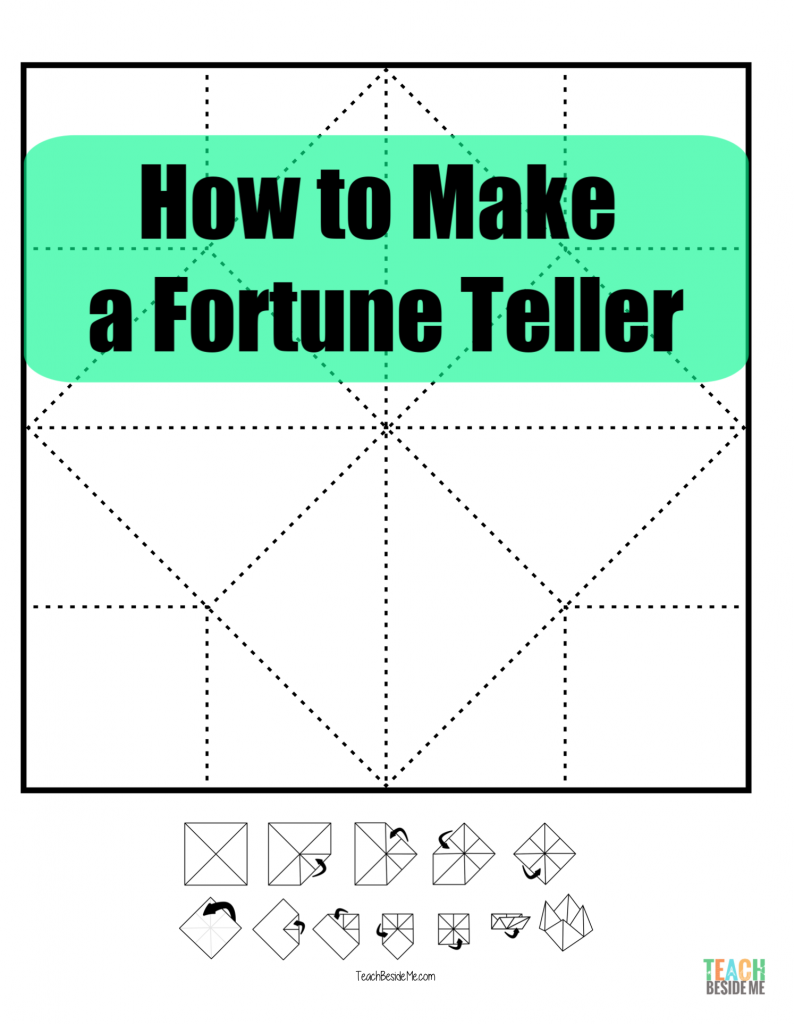
Cootie Catcher: Make a paper fortune teller with hidden messages inside. Learn how to make one here!
Drawing Games:
Drawing Relay: One player starts a drawing with a few lines, and the next player adds to it. Continue until everyone has contributed, then see the final creation. You don’t need great artistic skills to have fun with this one.
Pictionary: This is a great drawing game for a large group or even just two players. Split into teams and send up one player to draw a picture to represent a word or phrase, and the others guess what it is. Make sure to use a timer! (See my Christmas Pictionary Cards!)
Guess the Doodle: One player quickly draws a doodle, and others guess what it is within a time limit.
Folded Drawing: Fold a paper into sections. Each player draws a part of a creature (head, body, legs) without seeing the other parts. Unfold to reveal a mixed-up creature.
Symmetry Drawing: One player draws half of a picture on one side of a vertical line, and the other player completes it symmetrically on the other side.
Alphabet Drawing: Draw pictures starting with each letter of the alphabet, trying to complete all 26.
Story Cubes: Draw nine random shapes or symbols, then use them to create a story by incorporating each element.
Scribble Game: One player makes a random scribble, and the other player turns it into a recognizable drawing.
Mirror Drawing: One player draws a simple shape or pattern, and the other player tries to replicate it as a mirrored image.
Color By Numbers: Draw a simple picture, divide it into sections, and number the sections. Players color each section by number with a corresponding color. This one needs things to color with (such as colored pencils), so a little more than just a pencil. I have a whole bunch of color by number printables on my site!
Maze Making: Create a maze on paper for others to solve.
I-Spy or Hidden Pictures: These feature a complex scene or images with small objects hidden within it. Find and circle the hidden objects. (See my I-Spy pages)
Strategy, Number and Logic Games:
Tic-Tac-Toe: This is a simple game for 2 players. Draw a 3×3 grid and take turns marking Xs and Os to get three in a row. Try my Valentine’s Tic-Tac-Toe, or learn how to make a jumbo wooden board. Also called Noughts and Crosses: Play on a larger grid (4×4 or 5×5) for a more challenging version of Tic-Tac-Toe.
Ultimate Tic-Tac-Toe: This is another two-player game. It’s a more advanced version of the original tic tac toe game. I just did a whole post on this game with a printable grid.

Circular Tic-Tac-Toe: This is a fun twist on the traditional game but done on a circular game board! See my post on this here.

Dots and Boxes: Draw a grid of dots, take turns connecting two dots with a line, and claim boxes by completing the fourth side. Learn more in my post about it plus a printable.

Battleship: To play this great game, draw or print grids for each player. Hide your ships by drawing them on your grid, and take turns guessing coordinates to sink the opponent’s ships. Try my Hundred Chart Battleship or my Periodic Table Battleship.

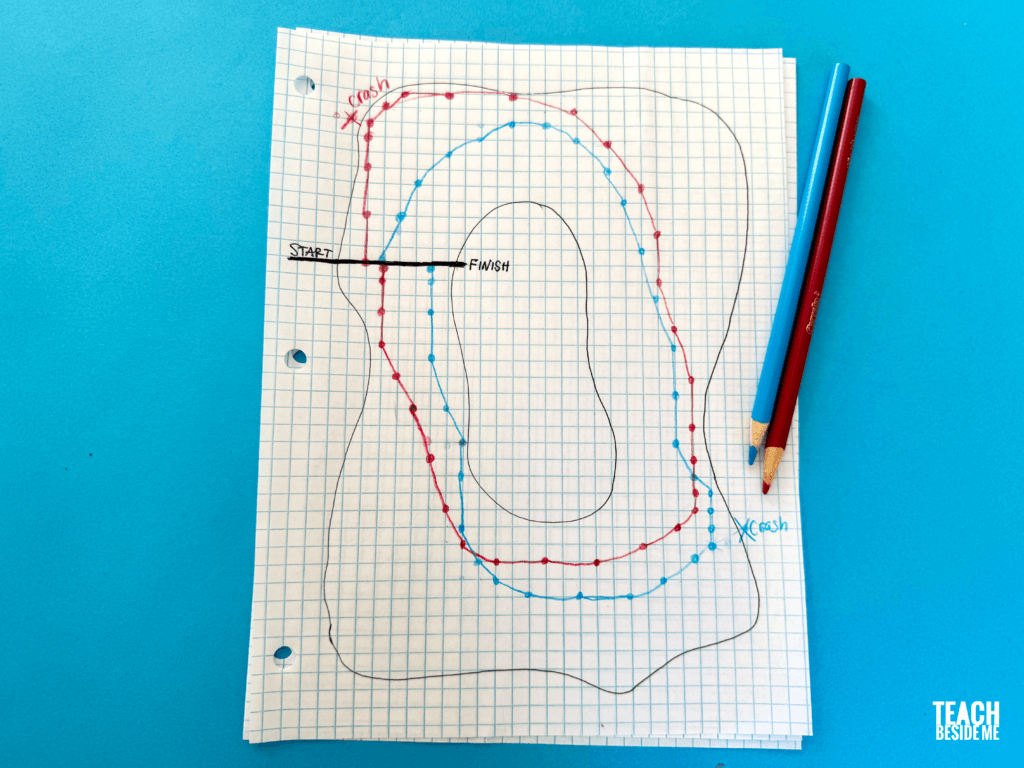
Racetrack: This is a fun car racing game played with graph paper and a pen or pencil. Check out my post on it. It can be played with up to four people.
Connect the Dots: Also called a dot-to-dot. Draw a series of numbered dots and connect them in order to reveal a picture. This is a single player game. I have fun Alphabet Dot-to-dots in my preschool letter packs!
Connect Four Printable Game– Grab this printable version of the old classic!

Number Squares (or Magic Squares): Fill a 3×3 grid with numbers so each row, column, and diagonal sum to the same number. You can draw these or print my free one!
Sudoku: In this paper game, there is a 9×9 square grid. You need to fill in all of the squares using the numbers 1-9 with no repeated numbers in each line vertically or horizontally.

Squares and Circles: Draw a grid, and take turns drawing squares or circles in empty spaces. The goal is to form squares with four of your own symbols.
Paper Soccer: Draw a soccer field grid and take turns “kicking” the ball by drawing lines from one dot to another. I’ll have a full tutorial on this one soon!
Scavenger Hunt: Make a list of items or clues to find around the house or outdoors, and check them off as you find them. See some of my printable scavenger hunts.
Ship, Captain, and Crew: Roll dice to build a ship (6), captain (5), and crew (4) in three rolls, and get the highest score with the remaining dice.
Sim: Draw six dots in a hexagon shape and take turns connecting them with lines. The goal is to avoid completing a triangle in your color.
Ladders: Draw two parallel vertical lines with rungs in between to form a ladder. Players choose different starting points on each side and draw a line across rungs. The goal is to predict where each path will end.
Bulls and Cows: One player thinks of a four-digit number with no repeating digits, and the other guesses the number. The thinker provides feedback on how many digits are correct and in the correct position (bulls) or correct but in the wrong position (cows).
Sprouts: Draw several dots on a piece of paper. Players take turns connecting two dots with a line and adding a new dot on the line, with the goal to force the opponent into a position where they cannot draw a valid line.
Paper Telephone: Similar to the game Telephone, where you whisper to each other, but with drawings and captions. One player writes a caption, the next player draws a picture based on it, the next writes a caption based on the picture, and so on. Fold the paper between each person’s turn.
Hex: Draw a hexagonal grid. Players take turns coloring hexagons, aiming to create a continuous path connecting opposite sides of the board.
Thermometer: Draw a thermometer outline, and inside it, write numbers in a sequence. Players take turns guessing the next number in the sequence, filling in the thermometer as they go.
Rebus Puzzles: Draw pictures or use symbols to represent words or phrases, and others have to guess the meaning.
Math Squares: Create a grid of squares with math problems in each. Players solve the problems to complete the grid.
Multiplication Grid Game: Use a sheet of graph paper, some dice & 2 colors of pencil or markers for this math game.

Hidden Path: Create a grid of squares and draw a hidden path through it. Others try to find the path by guessing squares one at a time.
Educational Benefits to these Paper & Pencil Games
Besides just being lots of fun, these paper and pencil games also have many educational benefits.
Cognitive Benefits
- Problem-Solving Skills: Games like Sudoku, crossword puzzles, and logic puzzles enhance problem-solving and critical thinking skills.
- Creativity: Games that involve drawing or storytelling, like Pictionary and Folding Stories, stimulate creativity and imagination.
- Memory Enhancement: Games such as Word Search and Memory Challenge improve memory and recall abilities.
- Mathematical Skills: Games like Number Squares and Bulls and Cows help reinforce arithmetic and logical reasoning.
- Language Development: Hangman, word ladders, and categories games expand vocabulary and spelling skills.
- Learning Through Play: Many pencil-and-paper games are educational, teaching concepts in a fun and engaging way.
- Focus and Concentration: Games like Battleship and Sim require sustained attention and concentration.
- Analytical Thinking: Strategy games like Dots and Boxes and Hex develop analytical and strategic thinking.
Social and Emotional Benefits
- Communication: Interactive games like Pictionary and Telephone encourage clear communication and teamwork.
- Bonding: Playing games together strengthens family bonds and friendships, providing quality time and shared experiences.
- Emotional Regulation: Learning to cope with winning and losing in a game setting helps develop emotional resilience and sportsmanship.
- Collaboration: Cooperative games foster teamwork and collaborative problem-solving.
Practical Benefits
- Accessibility: Pencil-and-paper games are inexpensive and easily accessible, requiring minimal materials.
- Portability: These games can be played anywhere, making them ideal for travel, waiting rooms, or impromptu play sessions.
- Low Tech: They offer a screen-free alternative for entertainment, reducing screen time and digital dependency.
- Easy to Set Up: Most games require little to no preparation, allowing for spontaneous play.
I hope you’ve found a game that will work for your needs in this great big list of paper and pencil games!
See More Fun Games & Activities From my Site:
96 Printable Charades Ideas for Kids
100 FUN Spelling Games and Activities for Kids
In need of a great printer for all of these fun printable activities? I love my HP Color LaserJet All in One Printer!