Spider Life Cycle for Kids + Free Printable Worksheets
This post may contain affiliate links.
Have you ever watched a tiny spider scurry across a leaf or discovered a spider egg sac tucked into the corner of a garden? Spiders are fascinating creatures, and learning about how they grow is a wonderful way to introduce kids to the world of arachnids!
Today we’re exploring the spider life cycle, from tiny eggs to fully grown spiders. I’ve also created a free printable spider life cycle worksheet set to help kids learn and review the stages.
This is a fun addition to a nature study lesson, an elementary science unit, or your autumn learning activities. And although spiders are especially popular around Halloween, they’re fascinating to study any time of year!
What Is the Life Cycle of a Spider?
Like all living things, spiders go through a life cycle as they grow and reproduce. Young spiders hatch looking like tiny versions of spiders. As they grow, they shed their outer covering, called an exoskeleton, several times before reaching adulthood.
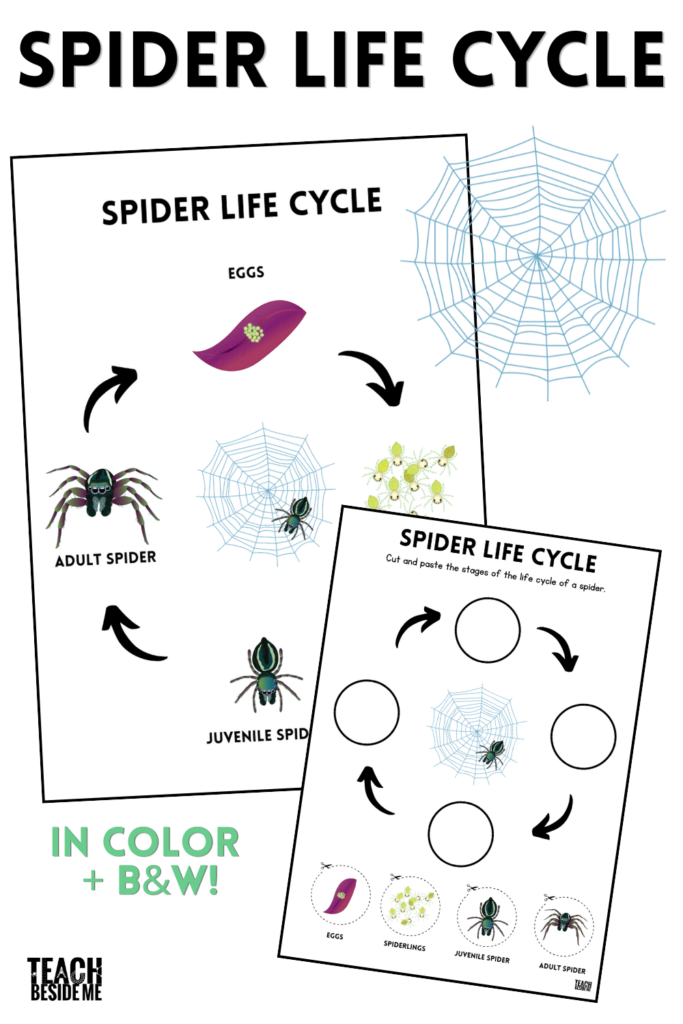
For a simple elementary science lesson, we can divide the spider life cycle into four stages:
- Eggs
- Spiderlings
- Juvenile spiders
- Adult spiders
Let’s look at each stage!
Stage 1: Spider Eggs
The spider life cycle begins with eggs. Female spiders typically lay their eggs inside a protective silk egg sac. Depending on the species, an egg sac may contain just a few eggs or hundreds!
Some spiders attach their egg sacs to plants, hide them in sheltered places, or guard them until the young hatch. The silk helps protect the developing spiders while they grow inside their eggs.
Stage 2: Spiderlings
When the young spiders hatch, they’re called spiderlings. Spiderlings are very small, but they already have the basic body structure of a spider, including eight legs.
In some species, spiderlings stay together for a short time before spreading out to find their own food and shelter. Some young spiders travel by ballooning. They release fine silk threads that can catch the wind and carry them through the air!
Stage 3: Juvenile Spider
As spiderlings grow, they become juvenile spiders. Spiders have an exoskeleton, which is a firm outer covering that supports and protects their bodies.
Unlike our bones, an exoskeleton cannot grow continuously with the animal. To get bigger, a spider must shed its old exoskeleton and form a larger one. This process is called molting.
A juvenile spider may molt several times before becoming an adult. The number of molts varies depending on the spider species.
Stage 4: Adult Spider
Once a spider reaches adulthood, it is able to reproduce and begin the life cycle again. Adult spiders vary enormously in size, color, shape, and behavior.
Some build elaborate webs to catch insects. Others, like jumping spiders, actively hunt their prey. Not all spiders make the familiar circular webs we see in Halloween decorations!
Adult female spiders can produce eggs, beginning a new generation of spiders. And the life cycle continues!
Do Spiders Go Through Metamorphosis?
This is a great question to explore with kids, especially if they’ve already studied butterflies, ladybugs, or other insects.
Spiders grow differently from butterflies. A butterfly goes through four very different stages: egg, larva (caterpillar), pupa (chrysalis), and adult.
A spider develops from an egg into a young spider that resembles the adult. It grows larger through a series of molts rather than transforming through a pupal stage.
This makes spider life cycles a wonderful opportunity to compare how different animals grow and change.
You can also point out that spiders are arachnids, not insects. Most spiders have eight legs and two main body regions, while adult insects have six legs and three main body regions.
Free Printable Spider Life Cycle Worksheets
To make this science lesson more hands-on, I’ve created a printable spider life cycle activity for kids. The worksheets are designed to help children recognize the stages of a spider’s development and understand how the life cycle repeats.
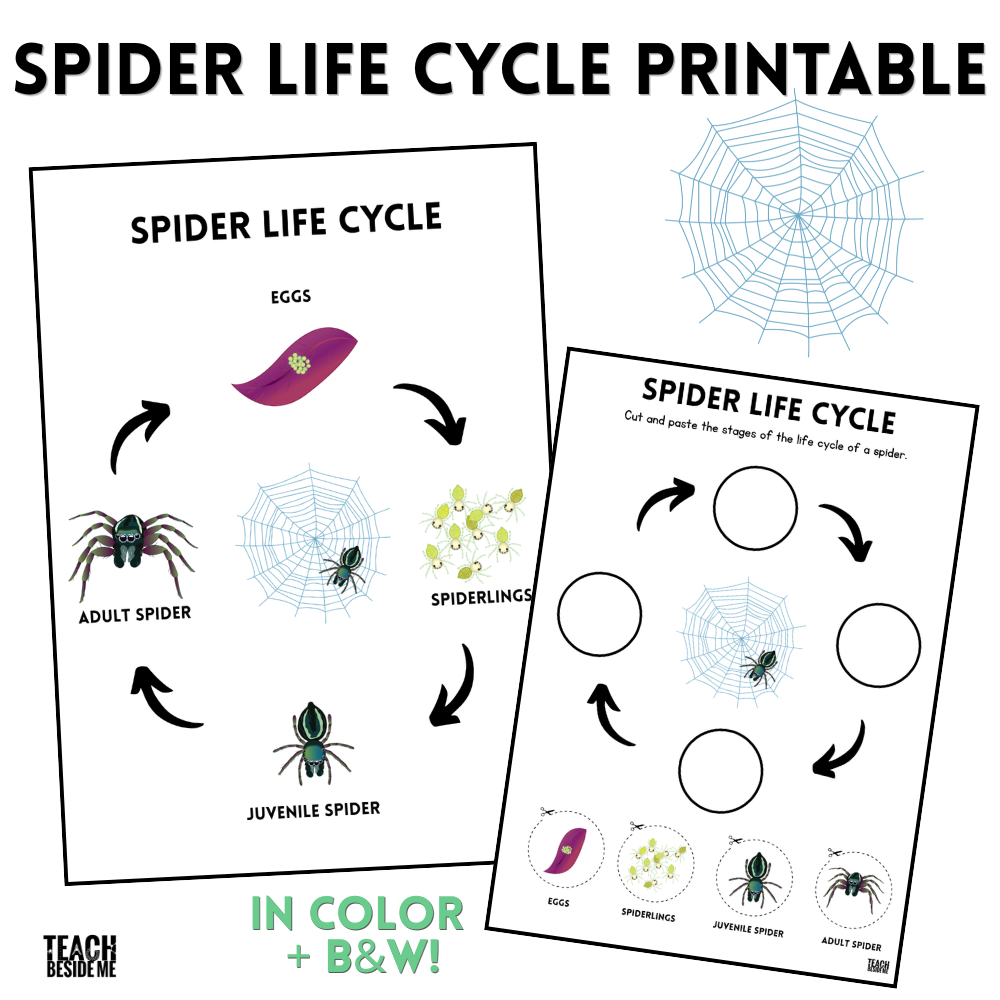
Use them during a homeschool science lesson, in a classroom science center, or as part of an autumn nature study.
Download the Spider Life Cycle Set Now!
The printable makes a great companion to a lesson about arachnids, animal life cycles, or the differences between spiders and insects.
Spider Life Cycle Activities for Kids
Want to extend the lesson beyond the worksheets? Here are a few easy ways to explore spider science.
1. Observe Spider Webs Outdoors
Take a walk around your yard, garden, or neighborhood and look for spider webs. Can you find different shapes of webs? Do you notice spiders hiding nearby?
Encourage children to sketch what they see in a nature journal. Remind kids to observe spiders without touching or disturbing them.
2. Compare Animal Life Cycles
Print several different animal life cycle diagrams and compare them.
Ask children:
- Which animals hatch from eggs?
- Which young animals look similar to their parents?
- Which animals change dramatically as they grow?
- How is a spider’s life cycle different from a butterfly’s?
Comparing life cycles helps children identify similarities and differences in the natural world.
3. Build a Spider Web Engineering Project
Spiders are incredible builders! Try constructing your own spider web using straws and pipe cleaners.
This is a fun way to connect your spider science lesson to engineering and problem-solving.
4. Explore Spider Web Geometry
Spider webs are full of interesting lines, shapes, and patterns.
Try my Spider Web Fractions Game for a creative way to combine math and spider-themed learning.
More Spider Activities for Kids
Looking for more ways to learn about spiders?
Here are some other creative projects to try:
- Spider Web Snowflakes: Explore symmetry while making paper spider webs.
- Glue and Salt Spiderweb Art: Create a colorful, textured spider web craft.
- The Spider and the Fly: Add literature and poetry to your spider studies.
- Jello Spiders: Make a fun spider-themed creation.
These activities are especially fun for an October learning theme, but they work just as well during a study of insects, arachnids, or backyard nature.
Learn More About Life Cycles
Studying life cycles helps children understand that living things grow, change, reproduce, and continue through new generations. Check out a few more of my life cycle activities.
- Monarch Butterfly Life Cycle Mobile
- Bird Life Cycle Spinners (Chicken, Bald Eagle & Robin)
- Edible Frog Life Cycle Snack
- Shark Life Cycle Spinner Activity for Kids
- Sunflower Life Cycle Printable Diagrams
- Pumpkin Life Cycle Activities + Printable